

Middle Eastern artists in the spotlight at Sotheby’s

Shadi Ghadirian, Untitled from the Like Everyday Series, 2000-2001, C-print (est. £3,000-4,000). (Supplied)
Short Url
Updated 18 March 2021
Follow

Middle Eastern artists in the spotlight at Sotheby’s

  • Highlights from the auction house’s ‘20th Century Art/Middle East’ sale, which begins online March 23

Shadi Ghadirian 


Shadi Ghadirian, ‘Untitled from the Ghajar Series,’ 2000-2001, C-print (est. £3,000-4,000). (Supplied)

‘Untitled from the Ghajar Series’

Inspired by studio portraiture from Iran’s Qajar dynasty in the late 19th and early 20th centuries, Ghadirian’s series of 33 portraits features models dressed in vintage clothes — short skirts worn over baggy trousers — but in each image is an incongruously modern element: A Pepsi can, a guitar, a pair of sunglasses, or — as here — a boombox (held by the artist’s sister, Nikki). The resulting portraits capture the dichotomy of womens’ lives in Iran, the contrast between the traditional and the modern, East and West, the public and private faces. “This conflict between old and new is how the younger generation are currently living in Iran,” Ghadirian told The Guardian in 2013. “We may embrace modernity, but we're still in love with our country's traditions.”

Chant Avedissian 


Chant Avedissian, ‘Icons of the Nile,’ gold and silver acrylic paint on cardboard, 52.5 by 72.6cm, 1995-2015 (est. £60,000-80,000). (Supplied)

‘Icons of the Nile’

The late Egyptian artist received wide acclaim for his integration of famous figures from Egyptian history with traditional iconography from Pharaonic times and art styles from the 1950s and 1960s. This is a prime example of Avedissian’s work, with 25 panels featuring stars from Egypt’s ‘Golden Age’ of cinema and music — including Umm Kulthum and Dalida — against stencilled backgrounds. The auction house describes it as “a splendid mosaic of Egyptian cultural history that retraces his country’s past.”

Abdulnasser Gharem
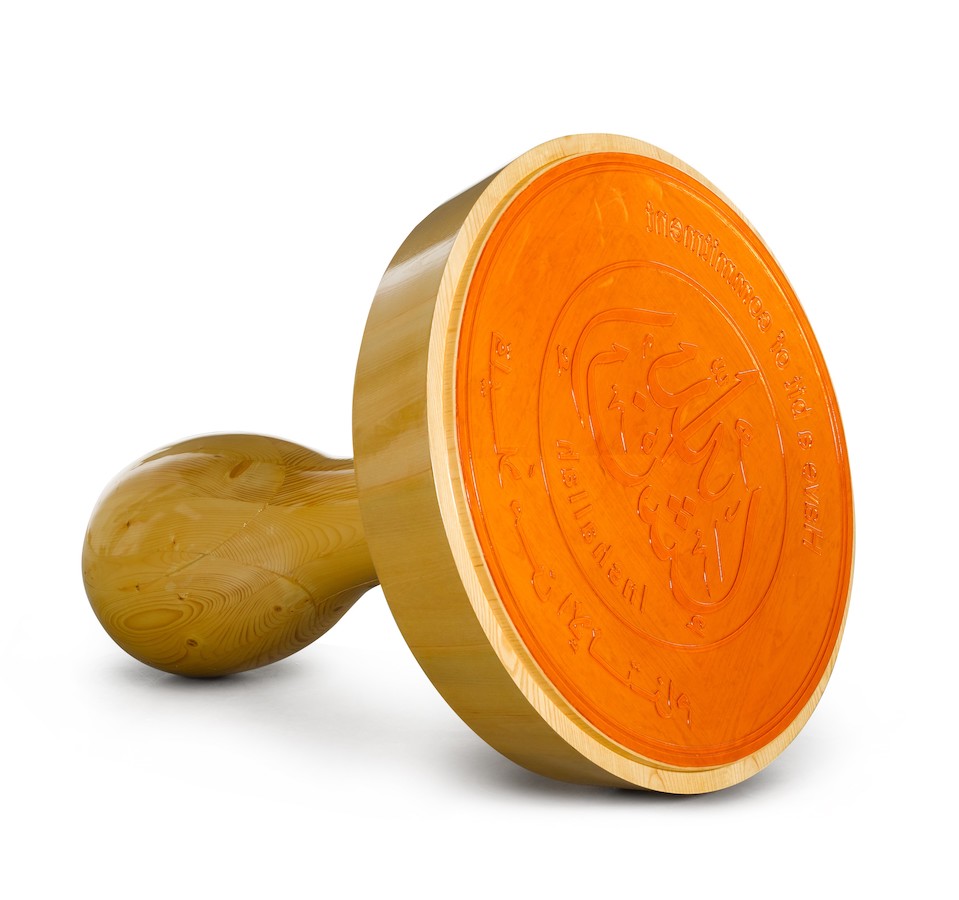


Abdulnasser Gharem, ‘The Stamp’ (Inshallah). (Supplied)

‘The Stamp’

Other editions of the Saudi army major and artist’s large sculpture have featured in Sotheby’s auctions before. The work is inspired by the realization that struck Gharem when his military promotion led to him spending much of his time behind a desk stamping papers: That “no matter how complex the logic that informed the thinking behind the decisions” the stamp reduced all of it to the binary choice of ‘stamp’ or ‘no stamp.’ The text on the stamp reads (in Arabic and English) “Have a bit of commitment” and “Inshallah.”

Mahmoud Said


Mahmoud Said, ‘Le Pirée A L’aube,’ 1949, oil on board, 46 by 66 cm. (est. £300,000-400,000). (Supplied)

‘Le Pirée A L’aube’

The Egyptian modernist pioneer remains one of the most collectible Arab modern artists in the world, and Sotheby’s hails this 1949 painting as “a rare masterpiece, depicting an extraordinarily industrial scene, which strongly represents the impressions of Said’s European influence, following his travels in the 1920s.” The brochure notes later add: “Said had an ability to capture the complexities of light in a way that gave all his paintings an otherworldly, soft dreamlike haze.”

Hassan Sharif


Hassan Sharif, ‘Weave.’ (Supplied)

‘Weave’

The late Emirati artist’s 2015 large-scale abstract wall hanging is described by the auction house as “a prime example” of his assemblages “embodying both his philosophical underpinnings and preferred artistic practices” by combining “notions of Duchampian absurdity, notions of ‘meaninglessness’ and of found objects being re-envisioned into something other.” The natural imperfections of his handcrafted work stand in deliberate contrast to mass-produced, factory-made items.

Behjat Sadr


Behjat Sadr, ‘Untitled,’ Circa 1976, oil on aluminium paper laid on board, 63 by 74 cm (est. £24,000-30,000). (Supplied)

‘Untitled’ 

This 1976 oil painting is typical of Sadr’s work from the mid-Fifties onwards, when she gave up painting on easels. “I cannot tell you the exact reason, but I felt an uncontrollable urge to put my canvases on the floor,” she once explained. “It allowed me to make much larger moves and offered me a greater control over my gestures. The relation between my body movements and the forms they produced fascinated me. I was interested in every aspect pertaining to the act of painting.” As the auction house puts it: “The lyricism of her work comes from the balance she strikes between the manipulation of the paint, the saturations of black and the shapes and angles she creates — to Sadr, there were infinite combinations of form and color.”

Mohsen Vaziri Moghaddam


Mohsen Vaziri Moghaddam, ‘Untitled’ from the ‘Sand Painting’ series, Oil and sand on canvas, 1963, 70 by 100 cm (est. £20,000-30,000). (Supplied)

‘Untitled’ from the ‘Sand Painting’ series

The late Tehran-born artist shifted to abstraction in his work when he was studying in Rome in the 1950s and his mentor Toti Scialoja reportedly told him: “If you want to be a normal painter, then keep going like this. But if you are trying to become an artist, forget everything you have done and start all over again.” So he did. The series of sand paintings he created in the early Sixties became his most famous works. They were inspired by childhood memories sparked by a visit to Lake Albano with its black sand, he explained. “I was playing with black sand on the shore, suddenly the traces of my fingers in the sand caught my attention. I (left) my friends and went back to Rome with a bag of sand. Finding shapes in sand turned into a pastime and it took me months to transfer the patterns I found onto a canvas.”


Riyadh takes shape at Tuwaiq Sculpture Symposium 2026

Updated 16 January 2026
Follow

Riyadh takes shape at Tuwaiq Sculpture Symposium 2026

RIYADH: This season, one of Riyadh’s busiest streets has taken on an unexpected role.

Under the theme “Traces of What Will Be,”sculptors are carving granite and shaping reclaimed metal at the seventh Tuwaiq Sculpture Symposium, running from Jan. 10 to Feb. 22.

The symposium is unfolding along Prince Mohammed bin Abdulaziz Road, known locally as Al‑Tahlia, a name that translates to desalination. The choice of location is deliberate.

The area is historically linked to Riyadh’s early desalination infrastructure, a turning point that helped to shift the city from water scarcity toward long‑term urban growth.

Twenty‑five artists from 18 countries are participating in this year’s event, producing large‑scale works in an open‑air setting embedded within the city.

The site serves as both workplace and eventual exhibition space, with sculptures remaining in progress throughout the symposium’s duration.

In her opening remarks, Sarah Al-Ruwayti, director of the Tuwaiq Sculpture Symposium, said that this year new materials had been introduced, including recycled iron, reflecting a focus on sustainability and renewal.

She added that the live-sculpting format allowed visitors to witness the transformation of raw stone and metal into finished artworks.

Working primarily with local stone and reclaimed metal, the participating artists are responding to both the material and the place.

For Saudi sculptor Wafaa Al‑Qunaibet, that relationship is central to her work, which draws on the physical and symbolic journey of water.

“My work … presents the connection from the salted water to sweet water,” Al‑Qunaibet told Arab News.

Using five pieces of granite and two bronze elements, she explained that the bronze components represented pipes, structures that carry saline water and allow it to be transformed into something usable.

The sculpture reflected movement through resistance, using stone to convey the difficulty of that transition, and water as a force that enables life to continue.

“I throw the stone through the difficult to show how life is easy with the water,” she said, pointing to water’s role in sustaining trees, environments and daily life.

Formally, the work relies on circular elements, a choice Al‑Qunaibet described as both technically demanding and socially resonant.

“The circle usually engages the people, engages the culture,” she said. Repeated circular forms extend through the work, linking together into a long, pipe‑like structure that reinforces the idea of connection.

Sculpting on site also shaped the scale of the piece. The space and materials provided during the symposium allowed Al‑Qunaibet to expand the work beyond her initial plans.

The openness of the site pushed the sculpture toward a six‑part configuration rather than a smaller arrangement.

Working across stone, steel, bronze and cement, American sculptor Carole Turner brings a public‑art perspective to the symposium, responding to the site’s historical and symbolic ties to desalination.

“My work is actually called New Future,” Turner told Arab News. “As the groundwater comes up, it meets at the top, where the desalination would take place, and fresh water comes down the other side.”

Her sculpture engages directly with the symposium’s theme by addressing systems that often go unseen. “Desalination does not leave a trace,” she said. “But it affects the future.”

Turner has been sculpting for more than two decades, though she describes making objects as something she has done since childhood. Over time, she transitioned into sculpture as a full‑time practice, drawn to its ability to communicate across age and background.

Public interaction remains central to her approach. “Curiosity is always something that makes you curious, and you want to explore it,” she said. Turner added that this sense of discovery is especially important for children encountering art in public spaces.

Saudi sculptor Mohammed Al‑Thagafi’s work for this year’s symposium reflects ideas of coexistence within Riyadh’s evolving urban landscape, focusing on the relationships between long‑standing traditions and a rapidly changing society.

The sculpture is composed of seven elements made from granite and stainless steel.

“Granite is a national material we are proud of. It represents authenticity, the foundation, and the roots of Saudi society,” Al‑Thagafi told Arab News.

“It talks about the openness happening in society, with other communities and other cultures.”

That dialogue between materials mirrors broader social shifts shaping the capital, particularly in how public space is shared and experienced.

Because the sculpture will be installed in parks and public squares, Al‑Thagafi emphasized the importance of creating multi‑part works that invite engagement.

Encountering art in everyday environments, he said, encouraged people to question meaning, placement, simplicity and abstraction, helping to build visual‑arts awareness across society.

For Al‑Thagafi, this year marked his fifth appearance at the symposium. “I have produced more than 2,600 sculptures, and here in Riyadh alone, I have more than 30 field works.”

Because the works are still underway, visitors can also view a small on‑site gallery displaying scaled models of the final sculptures.

These miniature models offer insight into each artist’s planning process, revealing how monumental forms are conceived before being executed at full scale.

As the symposium moves toward its conclusion, the completed sculptures will remain on site, allowing the public to encounter them in the environment that shaped their creation.