BEIJING: China is poised to ease border restrictions to allow some foreigners — including from the US, India and Pakistan — back in, provided they have taken a Chinese-made Covid-19 vaccine.
The country has been closed to most foreigners since last March to stem the spread of coronavirus which it has largely brought under control at home, stranding many foreigners with jobs and family inside China overseas.
But Chinese embassies in several countries have issued notices saying the country will open visa applications to select people who have taken a China-made jab.
The Chinese Embassy in the US said in a statement dated Monday that it would begin to process “visa applicants inoculated with Chinese Covid-19 vaccines.”
This would apply from this week to those visiting the Chinese mainland for work resumption, business travel, or for “humanitarian needs,” such as reuniting with family members.
Beijing is driving forward its inoculation plan for its vast domestic population with four domestically produced vaccines approved so far. But it has yet to approve any foreign-made jabs.
China has also shipped its vaccines overseas as it works to blunt foreign criticism of the initial spread of the virus from its shores.
The embassy statement said this applied to those who had either had two doses of the vaccine or a single-dose at least 14 days before applying for the visa.
Chinese embassies in other countries including India, Pakistan, the Philippines, Italy and Sri Lanka have published similar statements.
Those arriving in China will still have to face a gruelling quarantine of up to three weeks.
China’s vaccines have been rolled out in several countries around the world, including Turkey, Indonesia and Cambodia.
The Philippines received 600,000 vaccine doses from China two weeks ago, kickstarting its inoculation drive.
But they are not readily available everywhere, including in India or Sri Lanka.
And Beijing has struggled to gain international trust for its vaccine candidates, hindered by a lack of transparency on test results.
But Chinese companies are still set to export nearly 400 million doses of home-grown vaccines overseas, state media has reported.

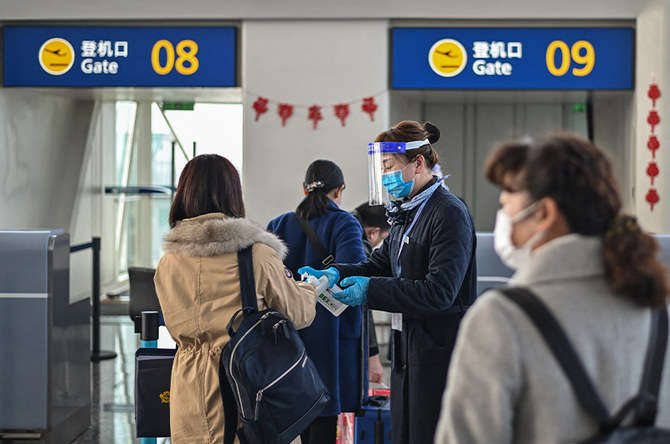
China to issue visas to foreigners, including Pakistanis, who take Chinese vaccine
https://arab.news/ysdug
China to issue visas to foreigners, including Pakistanis, who take Chinese vaccine
- China has been closed to most foreigners since last March to stem the spread of coronavirus
- Chinese Embassy in US says will begin to process “visa applicants inoculated with Chinese Covid-19 vaccines“
Pakistan’s defense chief accuses ‘Indian-sponsored proxies’ of fueling violence in Balochistan
- Field Marshal Syed Asim Munir speaks to participants of 18th National Workshop on Balochistan
- Warns violation of Pakistan’s territorial integrity will be met with a “firm and decisive response”
ISLAMABAD: Pakistan’s Chief of Defense Forces (CFD) Field Marshal Syed Asim Munir on Wednesday blamed militant groups allegedly sponsored by India for fueling violence and disrupting development in the province, warning the military will foil their designs.
Munir was speaking to participants of the 18th National Workshop on Balochistan (NWB) at the General Headquarters of the military in Rawalpindi. The NWB features discussions on Pakistan’s policies on security, development and other challenges related to Balochistan by officials, leaders and citizens.
Pakistan accuses India of sponsoring militant groups in its southwestern Balochistan province, who demand independence from Islamabad. India rejects the allegations. These ethnic Baloch militant groups accuse Pakistan’s government and military of denying locals a share in the province’s mineral wealth, charges that both deny.
“Highlighting the security challenges, the COAS & CDF remarked that Indian-sponsored proxies continue to propagate violence and disrupt development in Balochistan,” the Inter-Services Public Relations (ISPR), the military’s media wing, said in a statement.
“He reaffirmed that such inimical designs will be thwarted through stern actions by security forces to rid the province of terrorism and unrest.”
The Pakistani army chief lauded the federal and provincial governments’ initiatives for Balochistan’s development, underscoring a people-centric approach to unlock the province’s “vast economic potential.”
Munir appreciated the civil society for its constructive role in debunking propaganda, the military’s media wing said.
“He stressed the importance of rejecting vested political agendas to ensure that Balochistan’s future is shaped by long-term prosperity for all its residents,” the ISPR said.
The CDF reaffirmed Pakistan’s commitment to regional peace but stressed that any violation of the country’s territorial integrity will be met with a decisive response.
Pakistan suffered a surge in militant attacks in its northwestern and Balochistan provinces this year. As per the Pakistan Institute for Conflict and Security Studies (PICSS) think tank, combat-related deaths in 2025 rose by 73 percent to 3,387, compared with 1,950 in 2024.
These deaths included 2,115 militants, 664 security forces personnel, 580 civilians and 28 members of pro-government peace committees (combatants), the think tank said in a press release.
“PICSS noted that most violence remained concentrated in Pashtun-majority districts of Khyber Pakhtunkhwa, including the tribal districts (erstwhile FATA), and in Balochistan,” the think tank said in its report on Sunday.
Islamabad also accuses Afghanistan of sheltering militants who launch attacks on Pakistan soil. Kabul rejects these allegations and says it cannot be held responsible for Pakistan’s security lapses.


