

Russian missile attacks in Syria defy cease-fire with Turkey

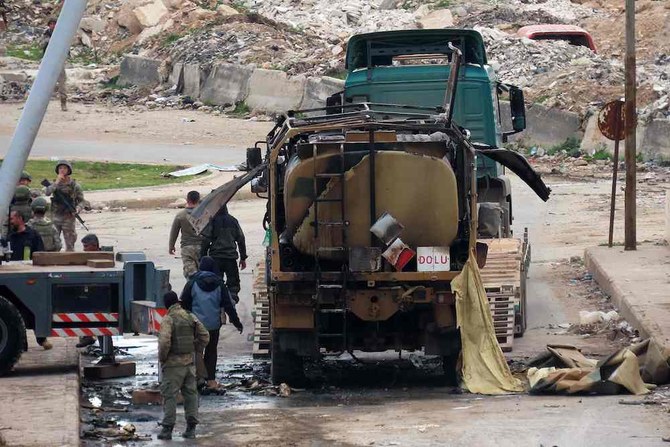
A destroyed fuel tanker that exploded in proximity to a Turkish military convoy near the rebel-held northwestern Syrian city of Idlib, March 15, 2021. (AFP)
Short Url
Updated 16 March 2021
Follow

Russian missile attacks in Syria defy cease-fire with Turkey

  • The Russian attack from Kweyris base in regime-controlled Aleppo targeted oil refineries under Turkish control in northwestern Syria
  • Ankara immediately sent a notification to the Russian Federation to stop firing and put its troops in the region on alert

ANKARA: Russian ballistic missile strikes in northern Syria on Monday in defiance of the cease-fire with Turkey in March 2020 could have broader repercussions, experts say.

The Russian attack from Kweyris base in regime-controlled Aleppo targeted oil refineries under Turkish control in northwestern Syria. It was the second such attack in nine days.

As Syria marks a decade of civil war, this region is considered vital for providing households, farmers, bakeries, and other businesses with oil.

The refineries here are used to refine about 40 percent of the crude oil that comes from the region controlled by the Syrian Kurdish YPG forces, which is mostly used for generators, heating or running machines.

Ankara immediately sent a notification to the Russian Federation to stop firing, and it put its troops in the region on alert.

Some experts believe that Russia is looking to consolidate its geopolitical interests in the region, while warning Ankara about any potential rapprochement with the United States.

However, the attacks may push Ankara into searching for allies in any standoff with Russia.

“The Biden administration should keep its promises and work with us to end the tragedy in Syria and protect democracy,” Turkish President Recep Tayyip Erdogan said yesterday.

Emre Ersen, an expert on Turkey-Russia relations at Marmara University in Istanbul, said the latest incident once again shows the fragility of the geopolitical balance in Syria, since it came only a few days after the meeting held between the foreign ministers of Turkey, Russia and Qatar regarding the solution of the Syrian crisis.

On March 11, the three countries launched a new trilateral consultation process to contribute for a lasting political solution in Syria.

“It has also reminded everyone that despite the development of a special relationship between Ankara and Moscow in the last few years, their differences regarding the solution of the regional conflicts could easily trigger a new crisis in the bilateral relations,” Ersen said.

According to Ersen, such tensions could also affect the outcome of the Russian Su-35 jet negotiations, even though Turkey has so far sought to compartmentalize these issues in its relations with Russia.

“The two countries still need each other in order to realize their objectives in Syria. That is why the so-called Turkish-Russian “marriage of convenience” in Syria is going to be maintained at least in the short term,” he said.

Navvar Saban, from the Istanbul-based Omran Center for Strategic Studies, said Russia and Turkey still have joint fronts in Idlib, the Euphrates Shield and eastern Syria, and each front has its own characteristics and goals.

He thinks that the latest Russian attack aims to test how much the Turkish side wants to advance by targeting these refineries.

“It is a direct message to show what they can target and to understand the Turkish response,” he said.

“It is a fragile agreement on different fronts. Russians have the upper hand for now and Turkey needs to send a clear and direct message to maintain the balance of power,” he added.

“Russia wants Turkey to ensure the security of the M4 highway and to eliminate the extremist groups in that area. On the eastern side, Russia wants a ceasefire agreement to prevent Turkey from advancing any more in that area,” Saban said.

However, there is disagreement among experts over how far Damascus can undertake military action against Turkey independently from Russia.

Anton Mardasov, a nonresident scholar at the Middle East Institute’s Syria program, does not think that the new missile attack is related to any warning from the Russian side.

“The last few missile strikes were an independent initiative by Damascus,” he said. “Outside observers grossly exaggerate Russia’s influence on the Syrian army,” Mardasov added.

According to Mardasov, Moscow is not interested in a new scandal over Syria.

“The main thing for Moscow is to remove its economic burden, so it prefers to act quietly,” he said. “Damascus is interested in PR before the elections and a new scandal in order to drag Russia into reconstruction.

“Russia is interested in constantly testing Turkey’s position for strength, but not during this period of time.”


Syrian military tells civilians to evacuate contested area east of Aleppo amid rising tensions

Updated 15 January 2026
Follow

Syrian military tells civilians to evacuate contested area east of Aleppo amid rising tensions

  • Syria’s military has announced it will open a “humanitarian corridor” for civilians to evacuate from an area in Aleppo province
  • This follows several days of intense clashes between government forces and the Kurdish-led Syrian Democratic Forces

DAMASCUS: Syria’s military said it would open a corridor Thursday for civilians to evacuate an area of Aleppo province that has seen a military buildup following intense clashes between government and Kurdish-led forces in Aleppo city.
The army’s announcement late Wednesday — which said civilians would be able to evacuate through the “humanitarian corridor” from 9 a.m. to 5 p.m. Thursday — appeared to signal plans for an offensive in the towns of Deir Hafer and Maskana and surrounding areas, about 60 kilometers (40 miles) east of Aleppo city.
The military called on the Kurdish-led Syrian Democratic Forces and other armed groups to withdraw to the other side of the the Euphrates River, to the east of the contested zone.
Syrian government troops have already sent troop reinforcements to the area after accusing the SDF of building up its own forces there, which the SDF denied. There have been limited exchanges of fire between the two sides, and the SDF has said that Turkish drones carried out strikes there.
The government has accused the SDF of launching drone strikes in Aleppo city, including one that hit the Aleppo governorate building on Saturday shortly after two Cabinet ministers and a local official held a news conference there.
The tensions in the Deir Hafer area come after several days of intense clashes last week in Aleppo city that ended with the evacuation of Kurdish fighters and government forces taking control of three contested neighborhoods. The fighting killed at least 23 people, wounded dozens more, and displaced tens of thousands.
The fighting broke out as negotiations have stalled between Damascus and the SDF, which controls large swaths of northeast Syria, over an agreement to integrate their forces and for the central government to take control of institutions including border crossings and oil fields in the northeast.
Some of the factions that make up the new Syrian army, which was formed after the fall of former President Bashar Assad in a rebel offensive in December 2024, were previously Turkiye-backed insurgent groups that have a long history of clashing with Kurdish forces.
The SDF for years has been the main US partner in Syria in fighting against the Daesh group, but Turkiye considers the SDF a terrorist organization because of its association with the Kurdistan Workers’ Party, or PKK, which has waged a long-running insurgency in Turkiye. A peace process is now underway.
Despite the long-running US support for the SDF, the Trump administration has also developed close ties with the government of interim Syrian President Ahmad Al-Sharaa and has pushed the Kurds to implement the integration deal. Washington has so far avoided publicly taking sides in the clashes in Aleppo.
The SDF in a statement warned of “dangerous repercussions on civilians, infrastructure, and vital facilities” in case of a further escalation and said Damascus bears “full responsibility for this escalation and all ensuing humanitarian and security repercussions in the region.”
Adm. Brad Cooper, commander of US Central Command, said in a statement Tuesday that the US is “closely monitoring” the situation and called for “all parties to exercise maximum restraint, avoid actions that could further escalate tensions, and prioritize the protection of civilians and critical infrastructure.” He called on the parties to “return to the negotiating table in good faith.”
Al-Sharaa blasts the SDF
In a televised interview aired Wednesday, Al-Sharaa praised the “courage of the Kurds” and said he would guarantee their rights and wants them to be part of the Syrian army, but he lashed out at the SDF.
He accused the group of not abiding by an agreement reached last year under which their forces were supposed to withdraw from neighborhoods they controlled in Aleppo city and of forcibly preventing civilians from leaving when the army opened a corridor for them to evacuate amid the recent clashes.
Al-Sharaa claimed that the SDF refused attempts by France and the US to mediate a ceasefire and withdrawal of Kurdish forces during the clashes due to an order from the PKK.
The interview was initially intended to air Tuesday on Shams TV, a broadcaster based in Irbil — the seat of northern Iraq’s semi-autonomous Kurdish region — but was canceled for what the station initially said were technical reasons.
Later the station’s manager said that the interview had been spiked out of fear of further inflaming tensions because of the hard line Al-Sharaa took against the SDF.
Syria’s state TV station instead aired clips from the interview on Wednesday. There was no immediate response from the SDF to Al-Sharaa’s comments.