IDLIB, Syria: Thousands took to the streets in Syria’s last major rebel bastion of Idlib Monday to mark 10 years since the nationwide anti-government protests that sparked the country’s devastating civil war.
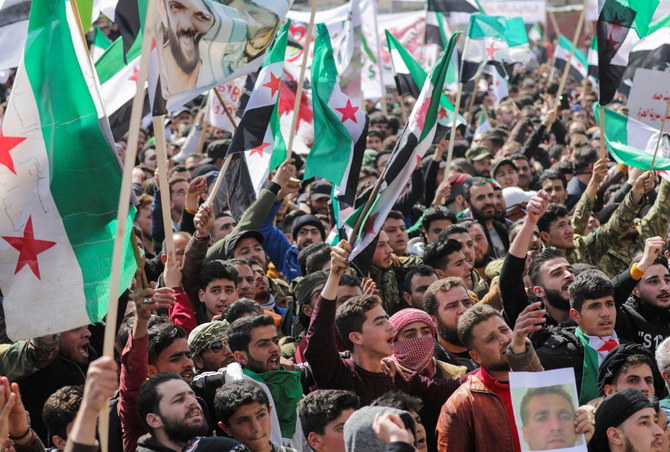
In the extremist-dominated stronghold’s main city, crowds marched, some waving the opposition’s three-star flag or holding up images of those killed during the conflict.
“Freedom, freedom, freedom,” they sang in Idlib city, exactly as did the first protesters in 2011 demanding an end to President Bashar Assad’s rule.
“The people want the fall of the regime,” they shouted, echoing the slogan adopted by protesters elsewhere in the Arabic-speaking region in the spring of 2011.
One of those marching, Hana Dahneen, said: “We came to renew the pledge we made in 2011 when we decided to oust Assad.
“We had hoped to topple the regime from day one,” she said.
“But it unleashed all kinds of weapons against the innocent people to crush the revolution.”
Syria’s war has killed more than 388,000 people and displaced millions of Syrians inside the country and abroad.
But today Assad is back in control of more than 60 percent of the country after a string of Russia-backed victories against rebels and militants.
A decade on, Assad looks set to win a new presidential election this summer in regime-held areas.
Idlib, whose 2.9 million inhabitants have been protected by a cease-fire since March 2020, is one of the few key areas still holding out against the Damascus government.
“We will remain committed to our... revolution even if it takes 50 years,” Dahneen said.
As the conflict entered its 11th year on Monday, the head of the UN refugee agency looked back on what he said was “one of the largest refugee crises in modern times.”
“Ten years of the Syrian crisis have inflicted unimaginable human suffering and pain,” UNHCR head Filippo Grandi said.
“The world has failed Syrians,” he said, while acknowledging the huge efforts made to accommodate Syria refugees.
The war has displaced some 6.7 million people inside Syria, and almost 5.6 million Syrians abroad, mostly to neighboring countries, according to UN figures.
Endless rounds of UN-backed peace talks have failed to stem the bloodshed, and have in recent years been overshadowed by a parallel negotiations track led by Moscow and rebel backer Ankara.


![]()

Thousands rally in Syria’s Idlib to mark 10 years since uprising
Short Url
https://arab.news/nurm7
Thousands rally in Syria’s Idlib to mark 10 years since uprising
- In the extremist-dominated stronghold’s main city, crowds marched, some waving the opposition’s three-star flag
- Syria’s war has killed more than 388,000 people and displaced millions


Latest updates


Recommended


© 2026 SAUDI RESEARCH & PUBLISHING COMPANY, All Rights Reserved And subject to Terms of Use Agreement.