

Filipinos celebrate end of decades-old kafala system in Saudi Arabia

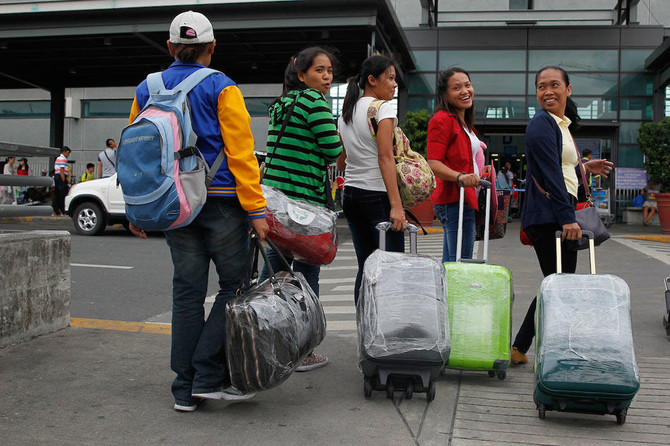
An alliance of overseas Filipino workers (OFW) celebrated the abolition of Saudi Arabia’s kafala sponsorship system on Sunday. (Reuters/File)
Short Url
Updated 14 March 2021
Follow

Filipinos celebrate end of decades-old kafala system in Saudi Arabia

  • Move will encourage transparency and freedom, migrant workers’ group says

MANILA: An alliance of overseas Filipino workers (OFW) celebrated the abolition of Saudi Arabia’s kafala sponsorship system on Sunday, rejoicing over the historic labor reforms that have given more “freedom” to millions of migrant workers in the Kingdom.

“Saudi Arabia has announced that it will end its notorious sponsorship or kafala system on March 14. Migrante-Kingdom of Saudi Arabia, together with all OFWs in the country, is glad and jubilant and is celebrating over this historic action,” Migrante International (MI) said in a statement late on Saturday.

The new measures, effective March 14, will ensure that migrant workers in the private sector have improved job mobility and can switch jobs or leave the Kingdom without their employers’ consent.

The move will also allow foreign workers to apply directly for government services, with all employment contracts documented online.

“The announcement will do away with the need for a sponsor or kafeel’s approval to transfer sponsorship, for a migrant worker to undergo sponsorship to receive exit and re-entry visas, and for migrants to become runaways or ‘huroob’ from their kafeels,” according to MI.

It added that the Kingdom was undertaking the initiative “to strengthen its private sector and make it more attractive to foreign talent,” as it seeks to diversify its internal economy, which has for long been dependent on oil.

“Migrante-KSA lauds Crown Prince Mohammed bin Salman who, in his Vision 2030, is undertaking economic reforms in the country and has boldly decided to let go of the kafala system,” the statement said.

Recruitment and migration expert Emmanuel Geslani told Arab News that ending the kafala system was a “liberation” for Filipino workers, as well as for workers of other nationalities, in the Kingdom.

As many as 10 million migrant workers are expected to benefit from the Kingdom’s Labor Reform Initiative, which is intended to foster “a competitive and fair working environment.”

“Abolition of this major restriction, which has been imposed on all foreign workers, will now free our OFWs from the abusive manners of some employers,” he said.

“It will create more liberal conditions, especially for our household service workers, who were susceptible to abuse from their employers,” Geslani added.

Geslani said there had been instances in which some employers used the system to hold workers “hostage” by withholding their exit visas unless payment was made by the Philippine embassy or the employee’s accredited recruiter.

“This was despite the termination of their contracts or contract disputes, which led some to run away,” he said, adding that the reforms were a win-win for all.

“The Saudi government also lifted the system to attract more highly skilled workers who were hesitant to work in the Kingdom due to the kafala system,” Geslani said.

According to MI, the kafala system had been in place for seven decades in the Kingdom.

“Many migrant workers, local and international NGOs, and even the UN have criticized it and have called for its reform,” MI said.

The Philippines has been advocating against the kafala system in the UN and international fora for years.

Earlier, it had officially partnered with Bahrain, one of the first countries to abolish the system in its labor reform movement through the Flexi Visa System, which allows undocumented workers to acquire regular immigration status without an employer sponsor.

The Philippines also pioneered the negotiation and international adoption of the Global Compact for Safe, Orderly and Regular Migration to protect Filipino migrant workers against exploitation and abuse and guarantee decent work, consistent with President Rodrigo Duterte’s policies for “no OFW to be a slave to anyone.”

Saudi Arabia has one of the highest numbers of Filipino migrant workers in the Middle East, with nearly 1 million OFWs deployed in the Kingdom.

There was a drop in number last year with the repatriation of many OFWs affected by the coronavirus disease (COVID-19) pandemic.


Filipinos celebrate Christmas on a budget amid soaring costs

Children spend the afternoon at Quezon Memorial Circle in Quezon City, Philippines on Dec. 23, 2025. (PNA)
Updated 55 min 52 sec ago
Follow

Filipinos celebrate Christmas on a budget amid soaring costs

  • Filipinos are choosing modest Christmas gifts, scaling down year-end festivities
  • Millions look to content creators for tips on how to spend less for Christmas dinner

MANILA: As the predominantly Catholic Philippines celebrates one of its most important annual holidays on Thursday, many Filipinos have been forced to rethink their traditional Christmas celebrations amid soaring prices. 

This year, street food vendor Gemma Gracia is among those who will keep her business open during the holidays. 

“As a vendor, I’ve felt the prices go up since I also still buy at the market for our needs and for our selling needs,” she told Arab News. 

But as celebrating Christmas was important for her family, the 39-year-old has allocated 1,000 Philippine pesos ($17) for a family meal out at Jollibee, the Philippines’ biggest fast-food chain restaurant. 

“When you don’t have food to share on the table on this holiday, it’s a sad day. That’s why we make sure that we always have something on the table each year,” she said. 

For many Filipinos, the time-honored traditions of Noche Buena, or Christmas Eve, is the most awaited part of this holiday season, when dinner tables across the country are filled with a hearty selection of traditional dishes. 

Noche Buena, which is Spanish for “the good night,” is the dinner that follows the last evening mass of the season, known as misa de gallo or simbang gabi.

In the Philippines, such festive staples include meaty Filipino-style spaghetti and hamonado, the local version of a Christmas ham that usually serves as the centerpiece of Christmas dinner tables.

But the pinch from rising prices has affected Filipino shoppers in recent years, forcing them to adjust according to their budget. 

Although the country’s central bank said inflation had eased to 1.5 percent in November, many say the statistics do not reflect on-the-ground realities, where people reel from rising retail prices, shrinking portions and diminishing purchasing power of the peso. 

Allan Manansala, a 48-year-old construction worker in Manila, told Arab News that he is expecting to spend 5,000 pesos for his family of five in 2025, nearly a third of his monthly wage and about a fifth higher than what he spent in previous years. 

“I might have to skip giving my children gifts this year because of the costs,” he said. 

To get around the high costs, Manansala is skipping the Noche Buena festivities altogether and has instead decided to splurge on New Year’s Eve dinner, which is also a significant occasion in the Philippines. 

Others, like Allan Melenio, look for different ways to save up. 

“Our relative owns a meat shop, so we’re able to save on that since the prices are quite low,” he told Arab News. “But everywhere else, a piece of meat can cost so much.” 

While the economy has forced Filipinos to make smarter choices and get creative, content creators are among those offering ideas to address consumers’ woes, teaching people how to stretch their meager budgets for the holidays. 

One such tip came from Ninong Ry, a food content creator who challenged himself to prepare an eight-dish Noche Buena dinner with a budget of 1,500 pesos. Posted about two weeks before Christmas, his one-hour YouTube video has since garnered more than 1.4 million views. 

The video was also a response to comments from Philippine Trade Secretary Cristina Aldeguer-Roque, who suggested last month that 500 pesos was enough for a family of four to host a modest Christmas Eve dinner, sparking anger among Filipinos who said she was out of touch with reality. 

Jelmark Toqueb, who works as a plumber in Manila, said that the 500-peso budget was unrealistic. 

“It is clearly not enough. (Five hundred pesos) is not even enough for you to cook spaghetti with meat. Maybe just the noodles and the sauce,” he told Arab News.

For 32-year-old Toqueb and his wife, who works as a public school teacher, the holiday season remains a cherished occasion to spend quality time with the family. As their Christmas tradition involves gift-giving, he chose more modest presents this year to circumvent the high costs. 

“The prices now are different even from last year, (when they were) already high,” Toqueb said. “Even if the gift is simple, it’s fine. It’s the thought that counts.”