

Airbus targets Boeing’s freight fortress

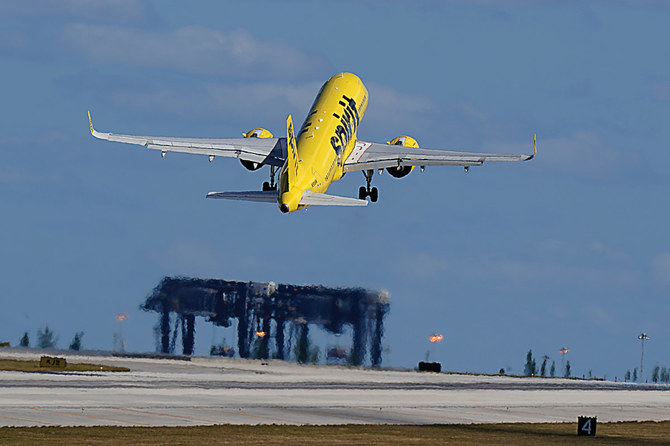
A Spirit Airlines Airbus A320 takes off from Fort Lauderdale-Hollywood Airport in Florida. (AP)
Short Url
Updated 13 March 2021
Follow

Airbus targets Boeing’s freight fortress

  • The company targeting a key stronghold of its rival as e-commerce lifts demand for transported goods

PARIS: Airbus is canvassing airline support for a potential freighter version of its A350 passenger jet, targeting a key stronghold of US rival Boeing as e-commerce lifts demand for transported goods, people familiar with the matter told Reuters.

The jet would be the first freighter spin-off of the latest generation of carbon-fiber jets and help stabilize output of wide-body jets that have been badly hit by the COVID-19 crisis.

But a launch depends on identifying enough buyers willing to take a punt on fickle cargo demand in the midst of the aviation industry’s worst downturn, which has trampled airline finances.

“We are always looking at product developments but do not comment on specific programs,” an Airbus spokesman said.

Air freight demand, which was weak before the COVID-19 crisis, has soared as home-bound shoppers turn to e-commerce, but analysts warn it is volatile and prone to extended downturns.

Normally about half the world’s air cargo is carried in the bellies of passenger jets, but a hit to travel from the pandemic has left the world more reliant on dedicated freighters and conversions of passenger planes.

SPEEDREAD

The jet would be the first freighter spin-off of the latest generation of carbon-fiber jets and help stabilize output of wide-body jets that have been badly hit by the COVID-19 crisis.

A launch depends on identifying enough buyers willing to take a punt on fickle cargo demand in the midst of the aviation industry’s worst downturn, which has trampled airline finances.

Although it has vaulted past Boeing as the world’s largest producer of passenger jets, Airbus has had limited success in penetrating the freighter fortress of its archrival.

It pulled the plug on a freighter version of its A380 superjumbo almost 15 years ago and has had no freighters in its order pipeline since December, when Turkey’s MNG Airlines canceled three A330 freighter.

Boeing has delivered 202 of the rival 777 freighter, compared with 38 of the A330 cargo version. Dominating the trade lanes is Boeing’s 747 freighter with more than 260 delivered.

It is not the first time a possible new freighter has been mooted. The latest design on the drawing board at Airbus’s Toulouse headquarters in France involves a slightly longer aircraft than the best-selling Airbus A350-900 jetliner.

Its development poses technical challenges since it would involve placing a cargo door in the composite shell chosen by Airbus to compete with Boeing’s lightweight composite 787.

Experts say cutting composite is more challenging than traditional aluminum, though Airbus could reap benefits from a decision — seen as costly at the time — to build the A350 from composite panels rather than barrel sections used on the 787.

Industry sources estimate Airbus would need commitments for some 50 aircraft to go ahead with a launch, with Chief Executive Guillaume Faury focusing on carrying out a major restructuring while directing resources toward an A321XLR passenger plane. A development would cost an estimated $2-3 billion.

Temptingly, the booming freight market offers respite from a slump in demand for big jets that has forced Airbus and Boeing to slash production, with A350 output halving to five a month.

More than a third of wide-body jets sold by Boeing in the past year have been freighters.

But the same crisis that crippled passenger travel has also created a glut of unused passenger planes that can be converted more cheaply into freighters than buying new. That means the business case for developing a new aircraft must be watertight.


Reforms target sustained growth in Saudi real estate sector, says Al-Hogail

Updated 26 January 2026
Follow

Reforms target sustained growth in Saudi real estate sector, says Al-Hogail

RIYADH: The Real Estate Future Forum opened its doors for its first day at the Four Seasons Riyadh, with prominent global and local figures coming together to engage with one of the Kingdom’s most prospering sectors.

With new regulations, laws, and investments underway, 2026 is expected to be a year of momentous progress for the real estate sector in the Kingdom.

The forum opened with a video highlighting the sector’s progress in the Kingdom, during which an emphasis was placed on the forum’s ability to create global reach, representation, as well as agreements worth a cumulative $50 billion

With the Kingdom now opening up real estate ownership to foreigners, this year’s Real Estate Future Forum is placing a great deal of importance on this new milestone and its desired outcomes and impact on the market. 

Aside from this year’s forum’s unique discussions surrounding those developments, it will also be the first of its kind to launch the Real Estate Excellence Award and announce its finalist during the three-day summit.

Minister of Municipalities and Housing and Chairman of the Real Estate General Authority Majed Al-Hogail took to stage to address the diverse audience on the real estate market’s achievements thus far and its milestones to come.

Of those important milestones, he underscored “real estate balance” as a key pillar of the sector’s decisions to implement regulatory tools “with the aim of constant growth which can maintain the vitality of this sector.” He pointed to examples of those regulatory measures, such as the White Land Tax.

On 2025’s progress, the minister highlighted the jump in Saudi family home ownership, which went from 47 percent in 2016 to 66 percent in 2025, keeping the Kingdom’s Vision 2030 goal of 70 percent by the end of the decade on track.

He said the opening of the real estate market to foreigners is an indicator of the sector’s maturity under the leadership of Crown Prince Mohammed bin Salman. He said his ministry plans to build over 300,000 housing units in Riyadh over the next three years.

Speaking to Arab News,  Al-Hogail elaborated on these achievements, stating: “Today, demand, especially local demand, has grown significantly. The mortgage market has reached record levels, exceeding SR900 billion ($240 billion) in mortgage financing, we are now seeing SRC (Saudi Real Estate Refinance Co.) injecting both local and foreign liquidity on a large scale, reaching more than SR54 billion”

Al-Hogail described Makkah and Madinah as unique and special points in the Kingdom’s real estate market as he spoke of the sector’s attractiveness.

 “Today, the Kingdom of Saudi Arabia has become, in international investment indices, one that takes a good share of the Middle East, and based on this, many real estate investment portfolios have begun to come in,” he said. 

Al-Ahsa Gov. Prince Saud bin Talal bin Badr Al-Saud told Arab News the Kingdom’s ability to balance both heritage sites with real estate is one of its strengths.

He said: “Actually the real estate market supports the whole infrastructure … the whole ecosystem goes back together in the foundation of the real estate; if we have the right infrastructure we can leverage more on tourism plus we can leverage more on the quality of life … we’re looking at 2030, this is the vision … to have the right infrastructure the time for more investors to come in real estate, entertainment, plus tourism and culture.”