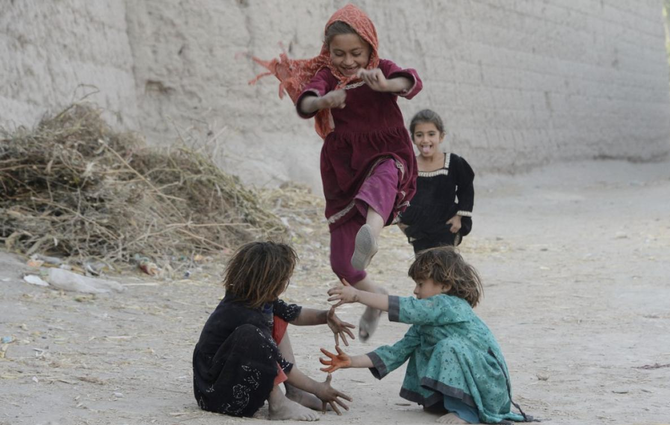
KABUL: A decision to ban girls over the age of 12 from reading poems or singing at public events sparked anger in Afghanistan this week, with literary figures and campaigners saying it marked a backwards step on educational rights.
The Education Ministry’s directive comes as the government negotiates a power-sharing deal with the Taliban, and critics said the order recalled rules imposed by the hard-line Islamist group during its 1990s rule, when it banned girls from school.
“Forgive us God, human beings can be so cruel that they see even a child from a gender-based perspective,” tweeted author and poet Shafiqa Khpalwak, one of the country’s most renowned female writers.
Other social media users quoted from well-known poems and national songs as they criticized the ban, which further separates male and female students in the country’s already segregated schools.
Most Afghan schools have separate classes for boys and girls. Only a few city schools allow them to study together until the third grade.
Education Ministry spokeswoman Najeeba Aryan said many parents had asked for their daughters to be excluded from performing in public, while some students had complained that taking part in school events hindered their studies.
The country’s independent human rights commission rejected the government’s explanation, however, saying the freedom to express artistic skills was a fundamental right of all children.
“Any restrictions on the rights and freedoms of children violate the principles of the Universal Declaration of Human Rights,” the commission said in a statement.
Women’s rights have improved dramatically in Afghanistan since the Taliban was ousted in 2001, with billions of dollars poured into the country since then to help create a more open and equal society.
The Education Ministry’s move has fueled fears that with the Taliban seeking to return to formal power, conservative elements of society will be emboldened to demand that women stay at home.
In a report to Congress this week, John Sopko, the special inspector general for Afghanistan reconstruction (SIGAR), warned that gains made by Afghan women and girls in fields including education and public life might not be protected.
The Taliban says it has changed and will let girls be educated, but fears remain that women’s rights will deteriorate if the group regains influence.
An estimated 7.3 million Afghan children attend school, including 2.4 million girls, according to data from the UN children’s agency, UNICEF.
But about 2.2 million girls are still out of school and less than 30% of women in Afghanistan are literate, according to UN agencies.


![]()

Curbs on girls reading, singing in public stir rights fears in Afghanistan
Short Url
https://arab.news/5j64e
Curbs on girls reading, singing in public stir rights fears in Afghanistan
- Social media users quoted from well-known poems and national songs as they criticized the ban
- About 2.2 million girls are still out of school and less than 30% of women in Afghanistan are literate


Latest updates



Recommended


© 2026 SAUDI RESEARCH & PUBLISHING COMPANY, All Rights Reserved And subject to Terms of Use Agreement.