

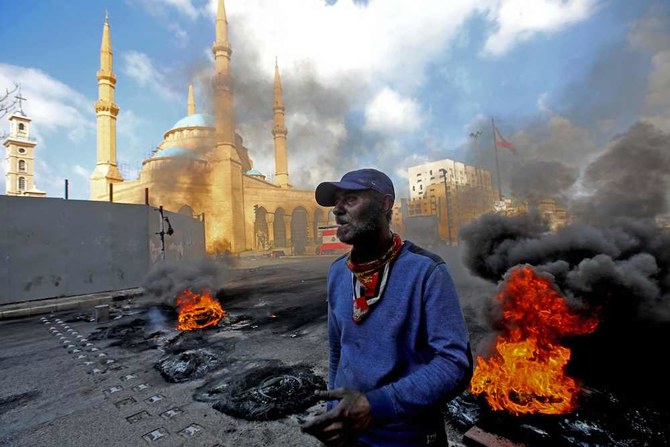

BEIRUT: Lebanon’s President Michel Aoun on Monday told security forces to prevent roads being blocked by protesters. It came as demonstrators declared a “day of rage” amid growing anger about more than a year of economic crisis and months of political paralysis, and blocked main routes across the country for a seventh day straight.
Gen. Joseph Aoun, commander-in-chief of the Lebanese Armed Forces, held a meeting on Monday with military commanders during which he stressed the right of people to engage in peaceful protest but not to damage public property. He also said that violations of the rights of the army would not be tolerated, and called on politicians to resolve the crisis.
In his first public critical comments, he said that “soldiers are hungry like the people, so what are the officials waiting for?” He added that “they launch political campaigns against us to distort our image” but said they will not succeed in doing so.
“It is forbidden to interfere with our affairs or with our promotions or formations. The army is compact and its dissolution means the end of the (Lebanese) entity. The experience of 1975 (the Lebanese Civil War) will not be repeated,” he said.
Gen. Aoun denied that there had been desertions from the military as a result of the economic crisis but added: “Do you want a potent army or not? The army budget is reduced every year, which negatively affects the morale of the military.”
The day of rage began to spread early on Monday to all parts of Lebanon as protesters once again blocked key roads in an attempt to prevent people from going to work.
The demonstrators spoke of their concerns about “the worries of daily life, the rise in the exchange rate of the dollar, and the need for early parliamentary elections.”
According to a report by the Crisis Observatory at the American University of Beirut, obtained by Arab News: “The accelerating collapse of the Lebanese pound last week and the increase of the value of the dollar on the black market to more than (10,000 Lebanese pounds) was a shock to citizens, who lost more than 85 percent of their salaries.
“If the repercussions of the pound’s plunge in value are evident in the deterioration of Lebanese and other residents’ buying power, and in feverish, sometimes violent competition over subsidized goods in some shops, the worst is still to come.”
The report continued: “The support obtained by the Banque du Liban (Lebanon’s central bank) covers between 85 percent and 90 percent of the value of fuel and medicine purchases so far.”
The blocking of roads by protesters, which resulted in clashes with the security services attempting to reopen them, caused alarm among politicians.
During a security, financial and economic meeting on Monday morning at the presidential palace in Baabda, there were calls “not to allow roadblocks, taking into account the safety of citizens, demonstrators and public and private property.”
However, Gen. Aoun made it clear that the military would not prevent peaceful demonstrations or attack protesters to suppress just demands for a resolution of the crisis.
In his speech to officers, he said: “The solution to the crisis is political, and the political forces must assume their responsibilities and work toward finding a solution. They cannot blame the demonstrators nor the Lebanese army.”
A protesters in the Tyre area poured gasoline over himself and tried to set himself on fire on Monday but was prevented from doing so by Lebanese Civil Defense.
In Tripoli, there was a confrontation between the army and protesters calling for “the resignation and trial of all officials.”
During the meeting at the presidential palace, concerns were raised about who was responsible for the latest increase to the dollar exchange rate at the weekend, when businesses were closed. President Aoun asked the security services to investigate plots to harm the country.
Several measures to address the currency crisis were agreed during a meeting with security and government officials, according to an official statement, including a crackdown on anyone found to be violating monetary and credit laws, including foreign exchange bureaus.


