

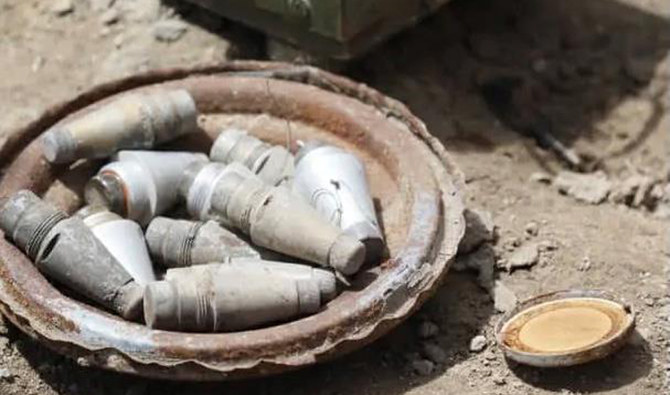
Saudi project clears 1,846 more mines in Yemen

1 / 2
In 2020, Masam’s contract was extended for one year at a cost of $30 million. (SPA)
2 / 2
In 2020, Masam’s contract was extended for one year at a cost of $30 million. (SPA)
Short Url
Updated 07 March 2021
Follow

Saudi project clears 1,846 more mines in Yemen

  • More than 1.1 million mines have been planted by the Houthis, claiming hundreds of civilian lives

RIYADH: The Saudi Project for Landmine Clearance (Masam) dismantled 1,846 mines in Yemen during the first week of March.

They comprised 19 anti-personnel mines, 954 anti-tank mines, 868 unexploded ordnances and five explosive devices.

Masam is one of several initiatives undertaken by Saudi Arabia on the directive of King Salman to help ease the suffering of the Yemeni people.

It is implemented by Saudi cadres and international experts to remove mines planted by Iran-backed Houthi militias in various Yemeni regions, especially Marib, Aden, Sanaa, Al-Jawf, Al-Dhale, Hodeidah, Shabwa and Taiz.

A total of 222,198 mines have been extracted since the start of the project. More than 1.1 million mines have been planted by the Houthis, claiming hundreds of civilian lives.

Masam has 32 demining teams, and aims to dismantle mines in Yemen to protect civilians and ensure that urgent humanitarian supplies are delivered safely.

It trains local demining engineers, gives them modern equipment and helps mine victims.

In 2020, Masam’s contract was extended for one year at a cost of $30 million.


Saudi reserve records critically endangered Ruppel’s vulture

Updated 4 sec ago
Follow

Saudi reserve records critically endangered Ruppel’s vulture

RIYADH: King Abdulaziz Royal Reserve Development Authority has announced the sighting and documentation of a Ruppel’s vulture (Gyps rueppellii) within the boundaries of the reserve — a landmark environmental and historical event.

This is the third officially documented record of the species at national level and the first of its kind in the central and eastern regions of the Kingdom, the Saudi Press Agency reported.

The sighting carries global significance given the conservation status of the vulture, which is classified as critically endangered by the International Union for Conservation of Nature, following the loss of more than 90 percent of its population throughout its original range in Africa over the past three decades.

The appearance of this rare bird in King Abdulaziz Royal Reserve adds a new entry to the limited record of its sightings in the Kingdom, which began in Aseer region in 1985, followed by a sighting in 2018, and another in AlUla in September 2025. 

Its latest recording in central and eastern Saudi Arabia is considered an important environmental indicator of the quality of natural habitats provided by the reserve.

Globally, Ruppel’s vulture faces major threats, including poisoning from pesticides, electrocution, collisions with power lines, and the loss of nesting sites as a result of urban expansion and land-use change. 

Additional challenges include the decline of carrion resulting from changes in livestock-rearing practices, illegal hunting for use in traditional beliefs, and the adverse effects of climate change on its breeding areas and migratory routes.

The vulture is primarily found in the African Sahel and is considered extremely rare in the Arabian Peninsula. Its sighting in King Abdulaziz Royal Reserve underscores the Kingdom’s leading role in conserving biodiversity and supporting the objectives of Saudi Vision 2030 for protecting ecosystems.

It also reflects the success of the authority’s efforts to protect wildlife and restore ecosystems, positioning the reserve as a safe and attractive habitat for rare and native species.