

Eritrean troops killed hundreds in Ethiopia massacre, says HRW

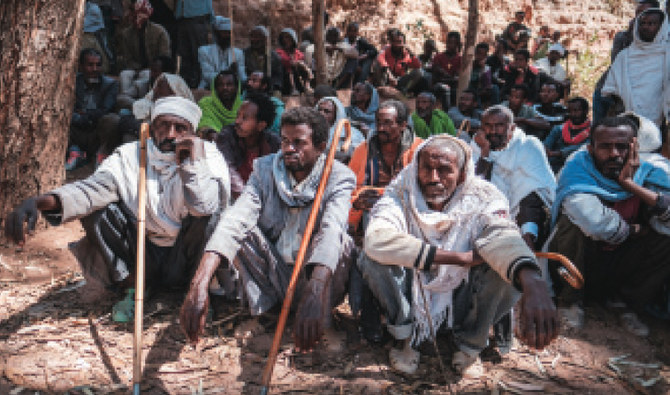
People mourn the victims of a massacre allegedly perpetrated by Eritrean soldiers in the village of Dengolat, north of Mekele, the capital of Tigray. (File/AFP)
Short Url
Updated 06 March 2021
Follow

Eritrean troops killed hundreds in Ethiopia massacre, says HRW

  • Ethiopian and Eritrean forces entered Axum on Nov. 20 after “indiscriminate” shelling that killed civilians, said the HRW report published Friday

ADDIS ABABA: Eritrean forces shot dead hundreds of children and civilians in a November massacre in Ethiopia’s war-hit Tigray region, Human Rights Watch (HRW) said.
It was the second major report on Eritrean abuses in the town of Axum, a UNESCO World Heritage site, in the past week.
An Amnesty International investigation into the same events detailed how Eritrean troops “went on a rampage and systematically killed hundreds of civilians in cold blood.”
The findings from the rights watchdogs come as global concern mounts over atrocities by Eritrean troops in Tigray.
UN leaders on Thursday accused the Eritreans of possible crimes against humanity and urged them to pull out.
Addis Ababa and Asmara deny Eritrea is actively involved in Tigray.
Prime Minister Abiy Ahmed announced military operations against the leadership of the Tigray People’s Liberation Front (TPLF), Tigray’s then-ruling party, in early November, saying they came in response to TPLF attacks on federal army camps.
Ethiopian and Eritrean forces entered Axum on Nov. 20 after “indiscriminate” shelling that killed civilians, said the HRW report published Friday.
The Eritreans then engaged in “widespread pillaging” as Ethiopian troops mostly looked on, the report said.
“I asked one soldier, why are you not doing anything, you are Ethiopian, and we are in Ethiopia; you are allowing the Eritreans to do this,” it quoted one resident as saying.
“He told me: We need an order from above.”

BACKGROUND

Prime Minister Abiy Ahmed announced military operations against the leadership of the Tigray People’s Liberation Front (TPLF), Tigray’s then-ruling party, in early November, saying they came in response to TPLF attacks on federal army camps.

The massacre began on Nov. 28 after Tigrayan militia members, joined by some residents, attacked Eritrean soldiers, HRW said.
After calling in reinforcements, the Eritreans began “moving through the town, going house to house, searching for young men and boys, and executing them.”
Like Amnesty, HRW said it was impossible to provide an exact death toll but estimated that “over 200 civilians were most likely killed on Nov. 28-29 alone.”
That would make the Axum massacre one of the deadliest atrocities of the conflict so far.
Last week AFP traveled to the Tigray village of Dengolat to document a separate massacre by Eritrean troops at around the same time that church officials said left 164 civilians dead.
Since the publication of Amnesty’s report, Abiy’s government has said federal investigators are probing “credible allegations” of atrocities and abuses including in Axum.
But the government has also tried to cast doubt on Amnesty’s findings and accused it of “reinforcing the misinformation and propaganda by TPLF and its cohorts.”
HRW called Friday for an urgent UN investigation into possible war crimes and crimes against humanity in Tigray.
“Eritrean troops committed heinous killings in Axum with wanton disregard for civilian lives,” HRW Horn of Africa director Laetitia Bader said.
“Ethiopian and Eritrean officials can no longer hide behind a curtain of denial, but should allow space for justice and redress, not add to the layers of trauma that survivors already face.”


8 in 10 British Muslims face ‘financial faith penalty’ when seeking home finance, survey finds

Updated 5 sec ago
Follow

8 in 10 British Muslims face ‘financial faith penalty’ when seeking home finance, survey finds

  • Restricted choices plague potential buyers

LONDON: Eight in 10 British Muslims say their home finance choices are restricted because of their faith, according to a new national survey that highlighted what researchers describe as a growing “financial faith penalty” in the UK housing market.

The report, published by Islamic home finance fintech firm Offa, found that 80 percent of Muslim respondents believe their religious beliefs limit their access to suitable home finance, while those who do use Islamic products often face slower decisions, heavier paperwork and poorer customer experiences than in the conventional mortgage market.

Based on surveys of 1,000 British Muslims conducted by Muslim Census, and 2,000 non-Muslims carried out by OnePoll, the research calls on providers, brokers and policymakers to modernize Islamic home finance and improve access to Sharia-compliant products.

Among the 24.3 percent of British Muslims who have used Islamic home finance, just 5 percent said they had received a same-day decision.

Some 62 percent waited up to two weeks, while 33 percent waited more than 15 days, including 16 percent who waited over a month.

Long decision times were cited as the biggest challenge by 28 percent of respondents, followed by excessive paperwork (22.6 percent) and poor customer service (18.9 percent).

Islamic home finance differs from conventional mortgages by avoiding interest and steering investment away from sectors considered harmful to society, including gambling, alcohol, tobacco, arms trading and animal testing.

Sagheer Malik, chief commercial officer and managing director of home finance at Offa, said the findings showed British Muslims were being underserved by outdated systems.

Malik said: “Property is the asset class of choice for many of the UK’s 3.87 million Muslims, both as a route to generational wealth and as a long-term financial foundation, yet our insightful research report reveals that British Muslims are being underserved and deterred by slow, outdated and opaque Islamic home finance provision.

“This is not a niche concern. It goes to the heart of financial fairness and inclusion in modern Britain.”

He added that Muslims deserved Sharia-compliant products that matched mainstream standards on “price, speed and simplicity.”

Despite strong demand, uptake remains low.

Only 12.8 percent of British Muslims surveyed said they currently use Islamic home finance, with a further 11.5 percent having done so in the past. More than three quarters (75.7 percent) have never used it.

Faith plays a central role in financial decisions, with 94.2 percent saying it is important that their financial products align with their ethical or religious beliefs. Yet more than half of those using conventional mortgages said they felt unhappy or uneasy about doing so because of their faith.

The study also found that British Muslims share similar home ownership aspirations to the wider population, with 79.1 percent citing the desire to provide a stable home for their family, while 18.6 percent said building generational wealth was their main motivation. Only 2.2 percent said they did not want to own a home.

The report suggests Islamic finance could appeal beyond Muslim communities. While 64 percent of non-Muslim respondents had never heard of Islamic home finance, 63 percent said they favored its ethical principles once explained.

Younger generations were the most receptive, with 43 percent of Generation Z and 37 percent of millennials saying they would consider using Islamic home finance, compared with just 7 percent of baby boomers. More than three quarters of Gen Z and 72 percent of millennials also said it was important that their finance provider avoided investing in ethically harmful sectors.

Offa said the findings pointed to an opportunity to expand ethical finance in the UK, provided the industry can deliver faster, simpler and more transparent services.