

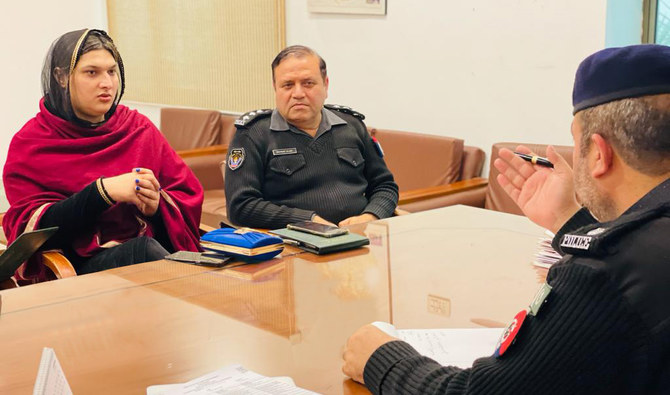

PESHAWAR: A transgender person who was recently appointed by Khyber Pakhtunkhwa (KP) Police to its dispute resolution council (DRC) in Peshawar said on Friday she would do her best to address the problems faced by her "ostracized community" in the province.
"I commend the police for allowing representation to a marginalized community. I will represent transgender people in relevant cases," Sobia Khan told Arab News while commenting on her inclusion in the council that was established in 2014 to institutionalize alternative dispute resolution mechanism in the province.
Khyber Pakhtunkhwa's transgender community has frequently faced sexual abuse, physical torture and killings, and the perpetrators of these crimes have often been unpunished.
Discussing Khan's appointment to the DRC, KP's Inspector General Police Dr. Sanaullah Abbasi told Arab News that his department was striving to protect marginalized people in the province.
"The system of alternative dispute resolution is based on active engagement among victims, offenders and the rest of the community in pursuit of reconciliation by adapting a balanced approach that caters to the needs of all three through a process that preserves everyone's safety and dignity," he said.
Khan said that transgender persons faced serious issues related to education, health and employment in government institutions. She added that many of them were also forced into prostitution.
In 2018, Pakistan's parliament tried to address such challenges by enacting Transgender Persons (Protection of Rights) Act to recognize their legal equality and safeguard their rights.
The legislation prohibits any discrimination against them in education institutions, medical centers and public transportation facilities. It also makes it possible for them to apply for passports, driver's licenses and other official documents by using their gender identity.
Qamar Naseem, a program coordinator with Blue Veins that works for the protection of women and transgender people, told Arab News that the DRC could help people on social peripheries and reduce pressure on local courts since many contentious issues could be amicably resolved by its members.
He said that there were about 50,000 transgender people in Khyber Pakhtunkhwa province, adding that at least 83 of them had been killed since 2015 in targeted attacks.
"Transgender people are even disowned by their parents in our society and hated by a large majority of those around us," Naseem continued. "With some representation in the DRC, their grievances may be addressed."
Arzoo Khan, president the provincial transgender association, said the inclusion of one of her community members in the council was a good initiative, though she added that such representation should not be limited to a single district.
The inspector general police informed Arab News he had already issued directives to ensure transgender representation in DRCs across the province.
"Transgender people face problems in hospitals, schools and other places due to their gender identity," Naseem said. "The government should launch a campaign to sensitize members of our society to own such marginalized communities."


