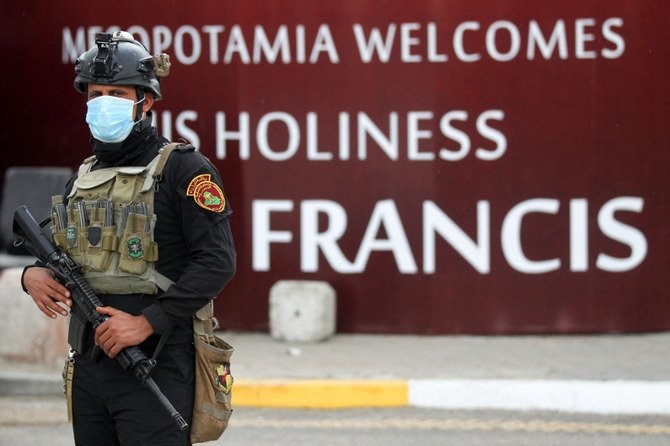
ROME: Iraq is deploying thousands of additional security personnel to protect Pope Francis during his four-day visit, which comes after a spate of rocket and suicide bomb attacks raised fears for the Catholic leader’s safety.A senior security official who has been briefed on the security plan said that forces involved had been trained to deal with worst-case scenarios, from street battles to bombings and rocket attacks.
Large-scale exercises included hypothetical threats among preparations for the March 5-8 visit, the first-ever by a pope to Iraq. As well as concerns over violence, the country has seen a spike in COVID-19 cases, further complicating preparations.
The 84-year-old will visit four cities, including the former Daesh stronghold of Mosul, where churches and other buildings still bear the scars of conflict. Francis will also visit Ur, birthplace of Prophet Abraham who is revered by Christians, Muslims and Jews, and meet Iraq’s top Shiite cleric, 90-year-old Grand Ayatollah Ali Al-Sistani.
Interior Ministry special forces and the army will set up a security cordon around the pope wherever he goes, while the air force will operate drones around the clock to monitor the routes he will take. There will be an explosives team and
counterterrorism personnel on standby in case of any suspicious devices or street battles.
Undercover intelligence and national security officers will also be deployed at gatherings attended by the pope. A technical team can also jam or cut off suspicious phone calls or radio communications, he added.
About 10,000 security personnel will be deployed to protect Francis, who may travel in armored cars in what would be a departure from the norm for him.
Pope Francis said in a video message on Thursday that he wants to be seen by the Iraqi people as a “penitent pilgrim” asking God for “forgiveness and reconciliation after years of war and terrorism,” and for “consolation of hearts and the healing of wounds.”
He added: “I come among you like a pilgrim of peace and I repeat, you are all brothers. I come as a pilgrim of peace in search of fraternity animated by desire to pray together and to walk together, also with brothers and sisters belonging to other religious traditions.”
A special bronze medal has been minted by the Vatican to celebrate the pope’s visit. Vatican sources told Arab News that the medal will be one of the gifts that the pope will give to Iraqi representatives.
The medal has been designed by artists from the Ufficio Filatelico e Numismatico, the dedicated branch of the Vatican State Post Office for stamps and coins. It features the map of Iraq, the Tigris and Euphrates rivers, a palm tree and Abraham leaving Ur. In the lower part of the medal, there is the inscription of the apostolic visit’s dates (March 5-8) in Latin, the official language of the Vatican. In its upper part the medal reads “Visit Iraquiam,” Latin for “Visit to Iraq.”


Massive security net in Iraq as Pope Francis begins visit
https://arab.news/zvtr4
Massive security net in Iraq as Pope Francis begins visit

- Undercover intelligence and national security officers will also be deployed at gatherings attended by the pope
- The 84-year-old will visit four cities, including the former Daesh stronghold of Mosul

Can AI really discover anything?
- Nobel Laureates discuss true impact on science at World Laureate Summit in Dubai
DUBAI: Since its rise, artificial intelligence has brought with it a promise of human and scientific progression beyond most people’s imaginations.
However, the spread of AI slop, fakes and proliferation of seemingly nefarious and useless applications have caused many to wonder whether the technology can really live up to its promise.
Scientists and academics gathered in Dubai on Sunday for the opening of the World Laureates Summit argued that the technology does, in fact, help them work faster, spot patterns and test ideas that would otherwise take years or decades.
“Can AI help us in speeding up discovery? Yes. Can it simplify the tasks and eliminate a lot of the trial and error that we chemists use to crystallize things. Yes. Will it get better? Yes,” Palestinian-Saudi Prof. Omar M. Yaghi, 2025 winner of the Nobel prize in chemistry, told the conference.
“I think we are in the middle of a revolution, transforming chemistry by blending it with AI.”
Yaghi said AI was already reducing the time it took chemists to crystallize molecules — a process that lines up atoms or molecules in a neat, repeating pattern rather than a jumble — from several years down to just two weeks. This, in turn, speeds up the process of scientific discovery and application.
His views were echoed by Prof. Tony Fan-cheong Chan, president of the King Abdullah University of Science and Technology, who said AI had already contributed to Nobel Prize-winning discoveries.
However, he questioned the limits of AI saying that despite its ability to improve and accelerate science, humans still led the big, world-changing ideas.
“Here’s my thought experiment for all of you to consider: If someone besides Einstein had the best AI model pre-1905, would that person be able to discover the general theory of relativity?” Feng asked the crowd gathered in Dubai’s Madinat Jumeirah.
Robert Endre Tarjan, a prolific American computer scientist and mathematician, warned against AI — specifically for its inclination to “hallucinate.” He said he believed that regardless of how useful a tool it was, it could never replace human creativity and ingenuity in science.
“AI systems as we know them hallucinate; asking the right question is more important than finding the answer,” he said.
Russian mathematician Yurii Nesterov said AI was ultimately limited by the data made available to it. While he believes AI does have creative capacity, it depends how well it is programmed by humans.
“I believe that artificial intelligence has indeed a considerable creative power, it can discover new links, structures, and properties of the investigated objects,” he said.
“Artificial intelligence is already alive, and the main goal of the scientific community is to ensure the developments in the right directions.”
The World Laureates Summit, held in partnership with the World Governments Summit in Dubai, brings together some of the world’s most distinguished scientists, including Nobel Prize winners, Turing Award recipients, Fields Medalists and other award-winning researchers.


