Saudi Arabia urges UN Security Council to hold Houthis accountable for threat posed to global peace, security

Abdallah Al-Mouallimi alerted the council to the continued military hostilities committed by the Houthis against the Kingdom.
Short Url
Updated 03 March 2021
Follow

Saudi Arabia urges UN Security Council to hold Houthis accountable for threat posed to global peace, security

  • Attacks against the Kingdom prove that these Iran-backed militias ‘only believe in terrorist behavior to reach their narrow political aims,’ top Saudi envoy writes in letter seen by Arab News
  • Abdallah Al-Mouallimi: Houthis continue to ignore and violate Security Council resolutions and international humanitarian law

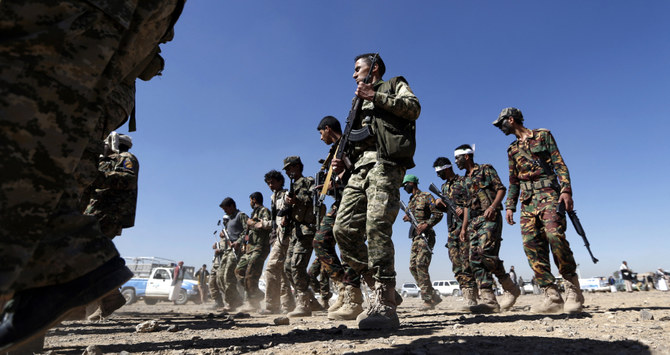
NEW YORK: Saudi Arabia urged the UN Security Council (UNSC) on Tuesday to shoulder its responsibility and hold the Iran-backed Houthi militias in Yemen accountable for the threats they pose to international peace and security.
The Houthis’ terror activities continue to jeopardize UN efforts to reach a comprehensive solution in Yemen, and undermine the credibility of UNSC resolutions, Abdallah Al-Mouallimi, Saudi Arabia’s permanent representative to the UN, wrote in a letter seen by Arab News.
He alerted the council to the continued military hostilities committed by the Houthis against the Kingdom. “Among these hostilities towards civilians and civilian objects, some of the scattered debris of a ballistic missile launched by these militias resulted in material damage to one house in Riyadh on February 27th 2021, after being intercepted and destroyed,” Al-Mouallimi wrote.
“Moreover, the fall of a military projectile (on Monday) launched by these militias towards one of the border villages in Jazan Region injured five civilians as a result of flying shrapnel. It also damaged two houses, a grocery store and three civilian vehicles.”
The letter was addressed to US Ambassador Linda Thomas-Greenfield, who is assuming the rotating presidency of the UNSC this month. UN Secretary-General Antonio Guterres was copied in.
“Although the Security Council strongly condemned the continuation of Houthi attacks on Saudi Arabia and called for an immediate cessation of attacks without preconditions in its resolution 2564 (2021) that was adopted on 25 February 2021, the Houthi militias continue their behavior in ignoring and violating Security Council resolutions and International Humanitarian Law,” the top Saudi envoy wrote.
“It is an obvious response of the Houthi militias to the … calls and appeals (of the UNSC and international community) for a political solution to the crisis in Yemen, and it proves once again that these militias only believe in terrorist behavior to reach their narrow political aims.”
Al-Mouallimi reiterated that Saudi Arabia reserves its full rights “to safeguard its citizens, residents and territories in accordance with its commitments under international law.” He asked Thomas-Greenfield to circulate the letter as an official document.
 

Desert Storm: 30 years on
The end of the Gulf War on Feb. 28, 1991 saw the eviction of Iraq from Kuwait but paved the way for decades of conflict

Enter


keywords

Saudi Arabia targets 50 wildlife breeding programs within 5 years

Updated 5 sec ago
Follow

Saudi Arabia targets 50 wildlife breeding programs within 5 years

  • Strategy follows surging interest in protecting prized native species

RIYADH: Saudi Arabia’s top wildlife protection body has launched a plan to operate 50 breeding programs by 2030 and improve environmental balance, its CEO has said.

Mohammed Ali Qurban, head of the National Center for Wildlife, said the number of programs has already surged from seven to 21 in recent years, amid renewed interest in the protection of valued native species.

The breeding programs are based on precise scientific principles, starting with the selection of suitable species at research centers, followed by veterinary care and specialized nutrition programs, he added.

At the final stage, protected species are rehabilitated for release and monitored using the latest tracking and data analysis technologies.

The relocation of more than 10,000 animals in Saudi Arabia is “an important step in restoring ecosystems and enhancing environmental balance in the Kingdom,” Qurban said.

Veterinary scientists at work at the National Center for Wildlife's laboratory. (Supplied)

“Releasing wildlife into the wild contributes to forming new populations capable of self-reproduction; these releases support the genetic diversity of wild populations and enhance their ability to resist disease and adapt to environmental changes,” he added.

Releases have so far included more than 80 priority species, most notably reem antelopes, Arabian oryx, idmi gazelles, mountain ibex, houbara bustards, ostriches and sandgrouses. The animals were released within their historical and ecological ranges.

Qurban said that the plans take into account the carrying capacity of natural habitats and the importance of safe ecological corridors that connect protected areas to facilitate species movement and population sustainability.

Release sites are spread across more than 60 diverse environmental locations, including natural reserves, royal reserves and national parks, as well as strategic sites within the Kingdom’s giga-projects, ensuring the dispersal of animals across their targeted geographical ranges.

The efforts are part of a national integrated framework to support the goals of the Saudi Green Initiative, Vision 2030 and the National Environment Strategy, aiming to achieve thriving and sustainable wildlife and ecosystems, Qurban said.