

Iran rejects Netanyahu accusations that Tehran is ‘clearly’ behind Israeli ship blast

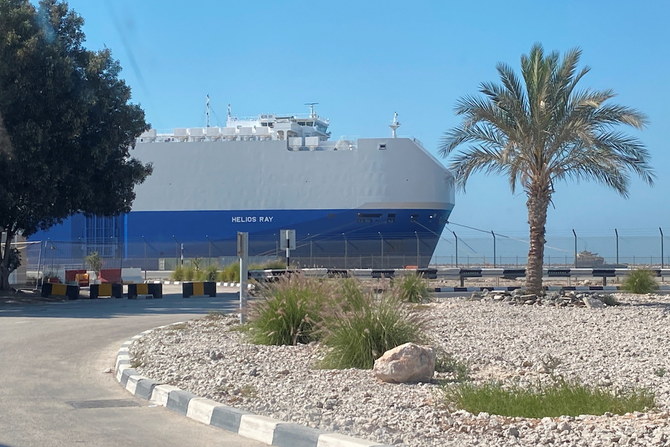
An Israeli-owned ship hit by an explosion in the strategic Gulf of Oman waterway is seen after arrival at a port in Dubai Feb 28, 2021. (Reuters)
Short Url
Updated 01 March 2021
Follow

Iran rejects Netanyahu accusations that Tehran is ‘clearly’ behind Israeli ship blast

JERUSALEM: Prime Minister Benjamin Netanyahu blamed Iran on Monday for a blast aboard an Israeli-owned ship in the Gulf of Oman last week, but Iran rejected the charge.

The MV Helios Ray, a vehicle-carrier ship, was hit overnight by a blast above the water line that a US official said ripped holes in both sides of its hull.

“This was indeed an operation by Iran. That is clear,” Netanyahu told Kan radio.

Asked if Israel would retaliate, he repeated previous statements about his determination to prevent Iran from developing nuclear capacity and added: “We are striking at it (Iran) all over the region.”

Meanwhile, Iran's foreign ministry on Monday “strongly” rejected accusations by Netanyahu that Tehran was behind the attack on the Israeli-owned ship.

“We strongly deny this accusation,” spokesman Saeed Khatibzadeh said at a press conference, adding that “the source of this accusation itself shows how invalid (the claim) is.”

(with Reuters and AFP)

Desert Storm: 30 years on
The end of the Gulf War on Feb. 28, 1991 saw the eviction of Iraq from Kuwait but paved the way for decades of conflict

Enter


keywords

Can AI really discover anything?

Updated 7 sec ago
Follow

Can AI really discover anything?

  • Nobel Laureates discuss true impact on science at World Laureate Summit in Dubai

DUBAI: Since its rise, artificial intelligence has brought with it a promise of human and scientific progression beyond most people’s imaginations.

However, the spread of AI slop, fakes and proliferation of seemingly nefarious and useless applications have caused many to wonder whether the technology can really live up to its promise.

Scientists and academics gathered in Dubai on Sunday for the opening of the World Laureates Summit argued that the technology does, in fact, help them work faster, spot patterns and test ideas that would otherwise take years or decades.

“Can AI help us in speeding up discovery? Yes. Can it simplify the tasks and eliminate a lot of the trial and error that we chemists use to crystallize things. Yes. Will it get better? Yes,” Palestinian-Saudi Prof. Omar M. Yaghi, 2025 winner of the Nobel prize in chemistry, told the conference.

“I think we are in the middle of a revolution, transforming chemistry by blending it with AI.”

Yaghi said AI was already reducing the time it took chemists to crystallize molecules — a process that lines up atoms or molecules in a neat, repeating pattern rather than a jumble — from several years down to just two weeks. This, in turn, speeds up the process of scientific discovery and application.

His views were echoed by Prof. Tony Fan-cheong Chan, president of the King Abdullah University of Science and Technology, who said AI had already contributed to Nobel Prize-winning discoveries.

However, he questioned the limits of AI saying that despite its ability to improve and accelerate science, humans still led the big, world-changing ideas.

“Here’s my thought experiment for all of you to consider: If someone besides Einstein had the best AI model pre-1905, would that person be able to discover the general theory of relativity?” Feng asked the crowd gathered in Dubai’s Madinat Jumeirah.

Robert Endre Tarjan, a prolific American computer scientist and mathematician, warned against AI — specifically for its inclination to “hallucinate.” He said he believed that regardless of how useful a tool it was, it could never replace human creativity and ingenuity in science.

“AI systems as we know them hallucinate; asking the right question is more important than finding the answer,” he said.

Russian mathematician Yurii Nesterov said AI was ultimately limited by the data made available to it. While he believes AI does have creative capacity, it depends how well it is programmed by humans.

“I believe that artificial intelligence has indeed a considerable creative power, it can discover new links, structures, and properties of the investigated objects,” he said.

“Artificial intelligence is already alive, and the main goal of the scientific community is to ensure the developments in the right directions.”

The World Laureates Summit, held in partnership with the World Governments Summit in Dubai, brings together some of the world’s most distinguished scientists, including Nobel Prize winners, Turing Award recipients, Fields Medalists and other award-winning researchers.