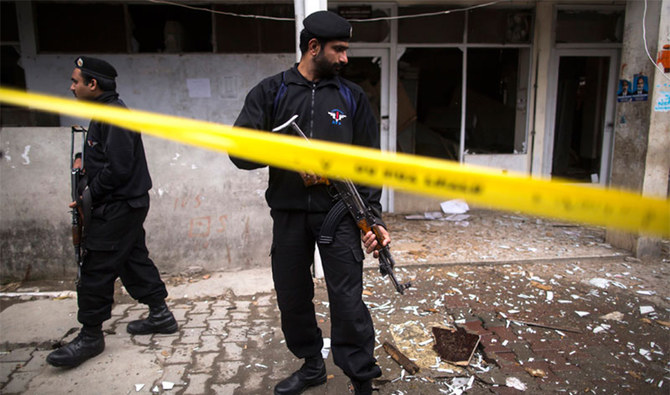
ISLAMABAD: A trio of gunmen shot and killed a religious cleric, his teenage son and a student on the outskirts of Pakistan’s capital Islamabad, police said, amid a rise in militant attacks.
Police officer Shahzad Khan said the killing took place in the Bhara Kahu neighborhood when Mufti Ikramur Rehman was heading toward his car with his 13-year-old son and a seminary student late Saturday night.
He said three assailants fired several shots before fleeing the scene. The cleric, his son and the student received multiple gunshot wounds and died at a hospital.
No one immediately claimed responsibility for the attack and Khan said an investigation was underway to ascertain the identity of the assailants and the motive behind the killings.
Ikramur Rehman was affiliated with the party of firebrand cleric Maulana Fazlur Rehman, who heads an 11-party opposition alliance to topple the government.
Militant violence in Pakistan is on the rise. Last week, four vocational school instructors who advocated for women’s rights were traveling together when they were gunned down in a Pakistan border region. A Twitter death threat against Nobel laureate Malala Yousafzai attracted an avalanche of trolls who heaped abuse on the young champion of girls education. A couple of men on a motorcycle opened fire on a police check-post not far from the Afghan border killing a young police constable.
In recent weeks, at least a dozen military and paramilitary men have been killed in ambushes, attacks and operations against militant hideouts, mostly in the western border regions.

Gunmen kill Islamic cleric, his son, student near Islamabad
https://arab.news/c4bnt
Gunmen kill Islamic cleric, his son, student near Islamabad
- No group claimed responsibility for the killing that place in Bhara Kahu neighborhood on Saturday night
- Cleric was affiliated with Maulana Fazlur Rehman who heads an 11-party opposition alliance to topple the government
Islamabad says surge in aircraft orders after India standoff could end IMF reliance
- Pakistani jets came into the limelight after Islamabad claimed to have shot down six Indian aircraft during a standoff in May last year
- Many countries have since stepped up engagement with Pakistan, while others have proposed learning from PAF’s multi-domain capabilities
ISLAMABAD: Defense Minister Khawaja Asif on Tuesday said Pakistan has witnessed a surge in aircraft orders after a four-day military standoff with India last year and, if materialized, they could end the country’s reliance on the International Monetary Fund (IMF).
The statement came hours after a high-level Bangladeshi defense delegation met Pakistan’s Air Chief Marshal Zaheer Ahmed Baber Sidhu to discuss a potential sale of JF-17 Thunder aircraft, a multi-role fighter jointly developed by China and Pakistan that has become the backbone of the Pakistan Air Force (PAF) over the past decade.
Fighter jets used by Pakistan came into the limelight after Islamabad claimed to have shot down six Indian aircraft, including French-made Rafale jets, during the military conflict with India in May last year. India acknowledged losses in the aerial combat but did not specify a number.
Many countries have since stepped up defense engagement with Pakistan, while delegations from multiple other nations have proposed learning from Pakistan Air Force’s multi-domain air warfare capabilities that successfully advanced Chinese military technology performs against Western hardware.
“Right now, the number of orders we are receiving after reaching this point is significant because our aircraft have been tested,” Defense Minister Asif told a Pakistan’s Geo News channel.
“We are receiving those orders, and it is possible that after six months we may not even need the IMF.”
Pakistan markets the Chinese co-developed JF-17 as a lower-cost multi-role fighter and has positioned itself as a supplier able to offer aircraft, training and maintenance outside Western supply chains.
“I am saying this to you with full confidence,” Asif continued. “If, after six months, all these orders materialize, we will not need the IMF.”
Pakistan has repeatedly turned to the IMF for financial assistance to stabilize its economy. These loans come with strict conditions including fiscal reforms, subsidy cuts and measures to increase revenue that Pakistan must implement to secure disbursements.
In Sept. 2024, the IMF approved a $7 billion bailout for Pakistan under its Extended Fund Facility (EFF) program and a separate $1.4 billion loan under its climate resilience fund in May 2025, aimed at strengthening the country’s economic and climate resilience.
Pakistan has long been striving to expand defense exports by leveraging its decades of counter-insurgency experience and a domestic industry that produces aircraft, armored vehicles, munitions and other equipment.
The South Asian country reached a deal worth over $4 billion to sell military equipment to the Libyan National Army, Reuters report last month, citing Pakistani officials. The deal, one of Pakistan’s largest-ever weapons sales, included the sale of 16 JF-17 fighter jets and 12 Super Mushak trainer aircraft for basic pilot training.


