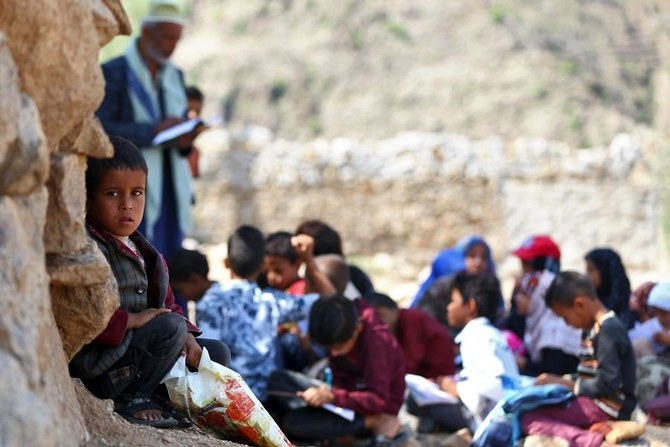
Yemen’s children starve as UN seeks billions to avoid vast ‘man-made’ famine

On Monday the United Nations hopes to raise some $3.85 billion at a virtual pledging event to avert what Lowcock says would be a large-scale “man-made” famine, the worst the world will have seen for decades. (File/AFP)
Updated 27 February 2021
Follow

Yemen’s children starve as UN seeks billions to avoid vast ‘man-made’ famine

  • Some 80 percent of Yemenis need help, with 400,000 children under the age of five severely malnourished

SANAA/NEW YORK: Ahmadiya Juaidi’s eyes are wide as she drinks a nutrition shake from a large orange mug, her thin fingers grasping the handle. Her hair is pulled back and around her neck hangs a silver necklace with a heart and the letter A.
Three weeks ago the 13-year-old weighed just nine kilograms (20 pounds) when she was admitted to Al-Sabeen hospital in Yemen’s capital Sanaa with malnutrition that sickened her for at least the past four years. Now she weighs 15 kilograms.
“I am afraid when we go back to the countryside her condition will deteriorate again due to lack of nutritional food. We have no income,” her older brother, Muhammad Abdo Taher Shami, told Reuters.
They are among some 16 million Yemenis — more than half the population of the Arabian Peninsula country — that the United Nations says are going hungry. Of those, five million are on the brink of famine, UN aid chief Mark Lowcock warns.
On Monday the United Nations hopes to raise some $3.85 billion at a virtual pledging event to avert what Lowcock says would be a large-scale “man-made” famine, the worst the world will have seen for decades.
Some 80 percent of Yemenis need help, with 400,000 children under the age of five severely malnourished, according to UN data. For much of its food, the country relies on imports that have been badly disrupted over the years by all warring parties.
“Before the war Yemen was a poor country with a malnutrition problem, but it was one which had a functioning economy, a government that provided services to quite a lot of its people, a national infrastructure and an export base,” Lowcock told reporters. “The war has largely destroyed all of that.”
“In the modern world famines are basically about people having no income and then other people blocking efforts to help them. That’s basically what we’ve got in Yemen,” he added.


Pakistan’s military chief Asim Munir in spotlight over Trump’s Gaza plan

Updated 19 sec ago
Follow

Pakistan’s military chief Asim Munir in spotlight over Trump’s Gaza plan

  • Munir may visit Washington to discuss Trump’s Gaza force, sources tell Reuters
  • US president’s 20-point Gaza plan calls for a force from Muslim nations to oversee a transition period
ISLAMABAD: Pakistan’s most powerful military chief in decades faces the toughest test of his newly amassed powers as Washington pushes Islamabad to contribute troops to the Gaza stabilization force, a move analysts say could spark domestic backlash.
Field Marshal Asim Munir is expected to fly to Washington to meet President Donald Trump in the coming weeks for a third meeting in six months that will likely focus on the Gaza force, two sources told Reuters, one of them a key player in the general’s economic diplomacy.
Trump’s 20-point Gaza plan calls for a force from Muslim nations to oversee a transition period for reconstruction and economic recovery in the war-torn Palestinian territory, decimated by over two years of Israeli military bombardment.
Many countries are wary of the mission to demilitarise Gaza’s Islamist militant group Hamas, which could drag them into the conflict and enrage their pro-Palestinian and anti-Israeli populations.
But Munir has built a close relationship with the mercurial Trump to repair years of mistrust between Washington and Islamabad. In June, he was rewarded with a White House lunch — the first time a US president hosted Pakistan’s army chief alone, without civilian officials.
“Not contributing (to the Gaza stabilization force) could annoy Trump, which is no small matter for a Pakistani state that appears quite keen to remain in his good graces — in great part to secure US investment and security aid,” said Michael Kugelman, Senior Fellow, South Asia at Washington-based Atlantic Council.

’PRESSURE TO DELIVER’

Pakistan, the world’s only Muslim country with nuclear weapons, has a battle-hardened military having gone to war with arch-rival India three times and a brief conflict this summer. It has also tackled insurgencies in its far-flung regions and is currently embroiled in a bruising war with Islamist militants who it says are operating from Afghanistan.
Pakistan’s military strength means “there is a greater pressure on Munir to deliver his capacity,” said author and defense analyst Ayesha Siddiqa.
Pakistan’s military, foreign office and information ministry did not respond to questions from Reuters. The White House also did not respond to a request for a comment.
Pakistani Foreign Minister Ishaq Dar said last month that Islamabad could consider contributing troops for peacekeeping but disarming Hamas “is not our job.”

UNPRECEDENTED POWER

Munir was earlier this month anointed chief of the defense forces to head the air force and navy as well, with a job extension until 2030.
He will retain his field marshal title forever, as well as enjoy lifetime immunity from any criminal prosecution under the constitutional amendments that Pakistan’s civilian government pushed through parliament late last month.
“Few people in Pakistan enjoy the luxury of being able to take risks more than Munir. He has unbridled power, now constitutionally protected,” Kugelman added.
“Ultimately, it will be Munir’s rules, and his rules only.”

THE HOME FRONT RISK
Over the past few weeks, Munir has met military and civilian leaders from countries such as Indonesia, Malaysia, Saudi Arabia, Turkiye, Jordan, Egypt and Qatar, according to the military’s statements, which Siddiqa said appeared to be consultations on the Gaza force.
But the big concern at home is that the involvement of Pakistan troops in Gaza under a US-backed plan could re-ignite protests from Pakistan’s Islamist parties that are deeply opposed to the US and Israel.
The Islamists have street power to mobilize thousands. A powerful and violent anti-Israel Islamist party that fights for upholding Pakistan’s ultra-strict blasphemy laws was banned in October.
Authorities arrested its leaders and over 1,500 supporters and seized its assets and bank accounts in an ongoing crackdown, officials said.
While Islamabad has outlawed the group, its ideology is still alive.
The party of former jailed premier, Imran Khan, whose supporters won the most seats in the 2024 national elections and has wide public support, also has an axe to grind against Munir.
Abdul Basit, Senior Associate Fellow, S. Rajaratnam School of International Studies in Singapore, said if things escalated once the Gaza force was on the ground, it would cause problems quickly.
“People will say ‘Asim Munir is doing Israel’s bidding’ — it will be foolhardy of anyone not to see it coming.”