LONDON: Ahmad Zaki Yamani, the longest-serving Saudi petroleum minister who oversaw the implementation of the oil embargo of 1973, is considered among the towering figures of the global energy market. It is therefore no surprise that his death at the age of 90 on Tuesday was picked up by international news agencies.
What is surprising, however, is how many of these reputable media outlets — including ones in Yamani’s native Saudi Arabia — got one major fact wrong about the late minister’s career.
Indeed, several major news outlets in the Kingdom referred to Yamani as the first ever secretary general of OPEC. These outlets include the Kingdom’s main business daily Al-Eqtisadiya, the English-language daily Saudi Gazette, the highly quoted Okaz newspaper, news portal Akbaar 24 and even the Saudi Broadcasting Authority’s official state newscaster, Al-Ekhbariya.
فيديو | #أحمد_زكي_يماني.. وداعا ثاني وزراء #البترول وأول أمين عام لـ #أوبك#الغوار#الإخبارية pic.twitter.com/wcsAxhnn7n
— الإخبارية - اقتصاد (@ekhbariya_eco) February 23, 2021
Of course, as per the list of secretary generals on OPEC’s official website, the first official to hold this position was Iran’s Fuad Rouhani. Saudi Arabia was one of OPEC’s five founding members in 1960, represented at the time by former oil minister Abdullah Touraiggi, who was succeeded in that role by Yamani in 1962.
The only Saudi national to become OPEC secretary-general was Mohammad Saleh Joukhdar — the fourth official to take helm — from Jan. 1, 1967, until Dec. 31 the same year.
An editorial review of the published Arabic-language articles containing this factual error suggests the source of the mistake was Yamani’s Arabic language Wikipedia page. The page lists “First secretary-general of the Organization of Petroleum Exporting Countries, OPEC” under Yamani’s professional milestones.
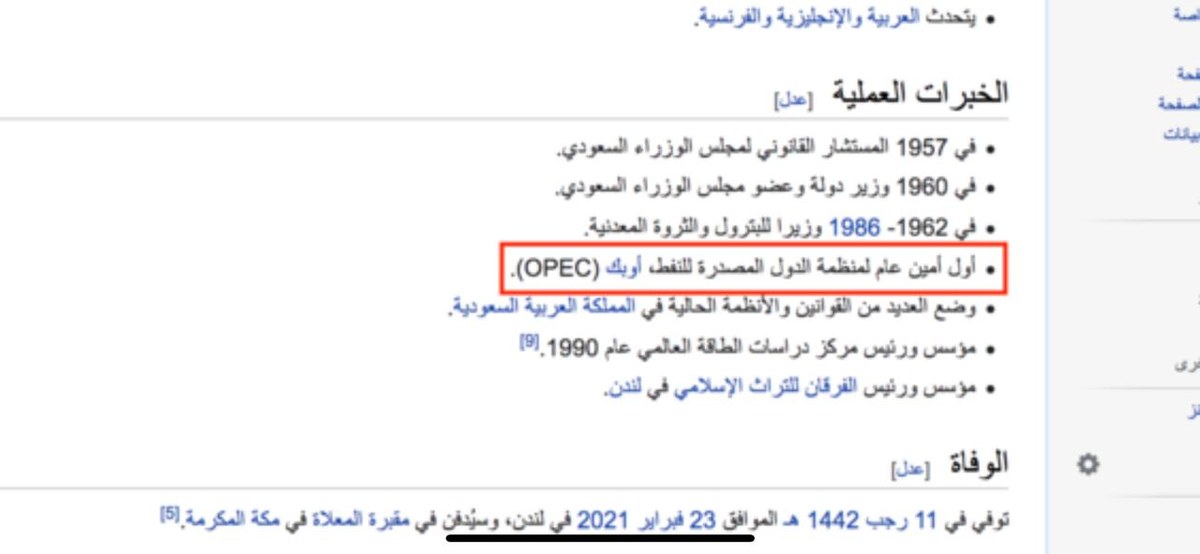
Wikipedia Arabic entry on Ahmed Zaki Yamani lists “First secretary-general of the Organization of Petroleum Exporting Countries, OPEC” as one of his professional experiences. (Screenshot)
However, none of the outlets that relied on the Arabic Wikipedia entry noticed that this information was unattributed to any source, and was excluded altogether in the English-language version of the same page.
A simple phone call or even a cursory skim of OPEC’s official list of secretaries-general would have revealed that Yamani’s name does not appear as the first — or indeed at all. Despite his legendary standing and influence, the late minister was never a secretary-general, but was in fact the first Saudi representative on the OPEC board of governors.
Many international media outlets, including the Russian state-owned RT Arabic relied on local Saudi press coverage — namely Okaz — and failed to verify the facts for itself.
The same mistake was committed by the Dubai-based CNN’s Arabic news site, which carried the factual error because it relied on the same report by Saudi Arabia’s Al Ekhabariya.
Other outlets that got it wrong were the London-based Asharq Al-Awsat, Turkey’s Anadolu Agency and the US-State Department-funded Alhurra News Channel, which tweeted a homage to Yamani, claiming he was “the first secretary-general of the Organization of Petroleum Exporting Countries (OPEC), for a period of 25 years.”
توفي وزير البترول السعودي الأسبق أحمد زكي يماني، صباح اليوم في لندن، عن عمر ناهز 90 عاما. ويعتبر يماني "أحد أقوى رجال البترول العرب"، حيث شغل منصب ثاني وزير للبترول والثروة المعدنية في الفترة ما بين 1962 و1986، وأول أمين عام لمنظمة الدول المصدرة للنفط (أوبك)، لمدة 25 عاما. pic.twitter.com/An3puXD0yM
— قناة الحرة (@alhurranews) February 23, 2021
Interestingly, Qatari-owned Al-Jazeera claimed Yamani was the first secretary-general of OPEC for five years since the organization’s establishment in Geneva 1960 and its move to Vienna in 1965.
"لُقب بعراب الذهب الأسود في #السعودية وكان أول أمين عام لمنظمة أوبك".. وفاة وزير البترول السعودي الأسبق أحمد زكي يماني عن عمر يناهز الـ 90 عاما | تقرير: جعفر سلمات #الأخبار pic.twitter.com/Iqq7vgbz5G
— قناة الجزيرة (@AJArabic) February 24, 2021
However, as is often the case with the controversial Doha-based broadcaster, the mistake was limited to its Arabic-language platforms, while its English-language service appears to have got it right.
Speaking to Arab News over the phone, a spokesperson for OPEC in Vienna firmly denied that Yamani was ever a secretary-general, nor was he the first conference president. He was in fact the fourth — a role he presided over seven times, first in 1962.
“It all comes down to the basics of journalism fact-checking and verification, the bread and butter of every professional and self-respecting journalist,” Dr. Jad Melki, associate professor of journalism and media studies at the Lebanese American University and director of the Institute of Media Research and Training, told Arab News.
“In the rush to report first in a 24-hour news cycle, many news outlets are making basic errors that can easily be avoided. They risk losing credibility in the long run and that will spell their demise.”
For his part, a Saudi reporter who is a member of the Kingdom’s journalists association (SJA) described the incident as an “industry-level scandal.”
“It is embarrassing in so many ways, for us not to know our own history, for some of the most reputable media outlets in the region to rely on sources like Wikipedia, it all makes you wonder how many other mistakes go unnoticed on daily basis,” he told Arab News.
- Tarek Ali Ahmad is the head of Arab News Research & Studies; Twitter: @Tarek_AliAhmad