

PM Khan invites Sri Lankan leaders to explore Pakistan's Buddhist heritage

Pakistan's Prime Minister Imran Khan speaks at a Trade and Investments conference in Colombo on February 24, 2021 on the second day of Khan's official visit to Sri Lanka. (AFP)
Short Url
Updated 24 February 2021
Follow

PM Khan invites Sri Lankan leaders to explore Pakistan's Buddhist heritage

  • Pakistan, Sri Lanka sign five accords in the fields of tourism, investment, education and technology 
  • Colombo and Islamabad agree to deepen their free-trade agreement to achieve $1 billion bilateral trade target

COLOMBO: Prime Minister Imran Khan during a speech in Colombo on Wednesday invited Sri Lankan political and business leaders to explore Pakistan's ancient Buddhist sites of the Gandhara civilization.

Khan arrived in Colombo on Tuesday afternoon. He was received by Prime Minister Mahinda Rajapaksa with whom he held extensive consultations at Temple Trees, the Lankan prime minister’s official residence, followed by delegation-level talks between the two sides to boost bilateral trade and investment.
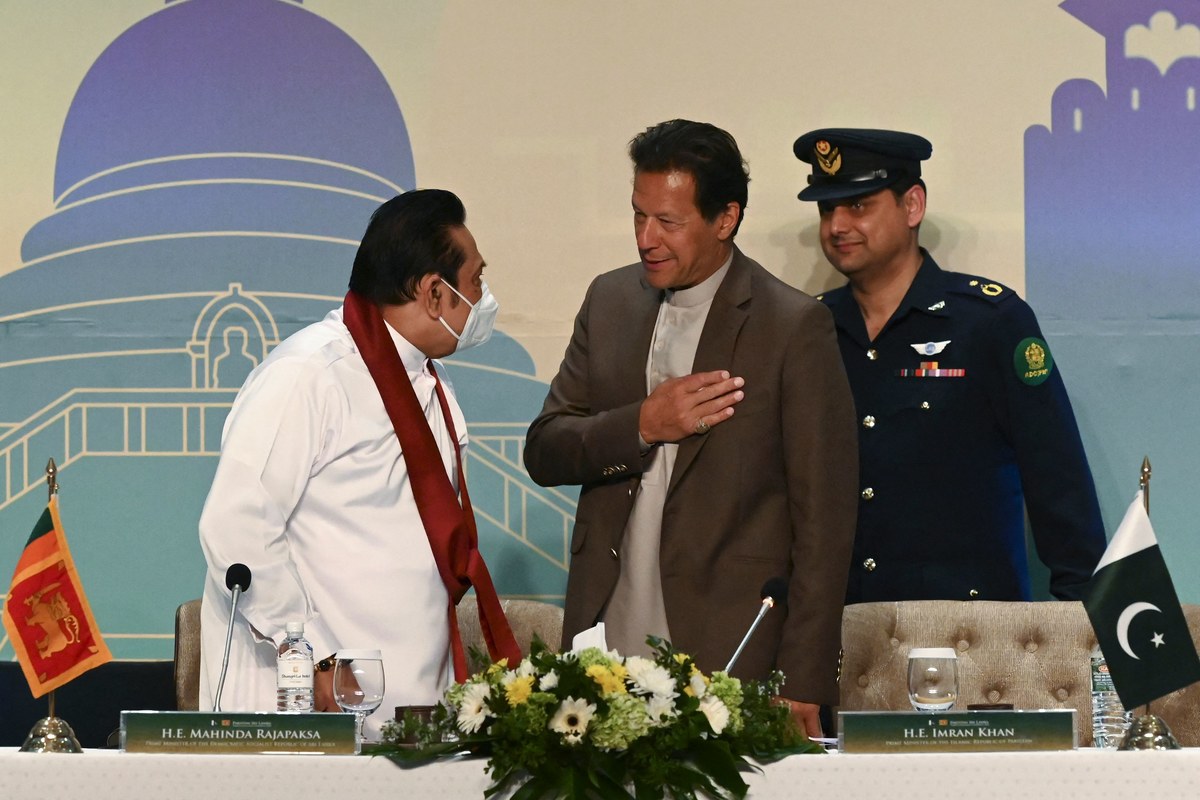


Pakistan's Prime Minister Imran Khan (C) and his Sri Lankan counterpart Mahinda Rajapaksa (L) gesture at the end of the Trade and Investments conference in Colombo on February 24, 2021 on the second day of Khan's official visit to Sri Lanka. (AFP)

On Wednesday, in talks with President Gotabaya Rajapaksa and during a speech at the Pakistan-Sri Lanka Trade and Investment Conference, the Pakistani prime minister highlighted Buddhist heritage sites of the Gandhara civilization that existed in northwestern Pakistan from the middle of the first millennium BCE to the beginning of the second millennium CE.

"For people in Sri Lanka, what is of great interest is the Gandhara Buddhist civilization ... We have discovered various new sites for tourists to visit Pakistan," Khan told delegates in Colombo.

"The findings will be of interest to Sri Lankan tourists who go to historical places," he said, adding that they include a 40-foot sleeping Buddha statue.

Buddhists account for more than 70 percent of Sri Lanka’s 22 million population. Ethnic minority Tamils, who are mainly Hindu, comprise about 15 percent and 9 percent are Muslims.

Khan said his Colombo visit was aimed at strengthening bilateral relations, especially trade and economic ties through enhanced connectivity, and that Sri Lanka could benefit from the $62 billion China Pakistan Economic Corridor (CPEC) project of infrastructure and energy projects.

"Pakistan is part of the One Belt and Road initiative of China and CPEC is one of its flagship programs, and it means connectivity and it would help enhance Sri Lanka's connectivity right up to Central Asia," he said.

In a joint communique after the visit, Pakistan and Sri Lanka announced they had signed five memorandums of understanding to increase cooperation in the field of tourism, investment, chemical and biological sciences, industrial technology and education.

They said they had also "stressed the importance of realizing the goal of achieving US$1 billion bilateral trade target" and agreed to deepen their free-trade agreement (FTA) which came into force in 2005.

Despite the FTA, the two-way trade currently stands at only $460 million.


Saudi company eyes multi-sector projects in Pakistan worth $200 million each — ministry

Updated 58 min 56 sec ago
Follow

Saudi company eyes multi-sector projects in Pakistan worth $200 million each — ministry

  • Delegation from Saudi firm Kyan explores investment in energy, mining, IT and agriculture
  • Talks come amid Pakistan’s push to attract Gulf capital and boost foreign investment inflows

ISLAMABAD: A Saudi company is exploring potential multi-sector investment projects in Pakistan with an estimated minimum value of $200 million per scheme, Pakistan’s ministry of information said on Wednesday.

The development comes as Pakistan seeks to attract increased foreign direct investment from Gulf countries, particularly Saudi Arabia, as part of efforts to stabilize its economy, improve investor confidence and expand industrial capacity. Saudi Arabia has in recent years pledged billions of dollars in potential investments across Pakistan’s mining, energy and infrastructure sectors, though several projects remain at exploratory or negotiation stages.

According to the ministry of Information, a delegation from Saudi firm Kyan visited Islamabad and expressed interest in investing in sectors including energy, mining, information technology, agriculture and livestock. The delegation participated in the “Indus AI Week” organized by the Ministry of Information Technology and Telecommunication and held meetings with Federal Minister for Board of Investment Qaiser Ahmed Sheikh.

“The delegation shared proposals for various potential projects with an estimated minimum investment of USD 200 million for each project and also conveyed their interest in bringing additional Saudi investors to Pakistan,” the information ministry said. 

Welcoming the delegation, Sheikh highlighted Pakistan’s market size and geographic position.

“With a population of over 250 million, Pakistan represents a large and dynamic market,” the minister said, adding that the country’s location provides access to landlocked Central Asian states, making it an attractive hub for regional trade and investment.

The ministry statement said the Board of Investment offered facilitation through its Business Facilitation Center, which provides a single-window mechanism for investor approvals and coordination. Sheikh also assured the delegation of support in arranging meetings with the business community and visits to Special Economic Zones, where incentives include income tax and import duty exemptions.

The minister referred to recent engagements between Pakistani and Saudi officials and reiterated that both countries could work to unlock new avenues of bilateral investment and economic cooperation, according to the statement.

Saudi Arabia is among Pakistan’s largest sources of worker remittances and has emerged as a key partner in Islamabad’s efforts to secure external financing and long-term investment commitments in recent years.