US seeks to extend, strengthen Iran nuclear pact despite Khamenei defiance

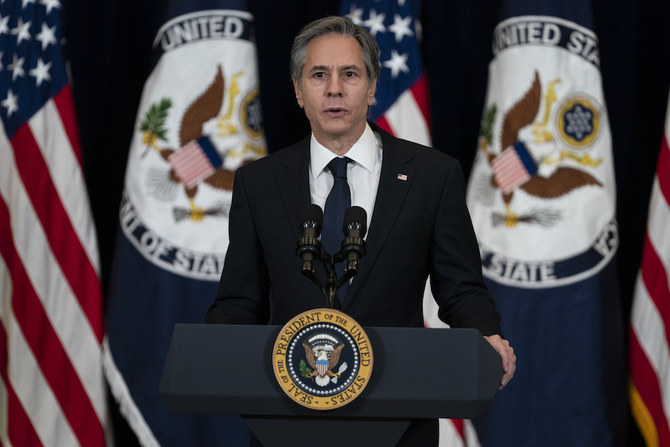
Secretary of State Antony Blinken said the US is prepared to return to the Iran nuclear deal if Tehran shows ‘strict compliance’ with it. (File/Reuters)
Short Url
Updated 23 February 2021
Follow

US seeks to extend, strengthen Iran nuclear pact despite Khamenei defiance

  • Supreme Leader said Iran could boost uranium enrichment to 60%
  • US remains committed to ensuring Iran never acquires a nuclear weapon

LONDON: The United States will seek to strengthen and extend the agreement between world powers and Iran aimed at curbing its nuclear program, Secretary of State Antony Blinken said on Monday.
It’s a new sign of Washington’s ambition to revive the 2015 nuclear deal rejected by former President Donald Trump even as Tehran appears to be backing further away from it.
The UN nuclear watchdog said on Sunday it had struck a deal with Iran to cushion the blow of steps Tehran plans to take this week that include ending snap inspections, with both sides agreeing to keep “necessary” monitoring for up to three months.
The announcement by International Atomic Energy Agency (IAEA) chief Rafael Grossi, made at Vienna airport after a weekend trip to Iran, confirmed that Tehran would go ahead with its plan to slash cooperation with the agency on Tuesday.
Blinken, addressing the UN-sponsored Conference on Disarmament in Geneva, said in a pre-recorded speech: “The United States remains committed to ensuring that Iran never acquires a nuclear weapon. Diplomacy is the best path to achieve that goal.”
US President Joe Biden has said that if Iran comes back into “strict compliance” with the 2015 pact, his administration will do the same, Blinken said.
“Working with allies and partners, we will also seek to lengthen and strengthen the JCPOA (Joint Comprehensive Plan of Action) and address other areas of concern, including Iran’s destabilizing regional behavior and ballistic missile development and proliferation,” Blinken said.
“Iran must comply with its safeguards agreements with the IAEA and its international obligations,” he added.
White House press secretary Jenn Psaki said USallies in Europe are still waiting a response from Iran on the European Union’s offer to host an informal meeting between current members of the nuclear deal and the US.
Iran has slowly walked away from all the nuclear deal’s limitations on its stockpile of uranium and has begun enriching up 20%, a technical step away from weapons-grade levels.
Supreme Leader Ayatollah Ali Khamenei said on Monday Iran might enrich uranium up to 60% purity if the country needed it and would never yield to US pressure over its nuclear activity, state television reported.
Iran’s 2015 nuclear deal with six powers caps the fissile purity to which Tehran can refine uranium at 3.67%, well under the 20% achieved before the agreement and far below the 90% suitable for a nuclear weapon.
“Iran’s uranium enrichment level will not be limited to 20%. We will increase it to whatever level the country needs...We may increase it to 60%,” the TV quoted Khamenei as saying.

Khamenei also repeated a denial of any Iranian intent to weaponize uranium enrichment.
“Our respected government did not abandon its commitments and gradually reduced some of them, which are still reversible in the case that they return to their responsibilities,” he said.
Moreover, Iran said on Monday it will end at 2030 GMT the implementation of the Additional Protocol that allows the UN nuclear watchdog to carry out snap-inspections at sites not declared to the agency, the semi-official Tasnim news agency reported.
“As of midnight tonight (2030 GMT), we will not have... commitments beyond safeguards. Necessary orders have been issued to the nuclear facilities,” Tasnim quoted Kazem Gharibabadi, Iran’s envoy at the IAEA as saying.
US State Department spokesman Ned Price said Khamenei’s comment about uranium enrichment “sounds like a threat” and declined to respond to what he described as “hypotheticals” and “posturing.”
Price also reiterated US willingness to engage in talks with Iran.
French Foreign Affairs Minister Jean-Yves Le Drian told his EU colleagues during a meeting in Brussels that the situation regarding Iran’s nuclear program is “worrying,” his ministry said on Monday.
(With AP, AFP and Reuters)

Soleimani’s shadow
Qassem Soleimani left a trail of death and destruction in his wake as head of Iran’s Quds Force … until his assassination on Jan. 3, 2020. Yet still, his legacy of murderous interference continues to haunt the region

Enter


keywords

First Ramadan after truce brings flicker of joy in devastated Gaza

Updated 55 min 51 sec ago
Follow

First Ramadan after truce brings flicker of joy in devastated Gaza

  • Ramadan lanterns and string lights appear on streets lined with collapsed buildings and piles of rubble in Gaza City
  • The first holy month since the October ceasefire brings mixed feelings for the many still living in tents

GAZA CITY: Little Ramadan lanterns and string lights appeared on streets lined with collapsed buildings and piles of rubble in Gaza City, bringing joy and respite as Islam’s holiest month began — the first since October’s ceasefire.
In the Omari mosque, dozens of worshippers performed the first Ramadan morning prayer, fajr, bare feet on the carpet but donning heavy jackets to stave off the winter cold.
“Despite the occupation, the destruction of mosques and schools, and the demolition of our homes... we came in spite of these harsh conditions,” Abu Adam, a resident of Gaza City who came to pray, told AFP.
“Even last night, when the area was targeted, we remained determined to head to the mosque to worship God,” he said.
A security source in Gaza told AFP Wednesday that artillery shelling targeted the eastern parts of Gaza City that morning.
The source added that artillery shelling also targeted a refugee camp in central Gaza.
Israel does not allow international journalists to enter the Gaza Strip, preventing AFP and other news organizations from independently verifying casualty figures.

‘Stifled joy’

In Gaza’s south, tens of thousands of people still live in tents and makeshift shelters as they wait for the territory’s reconstruction after a US-brokered ceasefire took hold in October.
Nivin Ahmed, who lives in a tent in the area known as Al-Mawasi, told AFP this first Ramadan without war brought “mixed and varied feelings.”
“The joy is stifled. We miss people who were martyred, are still missing, detained, or even traveled,” she said.
“The Ramadan table used to be full of the most delicious dishes and bring together all our loved ones,” the 50-year-old said.
“Today, I can barely prepare a main dish and a side dish. Everything is expensive. I can’t invite anyone for Iftar or suhoor,” she said, referring to the meals eaten before and after the daily fast of Ramadan.
Despite the ceasefire, shortages remain in Gaza, whose battered economy and material damage have rendered most residents at least partly dependent on humanitarian aid for their basic needs.
But with all entries into the tiny territory under Israeli control, not enough goods are able to enter to bring prices down, according to the United Nations and aid groups.

‘Still special’

Maha Fathi, 37, was displaced from Gaza City and lives in a tent west of the city.
“Despite all the destruction and suffering in Gaza, Ramadan is still special,” she told AFP.
“People have begun to empathize with each other’s suffering again after everyone was preoccupied with themselves during the war.”
She said that her family and neighbors were able to share moments of joy as they prepared food for suhoor and set up Ramadan decorations.
“Everyone longs for the atmosphere of Ramadan. Seeing the decorations and the activity in the markets fills us with hope for a return to stability,” she added.
On the beach at central Gaza’s Deir el-Balah, Palestinian artist Yazeed Abu Jarad contributed to the holiday spirit with his art.
In the sand near the Mediterranean Sea, he sculpted “Welcome Ramadan” in ornate Arabic calligraphy, under the curious eye of children from a nearby tent camp.
Nearly all of Gaza’s 2.2 million residents were displaced at least once during the more than two years of war between Israel and Hamas, sparked by the latter’s unprecedented October 7 attack on Israel.
Mohammed Al-Madhoun, 43, also lives in a tent west of Gaza City, and hoped for brighter days ahead.
“I hope this is the last Ramadan we spend in tents. I feel helpless in front of my children when they ask me to buy lanterns and dream of an Iftar table with all their favorite foods.”
“We try to find joy despite everything,” he said, describing his first Ramadan night out with the neighbors, eating the pre-fast meal and praying.
“The children were as if they were on a picnic,” he said.