

US military chief warns Iran against ‘provocation’

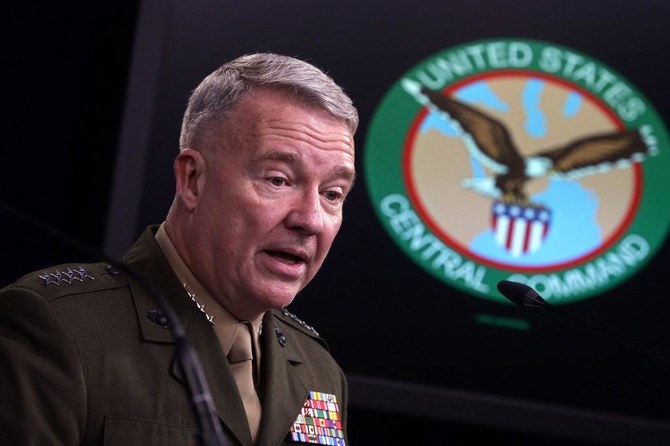
US Marine Corps Gen. Kenneth McKenzie, commander of US Central Command, participates in a press briefing Oct. 30, 2019 at the Pentagon in Arlington, Virginia. (File/AFP)
Short Url
Updated 23 February 2021
Follow

US military chief warns Iran against ‘provocation’

  • No one can stop Tehran acquiring a nuclear weapon, Khamenei says

JEDDAH: The US military chief in the Middle East has warned Iran against any provocation amid diplomatic maneuvers over Tehran’s nuclear program.
“I would think this would be a good time for everybody to behave soberly and cautiously, and see what happens,” Gen. Frank McKenzie said on a visit to Oman.
The four-star general, head of US Central Command (Centcom), did not rule out that Tehran would try to avenge Iranian warlord Qasem Soleimani, who was killed in a US drone strike in Baghdad in January 2020.
“I think there’s still a risk that they might entertain that as a course of action,” he said.
He urged Iran not to undertake any “nefarious activities” if it wanted to rebuild trust.
“I think they would want to be recognized as a responsible member of the family of nations and a stable member in the region,”
he said.
After he spoke, Iranian Supreme Leader Ayatollah Ali Khamenei said Tehran would enrich uranium up to any purity the country needed, and would never yield to US pressure over its nuclear work.
“Iran’s uranium enrichment level will not be limited to 20 percent. We will increase it to whatever level the country needs. We may increase it to 60 percent,” he said.
Khamenei claimed Tehran had never sought a nuclear weapon but if it wanted to, “no one could stop us from acquiring it.”
The supreme leader spoke after Iranian officials reached a compromise agreement with the International Atomic Energy Agency over access for UN inspectors to Iran’s nuclear facilities.
US President Joe Biden, European powers and Tehran are trying to revive Iran’s 2015 nuclear agreement, which collapsed when Donald Trump withdrew from it in 2018.
Since then the US has reimposed sanctions that were eased under the deal, while Iran has incrementally breached its obligations. Each side insists that the other should return to compliance first.
Iran threatened to restrict IAEA inspections of its nuclear facilities from Feb. 23 unless the US lifted sanctions, but IAEA chief Rafael Grossi held last-ditch talks in Tehran at which the two sides reached a technical agreement for up to three months.
Grossi said that under the temporary deal there was less access, but the IAEA would be able to “retain the necessary degree of monitoring and verification work.”

Soleimani’s shadow
Qassem Soleimani left a trail of death and destruction in his wake as head of Iran’s Quds Force … until his assassination on Jan. 3, 2020. Yet still, his legacy of murderous interference continues to haunt the region

Enter


keywords

Israel police to deploy around Al-Aqsa for Ramadan, Palestinians report curbs

Updated 17 February 2026
Follow

Israel police to deploy around Al-Aqsa for Ramadan, Palestinians report curbs

  • The Al-Aqsa compound is a central symbol of Palestinian identity and also a frequent flashpoint

JERUSALEM: Israeli police said Monday that they would deploy in force around the Al-Aqsa Mosque during the Muslim holy month of Ramadan, which begins this week, as Palestinian officials accused Israel of imposing restrictions at the compound.
Over the course of the month of fasting and prayer, hundreds of thousands of Palestinians traditionally attend prayers at Al-Aqsa — Islam’s third-holiest site, located in east Jerusalem, which Israel captured in 1967 and later annexed.
Arad Braverman, a senior Jerusalem police officer, said forces would be deployed “day and night” across the compound, known to Jews as the Temple Mount, and in the surrounding area.
He said thousands of police would also be on duty for Friday prayers, which draw the largest crowds of Muslim worshippers.
Braverman said police had recommended issuing 10,000 permits for Palestinians from the occupied West Bank, who require special permission to enter Jerusalem.
He did not say whether age limits would apply, adding that the final number of people would be decided by the government.
The Palestinian Jerusalem Governorate said in a separate statement it had been informed that permits would again be restricted to men over 55 and women over 50, mirroring last year’s criteria.
It said Israeli authorities had blocked the Islamic Waqf — the Jordanian?run body administering the site — from carrying out routine preparations, including installing shade structures and setting up temporary medical clinics.
A Waqf source confirmed the restrictions and said 33 of its employees had been barred from entering the compound in the week before Ramadan.
The Al-Aqsa compound is a central symbol of Palestinian identity and also a frequent flashpoint.
Under long?standing arrangements, Jews may visit the compound — which they revere as the site of their second temple, destroyed by the Romans in 70 AD — but they are not permitted to pray there.
Israel says it is committed to maintaining this status quo, though Palestinians fear it is being eroded.
Braverman reiterated Monday that no changes were planned.
In recent years, a growing number of Jewish ultranationalists have challenged the prayer ban, including far?right politician Itamar Ben-Gvir, who prayed at the site while serving as national security minister in 2024 and 2025.