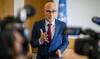
New Libyan PM seeks to develop ties with Italy

Libya’s new Prime Minister Abdul Hamid Dbeibah has expressed his wish to develop ties with Italy. (File/AFP)
Short Url
Updated 21 February 2021
Follow

New Libyan PM seeks to develop ties with Italy

ROME: Libya’s new Prime Minister Abdul Hamid Dbeibah has expressed his wish to develop ties with Italy, including increasing cooperation in managing migration in the Mediterranean.

“We intend to develop our privileged relationship with neighboring Italy, as we share many common challenges, including the management of migration,” tweeted Dbeibah, who congratulated  Italy’s new Prime Minister Mario Draghi for his new government.

“With Italy we have many opportunities for economic integration. We congratulate Draghi for having taken the post of head of government. We wish him success in his mission.”

Dbeibah’s comments came after the head of the new Presidential Council of Libya, Mohammad Younes Menfi, met with Italy’s ambassador to his country, Giuseppe Buccino Grimaldi, in Tripoli.

According to Italian Embassy sources in Tripoli, Menfi expressed to Grimaldi “his appreciation to Italy for keeping operational the embassy during the war.”

Menfi also expressed his hopes “for even stronger cooperation between Italy and Libya as part of the special relationship between the peoples” of the two countries. He said he intends to visit Rome as soon as possible.



Netanyahu vows independence of commission of inquiry into Oct 7

Updated 4 sec ago
Follow

Netanyahu vows independence of commission of inquiry into Oct 7

  • Polls show more than 70 percent of Israelis want a state commission of inquiry independent of the government, like those set up in the past to investigate major state-level failings

JERUSALEM: Israeli Prime Minister Benjamin Netanyahu hailed a government decision Monday to establish a commission of inquiry into the October 7 attack, assuring the public that it would not be subject to political influence.
“Today the Ministerial Committee for Legislation approved the bill to establish a special state commission of inquiry,” Netanyahu said in a video statement.
“This will be a balanced committee to investigate the events of October 7 and the circumstances that led to them.”
“Contrary to what has been claimed, politicians will not serve on the commission. The composition of the commission will be determined on an equal basis: half by the coalition and half by the opposition,” he said.
The opposition and much of the Israeli public have called for an independent inquiry into the events leading up to and including the 2023 Hamas attack, which resulted in the deaths of 1,221 people, according to an AFP tally based on official figures.
Polls show more than 70 percent of Israelis want a state commission of inquiry independent of the government, like those set up in the past to investigate major state-level failings.
The one established after the October 1973 Arab-Israeli war led to the resignation of then prime minister Golda Meir in June 1974.
The decision to create a state commission rests with the government, but its members must be appointed by the president of the supreme court.
But Netanyahu’s ruling coalition, one of the most right-wing governments in the country’s history, has accused the court of political bias.
The premier nonetheless vowed that “the commission will be made up of experts in security, academia, and law, as well as bereaved parents who will serve as observers.”
A commission appointed only by the government or only by the president of the supreme court “would enjoy the confidence of only part of the public,” he said.
The premier acknowledged that the mandate of the commission and the scope of the probe would be set by the government, noting that “this is not unusual” and that he would agree to being investigated.
Netanyahu has never admitted responsibility for any of the decisions that led to the October 7 attack, despite repeated calls from the opposition to do so.
Opposition leader Yair Lapid slammed the move, noting that it would allow the government to have “control over the hearings, the summoned witnesses, and the agenda.”
“This is not an inquiry committee, this is a death certificate for the truth,” Lapid said during a meeting at the Knesset, Israel’s parliament.
The establishment of the commission will only be finalized after a vote in parliament.