

NASA confirms Perseverance rover has landed on Mars

1 / 2
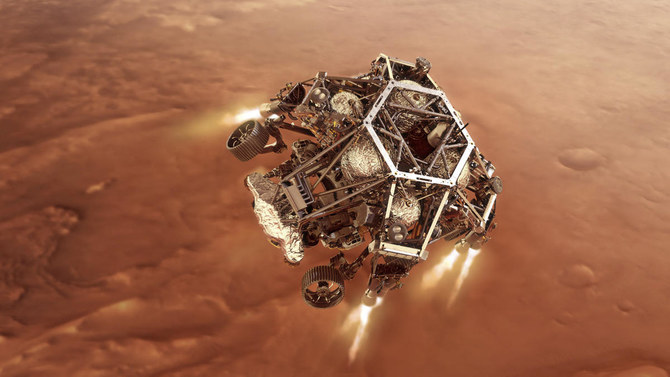
Members of NASA’s Perseverance rover as it landed on the surface of Mars on February 18, 2021 after successfully overcoming a risky landing phase known as the "seven minutes of terror." (AFP/NASA/JPL)
2 / 2
After a seven-month journey, NASA's Perseverance rover touched down on Mars on February 18, 2021. (AFP/NASA/JPL/Illustration)
Short Url
Updated 19 February 2021
Follow

NASA confirms Perseverance rover has landed on Mars

  • Will attempt to collect 30 rock and soil samples to be sent back to Earth sometime in the 2030s
  • Landing comes week after UAE’s Hope probe entered Red Planet’s orbit

WASHINGTON DC: NASA said Thursday that the Perseverance rover has touched down on the surface of Mars after successfully overcoming a risky landing phase known as the “seven minutes of terror.”
“Touchdown confirmed,” said operations lead Swati Mohan at around 3:55 p.m. Eastern Time (2055 GMT) as mission control at NASA’s Jet Propulsion Laboratory headquarters erupted in cheers.
The autonomously-guided procedure was completed more than 11 minutes earlier, which is how long it takes for radio signals to return to Earth.

READ MORE: How the UAE’s Mars mission can be the Arab world’s springboard to the future

“WOW!!” tweeted NASA Associate Administrator Thomas Zurburchen as he posted the Perseverance’s first black and white image from the Jezero Crater in Mars’ northern hemisphere.
The rover is only the fifth ever to set its wheels down on Mars. The feat was first accomplished in 1997 and all so far have been American.
About the size of an SUV, it weighs a ton, is equipped with a seven foot (two meter) long robotic arm, has 19 cameras, two microphones, and a suite of cutting-edge instruments to assist in its scientific goals.

READ MORE: UAE’s ‘Hope’ probe sends home first image of Mars

Perseverance now embarks on a multi-year mission to search for the biosignatures of microbes that might have existed there billions of years ago, when conditions were warmer and wetter than they are today.
Starting from summer, it will attempt to collect 30 rock and soil samples in sealed tubes, to be eventually sent back to Earth sometime in the 2030s for lab analysis.
“The question of whether there’s life beyond Earth is one of the most fundamental and essential questions we can ask,” said NASA geologist Katie Stack Morgan.

READ MORE: Arab world basks in the glory of UAE Mars mission triumph

“Our ability to ask this question and develop the scientific investigations and technology to answer it is one of the things that make us as a species so unique.”
NASA also wants to run several eye-catching experiments — including attempting the first powered flight on another planet, with a helicopter drone called Ingenuity that will have to achieve lift in an atmosphere that’s one percent the density of Earth’s.


Trump says ‘my own morality’ is only restraint on global power

Updated 13 sec ago
Follow

Trump says ‘my own morality’ is only restraint on global power

  • On Thursday the Senate advanced a measure to rein in presidential military action in Venezuela

WASHINGTON, United States: US President Donald Trump said in an interview published Thursday that his “own morality” was the only constraint on his power to order military actions around the world.
Trump’s comments to The New York Times came days after he launched a lightning operation to topple Venezuelan leader Nicolas Maduro, and threatened a host of other countries plus the autonomous territory Greenland.
“Yeah, there is one thing. My own morality. My own mind. It’s the only thing that can stop me,” Trump told the newspaper when asked if there were any limits on his global powers.
“I don’t need international law,” he added. “I’m not looking to hurt people.”
The Republican president then added that “I do” need to abide by international law, but said “it depends what your definition of international law is.”
The United States is not a member of the International Criminal Court (ICC), which tries war criminals, and it has repeatedly rejected decisions by the International Court of Justice (ICJ), the UN’s top court.
Trump himself has had his own run-ins with domestic law, having been impeached twice, faced a slew of federal charges including conspiring to overturn the 2020 election — which were eventually dropped after his re-election — and convicted for covering up a hush money payment to a porn star.
While proclaiming himself as “peace president” and seeking the Nobel Prize, Trump has launched a series of military operations in his second presidential term.
Trump ordered attacks on Iran’s nuclear program in June and in the past year has also overseen strikes on Iraq, Nigeria, Somalia, Syria, Yemen — and most recently on Venezuela.
Since Maduro’s capture, an emboldened Trump has threatened a string of other countries including Colombia, as well as Greenland, which is administered by fellow NATO member Denmark.
Asked whether his priority was preserving the NATO military alliance or acquiring Greenland, Trump told the Times: “it may be a choice.”
Some members of Congress, including a handful of Republicans, are trying to check Trump’s power.
On Thursday the Senate advanced a measure to rein in presidential military action in Venezuela. But even if it reaches his desk, Trump would likely veto it.
Billionaire Trump, who made his fortune as a property developer, added that US ownership of Greenland is “what I feel is psychologically needed for success.”
Trump said separately that he had no problem with his family conducting foreign business deals since his return to office.
“I prohibited them from doing business in my first term, and I got absolutely no credit for it,” Trump told the daily. “I found out that nobody cared, and I’m allowed to.”