

Little-known, uniquely Pakistani ‘boat art’ brings color to Arabian Sea

Artist Abdul Aziz paints a fishing boat at the Ibrahim Hyderi fish harbor in the Pakistani coastal city of Karachi, Pakistan, on Friday, February 12, 2021. (AN Photo)
Short Url
Updated 18 February 2021
Follow

Little-known, uniquely Pakistani ‘boat art’ brings color to Arabian Sea

  • Pakistan Fisherfolk Forum says most of 15,000 fishing vessels sailing along Sindh coastline are decorated but the local craft is yet to be recognized as art
  • Experts say while truck art can be found in Pakistan, India and other nations, boat art was a uniquely Pakistani tradition

KARACHI: In Pakistan, where traditional truck art adds color and humor to the landscape of roads, another unique but little-known form of ornamentation has emerged on its coast: boat art, which lends beauty to fishing boats sailing the Arabian Sea.
According to Muhammad Ali Shah, chairman of the Pakistan Fisherfolk Forum (PFF), most of the 15,000 fishing vessels sailing along the 350-kilometer coastline of Sindh province are decorated, but the local craft has yet to be recognized as art.
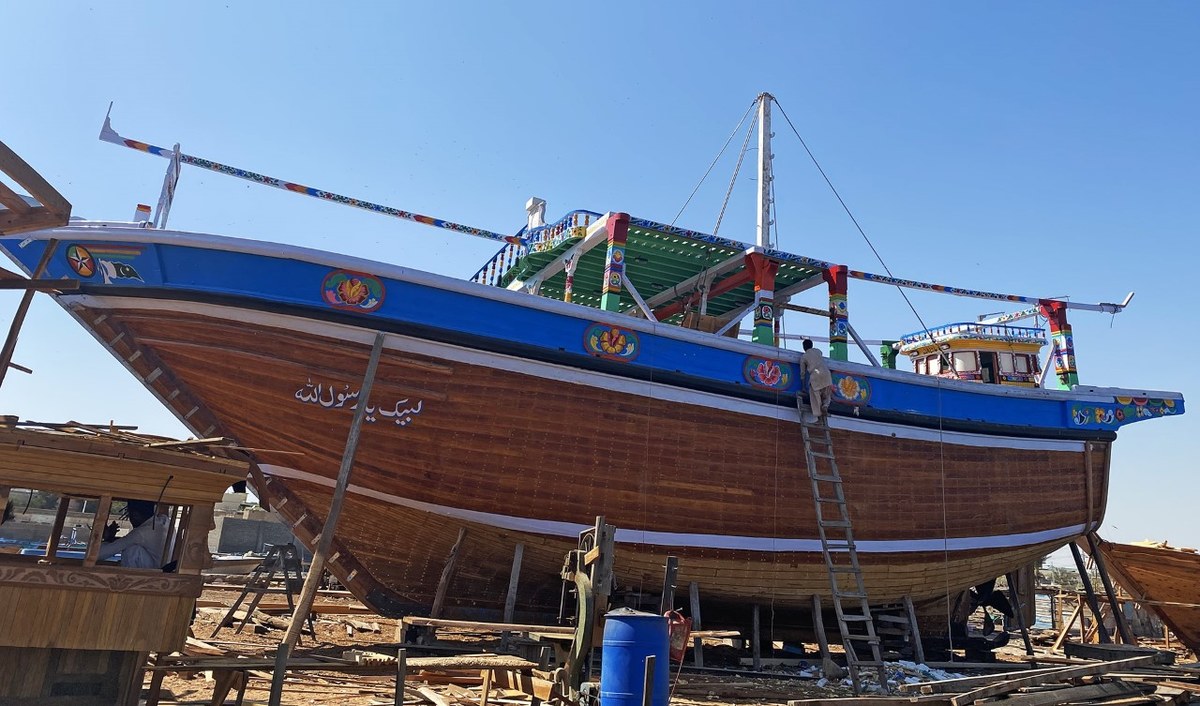


Closeup of artwork on a fishing boat at the Ibrahim Hyderi fish harbor in the Pakistani coastal city of Karachi on Friday, February 12, 2021 (AN Photo)

While it is difficult to establish when the tradition of painting boats with floral and marine patterns began, artists in Pakistan’s port city of Karachi say it emerged in Ibrahim Hyderi, a fishing village in Korangi district of Pakistan’s seaside metropolis, Karachi. A known figure, who some say is a pioneer, is Abdul Aziz, who has been painting boats for 50 years.
“My father used to paint boats for decades, and now I’ve taught the craft to my sons and apprentices,” the artist, affectionately called Ustad Aziz, told Arab News.
He learnt to paint when he was 12 and since then boat art has been his source of livelihood.
“The art of painting fishing boats started in Ibrahim Hyderi area, following which other fishermen communities also adopted the art,” said Shoaib Ali, one of Aziz’s pupils.
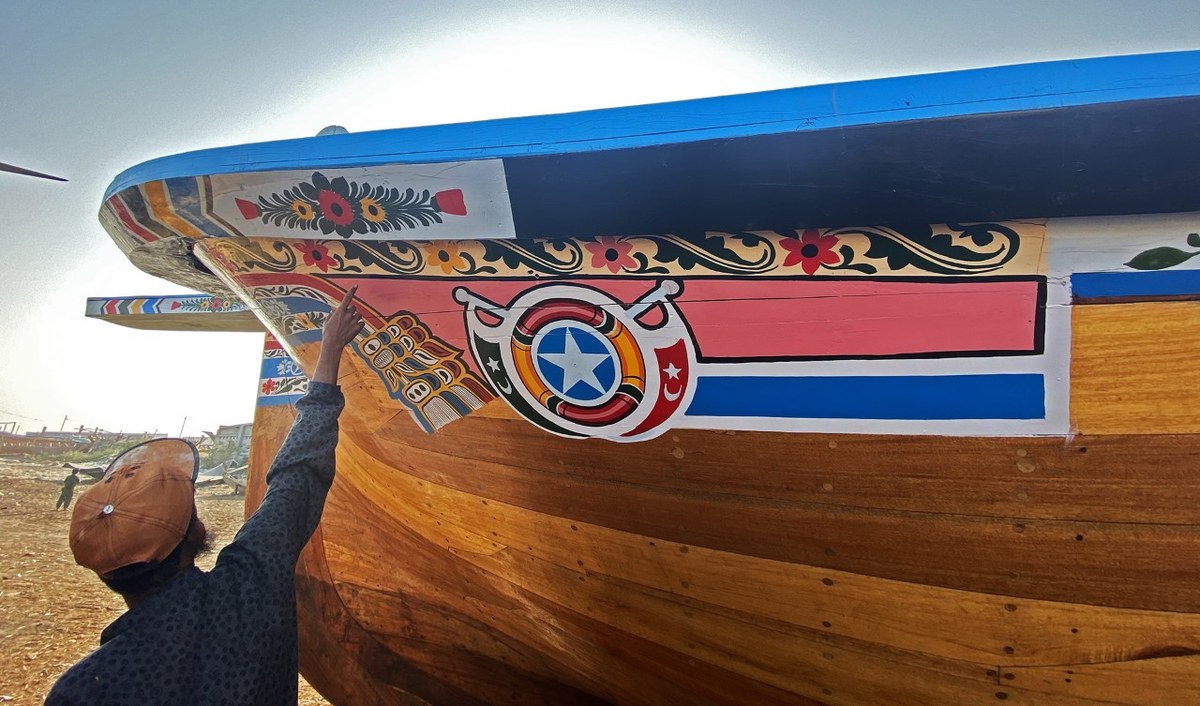


Artist Shoaib Ali points to boat art on a boat at the Ibrahim Hyderi fish harbor in the Pakistani coastal city of Karachi on Friday, February 12, 2021. (AN Photo)

Colors and designs are traditionally similar, but “some patterns act as geographical markers of their point of origin,” Ali said. A trained eye will be able to distinguish which vessels come from Ibrahim Hyderi, and which from other nearby regions such as Keti Bandar, Gharochan, Badin and Somiani.
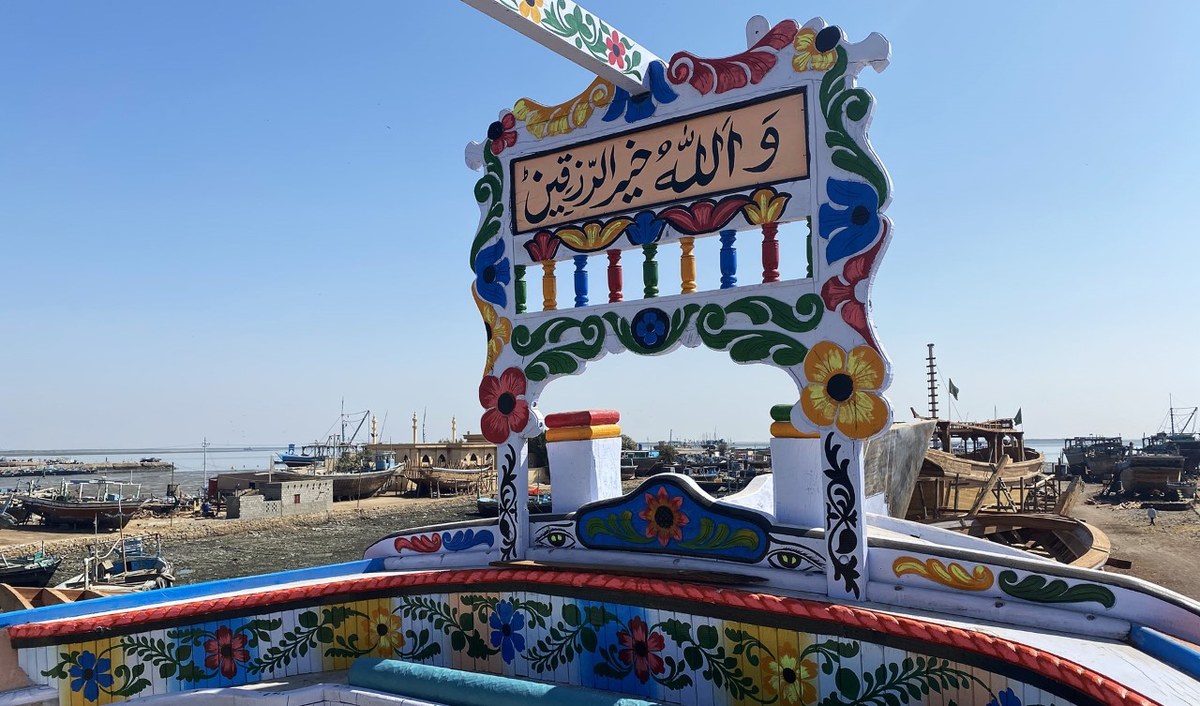


Closeup of artwork on a fishing boat at the Ibrahim Hyderi fish harbor in the Pakistani coastal city of Karachi on Friday, February 12, 2021 (AN Photo)

Filmmaker and artist Sharjil Baloch said while truck art could be found in Pakistan, India and around the world, boat art was a uniquely Pakistani tradition.
Indian boats are simple, he said, and only used basic matte coating to protect the wood from the impact of climate and water.
At first glance similar to truck art, boat art, Baloch said, was quite distinctive: “The shape of a boat is different, so the template is automatically different. Then you see truck art with landscapes, but here you’ll see seascapes.”
He added: “The way they decorate them, make detailed designs gives them their own identity.”
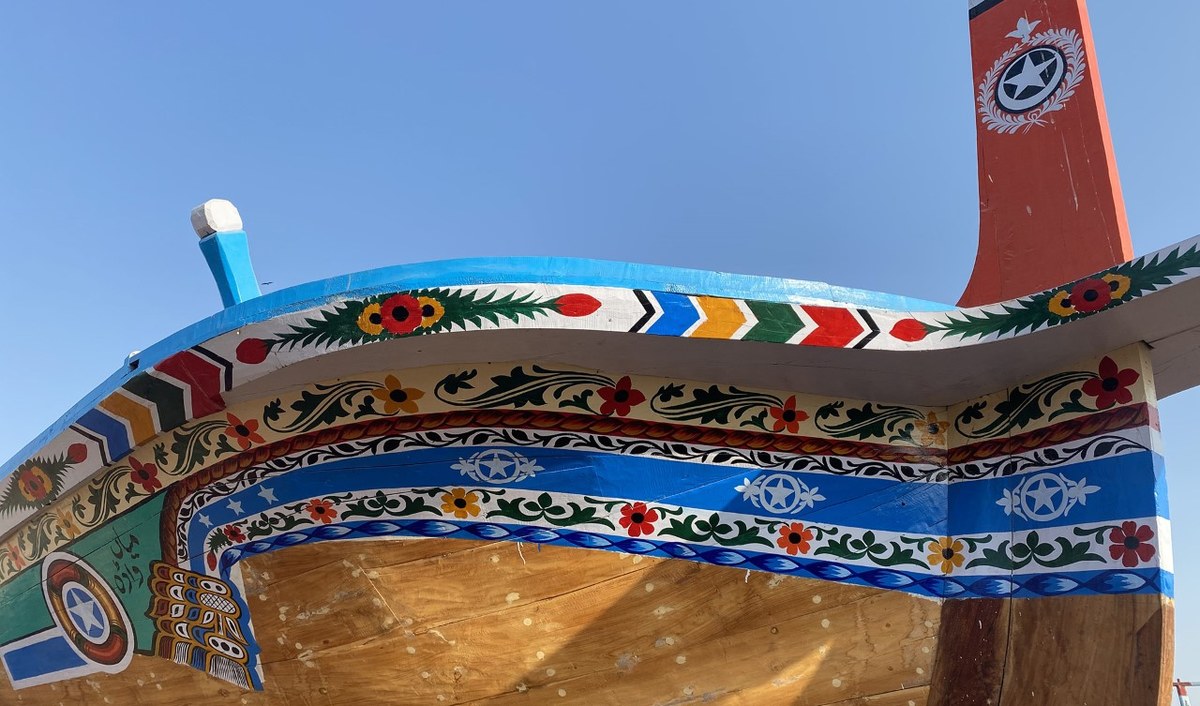


A Romal, a symbol of boat art on Sindh’s coastline, is seen on a boat at the Ibrahim Hyderi fish harbor in Pakistan's coastal city of Karachi on Friday, February 12, 2021. (AN Photo)

Jatin Desai, an Indian journalist and activist who has been working with fishermen, also said boat art was unknown in India.
“Be it from Gujarat or elsewhere in the country,” he said, “there is no artwork on Indian fishing boats.”


IMF board to meet tomorrow to consider $1.2 billion disbursement for Pakistan

Updated 11 sec ago
Follow

IMF board to meet tomorrow to consider $1.2 billion disbursement for Pakistan

  • Pakistan, IMF reached a Staff-Level Agreement for second review of $7 billion loan program 
  • Economists view disbursement crucial for cash-strapped Pakistan as it tackles economic crisis

ISLAMABAD: The International Monetary Fund’s (IMF) Executive Board will meet tomorrow, Monday, to consider and approve a $1.2 billion disbursement for Pakistan, according to the global lender’s official schedule. 

The meeting takes place nearly two months after the Fund reached a Staff-Level Agreement (SLA) with Pakistan for the second review of its $7 billion Extended Fund Facility (EFF) and the first review of its $1.4 billion Resilience and Sustainability Facility (RSF). 

The SLA followed a mission led by IMF’s Iva Petrova, who held discussions with Pakistani authorities during a Sept. 24–Oct. 8 visit to Karachi, Islamabad and Washington, DC.

“The International Monetary Fund’s (IMF) Executive Board will convene on Dec. 8 to consider Pakistan’s request for a $1.2 billion disbursement under the Extended Fund Facility (EFF) and the Resilience and Sustainability Facility (RSF), according to the Fund’s updated schedule,” the state-run Pakistan TV reported on Sunday.

Economists view IMF’s bailout packages as crucial for cash-strapped Pakistan, which has relied heavily on financing from bilateral partners such as Saudi Arabia, China and the United Arab Emirates, as well as multilateral lenders including the IMF, World Bank, Asian Development Bank and Islamic Development Bank. 

The South Asian country has been grappling with a prolonged macroeconomic crisis that has drained its financial resources and triggered a balance of payments crisis. Islamabad, however, has recorded some financial gains since 2022, which include recording a surplus in its current account and bringing inflation down considerably. 

Speaking to Arab News last month, Pakistan’s former finance adviser Khaqan Najeeb said the $1.2 billion disbursement will further stabilize Pakistan’s near-term external position and unlock additional official inflows. 

“Continued engagement also reinforces macro stability, as reflected in recent improvements in inflation, the current account, and reserve buffers,” Najeeb said. 

Pakistan came close to sovereign default in mid-2023, when foreign exchange reserves fell below three weeks of import cover, inflation surged to a record 38 percent in May, and the country struggled to secure external financing after delays in its IMF program. Fuel shortages, import restrictions, and a rapidly depreciating rupee added to the pressure, while ratings agencies downgraded Pakistan’s debt and warned of heightened default risk.

The crisis eased only after Pakistan reached a last-minute Stand-By Arrangement with the IMF in June 2023, unlocking emergency support and preventing an immediate default.