

Riyadh to host global energy leaders after ‘unparalleled’ year

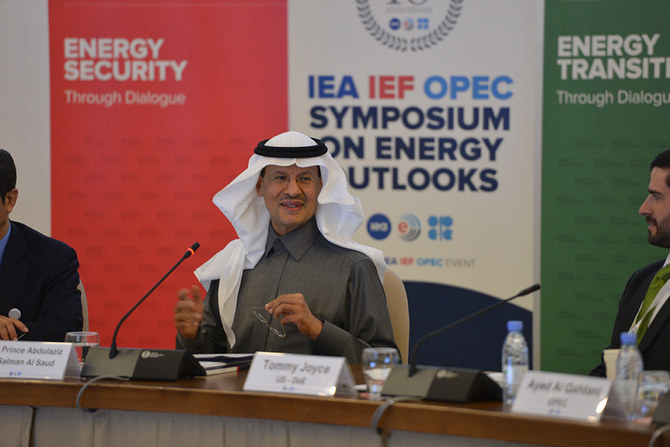
The symposium will be addressed by Prince Abdul Aziz Bin Salman Bin Abdulaziz, the Saudi energy minister, and will be keenly watched by the global energy industry looking for indicators of the Kingdom’s stance on oil production. (IEF.org/File Photo)
Short Url
Updated 16 February 2021
Follow

Riyadh to host global energy leaders after ‘unparalleled’ year

  • Coronavirus disease pandemic fallout and shifting global energy policies at top of agenda

DUBAI: Leaders of the global energy industry will gather in a virtual session organized by the International Energy Forum (IEF) in Riyadh to discuss the way forward after the most tumultuous year in energy history.

“The COVID-19 (coronavirus disease) pandemic impact on energy demand and supply balances is unparalleled in the history of energy markets,” a report from the IEF said ahead of the 11th symposium on energy outlooks, which brings together the International Energy Agency (IEA), the Organization of Petroleum Exporting Countries (OPEC), as well as gas and renewable industry bodies.

“The structural energy policy and market shifts that COVID-19 brings shall influence future energy supply and demand modelled in long-term scenarios,” the report added.

The IEF’s remit is to facilitate dialogue between the energy producers, mainly represented by OPEC, and consumers under the auspices of IEA.

The symposium will be addressed by Prince Abdul Aziz Bin Salman Bin Abdulaziz, the Saudi energy minister, and will be keenly watched by the global energy industry looking for indicators of the Kingdom’s stance on oil production ahead of a key meeting of the OPEC+ alliance next month.

OPEC+ participants will debate whether or not to return extra barrels to the global supply pool when the Kingdom’s surprise voluntary one million cut expires at the end of March.

Russia — Saudi Arabia’s partner in the leadership of OPEC+ — is believed to be keen to return extra barrels, in light of increased demand and rising prices.

Alexander Novak, the Russian deputy prime minister responsible for OPEC+ relations, said recently that “the market is balanced and the prices we are seeing today are in line with the market situation.”

Saudi Arabia is taking a more cautious stance, underlining the ongoing unpredictability of global markets as the pandemic continues to weigh on energy demand.

The uncertainty of the outlook will be a hot topic at the IEF symposium. “A swift and inclusive global economic recovery depends on how various public health, macroeconomic, and other variables will reinforce domestic and international energy policy, sustainable development, and climate goals,” the report said.

The two main models — from the IEA and OPEC — are subtly different in their outlooks. The IEA is predicting a 5.2 percent growth rate for the global economy in 2021, while OPEC is looking for a more modest 4.4 percent.

On India, the fastest growing energy user of the big economic powers, the IEA projects notably higher growth of 9.3 percent in 2021, compared to OPEC’s estimate of 6.8 percent.

There are also differences in energy demand models, with OPEC estimating a more severe impact in 2020 and a slower recovery for liquid energy products this year compared with the IEA’s forecasts.

The symposium will also discuss medium and long-term issues in global energy, including the prospect of “peak” oil demand and progress towards the climate change goals of the Paris Agreement.


Saudi economy grows 4.5% in 2025 as oil, non-oil sectors accelerate 

Updated 21 sec ago
Follow

Saudi economy grows 4.5% in 2025 as oil, non-oil sectors accelerate 

RIYADH: Saudi Arabia’s real gross domestic product expanded by 4.5 percent year on year in 2025, driven by strong growth in both oil and non-energy activities, official data showed. 

According to flash estimates released by Saudi Arabia’s General Authority for Statistics, oil activities in the Kingdom expanded by 5.6 percent in 2025 compared to the previous year, while non-oil operations and government activities rose by 4.9 percent and 0.9 percent, respectively, during the same period. 

The latest report aligns with an October outlook from the International Monetary Fund, which projected Saudi Arabia’s GDP would grow by 4 percent in both 2025 and 2026. 

Earlier this month, the World Bank forecast that the Kingdom’s GDP is projected to expand by 4.3 percent in 2026 and 4.4 percent in 2027, up from an expected 3.8 percent in 2025. 

“The main driver of real GDP growth in 2025 was non-oil activities, which contributed 2.7 percentage points, while oil activities with 1.4 pp, government activities at 0.1 pp and net taxes on products at 0.2 pp, also contributed positively,” said GASTAT.  

Momentum accelerated toward year-end. Real GDP expanded 4.9 percent in the fourth quarter from a year earlier, led by a 10.4 percent surge in oil activities, while non-oil sectors grew 4.1 percent. Government activities contracted 1.2 percent on an annual basis in the quarter. 

“The main driver of growth in real GDP of the fourth quarter of 2025 was oil activities, which contributed 2.5 pp, non-oil activities contributed 2.3 pp and net taxes on products contributed 0.2 pp, while government activities had a negative contribution of 0.2 pp,” added the authority.  

Saudi Arabia’s seasonally adjusted real GDP recorded growth of 1.1 percent in the fourth quarter of 2025 compared to the previous three months.  

In the fourth quarter, oil activities witnessed a quarter-on-quarter growth of 1.4 percent, while non-oil activities expanded by 1.3 percent during the same period.  

Government activities, however, recorded a decline of 0.2 percent in the fourth quarter compared to the previous three months.  

Earlier this month, a separate analysis by Standard Chartered said the Kingdom’s GDP is expected to expand by 4.5 percent in 2026, outperforming the global growth average of 3.4 percent, driven by sustained momentum in both hydrocarbon and non-oil sectors.