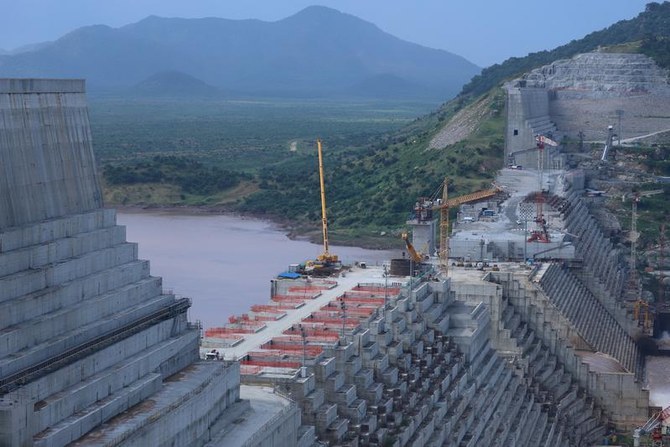

CAIRO: Egyptian Foreign Minister Sameh Shoukry confirmed that Egypt had hoped for the success of African Union efforts in managing the Grand Ethiopian Renaissance Dam (GERD) issue but negotiations had not yet yielded tangible results.
Shoukry stressed the need to reach a binding legal agreement before implementing the second phase of the filling by launching a serious negotiation process and taking into account the interests of the three countries: Egypt, Sudan and Ethiopia.
He said that Egypt had expressed a political will to reach a fair and balanced agreement that achieved development goals for Ethiopia and at the same time preserved Egypt’s rights and secured the two downstream countries from danger.
During a phone call from Finnish Foreign Minister Pekka Haavisto, Shoukry discussed the latest developments in the Horn of Africa, especially developments related to the GERD issue.
He said that Egypt was looking forward to the resumption of negotiations under the presidency of Felix Tshisekedi, president of the Republic of the Congo.
On Feb. 6, Ethiopia announced that engineering work in building the dam was 91 percent done, while the overall construction rate was 78.3 percent.
Egyptian President Abdel Fattah El-Sisi said a few days ago that Egypt rejected any action or measure that affected its rights in the Nile waters. He stressed the inevitability of reaching a binding and comprehensive legal agreement between all concerned parties that addressed Egyptian concerns.
The GERD issue has continued for years, with a failure to reach a binding agreement between the three countries.
Mohammed Abdel-Ati, minister of water resources and irrigation in Egypt, revealed the country’s water situation and the ministry’s plan to address the challenges facing the country.
“The Renaissance Dam is one of the most important challenges facing the country, in light of our dependence of 97 percent on the waters of the Nile River,” the minister said.
“We are facing a second challenge related to climate change in light of the noticeable rise in temperature as well as what we have seen in terms of rain, torrents and droughts . . . there is a change in the distribution of rain, in addition to the rise in sea level, which requires the resettlement of citizens,” Abdel-Ati said.
“Among the challenges, the increase in population, and the shortage of water resources, as we need 114 billion cubic meters annually, we have 60 billion meters available,” he said.
“We prepared a 900 Egyptian-pound billion strategy to rationalize and improve water use until 2037, which includes modern irrigation projects, lining canals, protection from floods and protection of beaches, along with other projects.”