

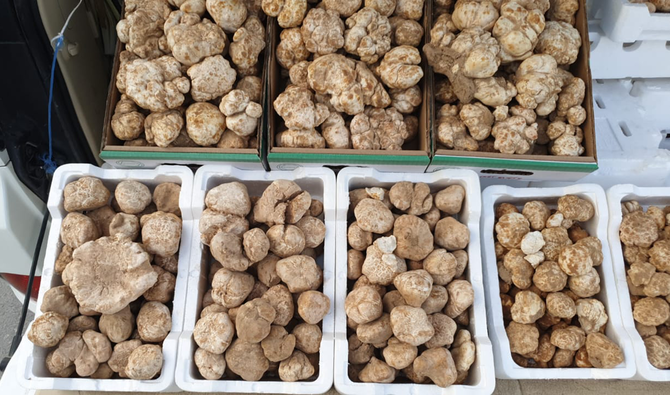
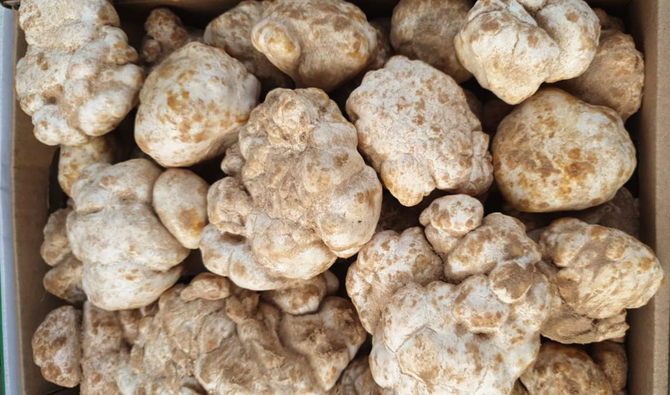

RIYADH: Almost two weeks into the year’s desert truffle season, successful hunters have started bringing their products to the market, and those looking for a tasty treat can finally get their hands on a fresh crop of earthy, savory goodness.
Known colloquially as the fage (pronounced with a hard, guttural “e”), the Terfeziaceae, or desert truffle, is a delicacy renowned across the Arabian Peninsula and certain parts of North Africa. It is popular in the region for its unique taste, like that of an earthy mushroom, and used in several traditional Arabic dishes.
The truffle also boasts certain health benefits. Prophet Muhammad (PBUH) cited truffle water as a cure for certain maladies of the eye. Desert truffles also contain a high amount of plant protein, comparable to that of tofu, making it a favorite among vegans and vegetarians.
The desert truffle is a fungal plant found in the desert after heavy rainfall. True desert truffles only grow in areas close to the raqrooq plant, also known as the sunrose or rock rose. In the Kingdom, the best places to search are located in the deserts of Northern Saudi Arabia, near places such as Arar or Hafr Al-Batin. Outside of it, the truffles are found in the deserts of Iraq, Syria, Algeria, Libya and Mauritania.
According to truffle expert Faisal Al-Hazeini, truffle season begins somewhere around Jan. 25, and ends around March 10, giving truffle hunters a fairly narrow window in which to dig up, sift through and sell the produce.
“These truffles are considered somewhat rare, due to the scarcity of rain in the desert and the difficulty of acquiring a good specimen,” Al-Hazeini told Arab News. “Searching for truffles requires covering long stretches of desert, some of which are protected or restricted, such as border areas and nature preserves. Their growth is also dependent on how much it has rained in the desert each year, so it’s not impossible for a year or two to pass without the sufficient rain required to produce them.”
Though not as expensive as their Italian and European counterparts, their rarity makes them relatively pricey. A kilo of desert truffles can cost anywhere from SR 700 (around $186.6) to SR 1200, depending on their size, quality, color and the fruitfulness of the year’s crop.
HIGHLIGHTS
• Known colloquially as the fage (pronounced with a hard, guttural ‘e’), the Terfeziaceae, or desert truffle, is a delicacy renowned across the Arabian Peninsula and certain parts of North Africa.
• It is popular in the region for its unique taste, like that of an earthy mushroom, and used in several traditional Arabic dishes.
• The truffle also boasts certain health benefits. Prophet Muhammad (PBUH) cited truffle water as a cure for certain maladies of the eye.
Desert truffles come in three main varieties: white, known as zubaidi; red; and the uncommon black, known as khulas. Each boasts its own unique flavor profile and price point.
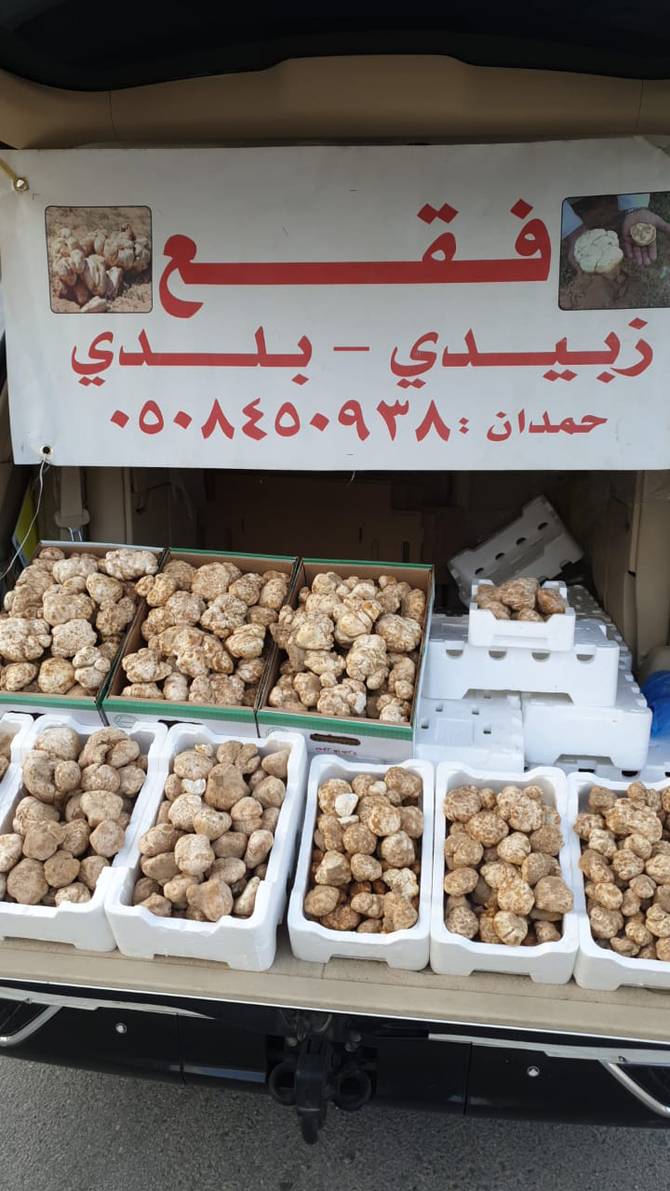
Hamdan Al-Adyni, a vendor of exotic fruits and vegetables, told Arab News that one of the most difficult aspects of truffle hunting was determining the good truffles from the bad, since not every truffle they find in the wild is necessarily an edible one.
“A good truffle should be firm and should have a good smell, color and shape. Bad truffles are distinguished by discoloration, an unpleasant smell and an almost gelatinous texture,” he said. “The quality of the dirt also plays a role. An expert hunter can tell just by examining the dirt whether they are going to find a good crop or not,” he said.
Basheer Al-Ruwaili, another expert, told Arab News that the best places to buy them was at special, seasonal markets that can be found across the Kingdom in the spring.
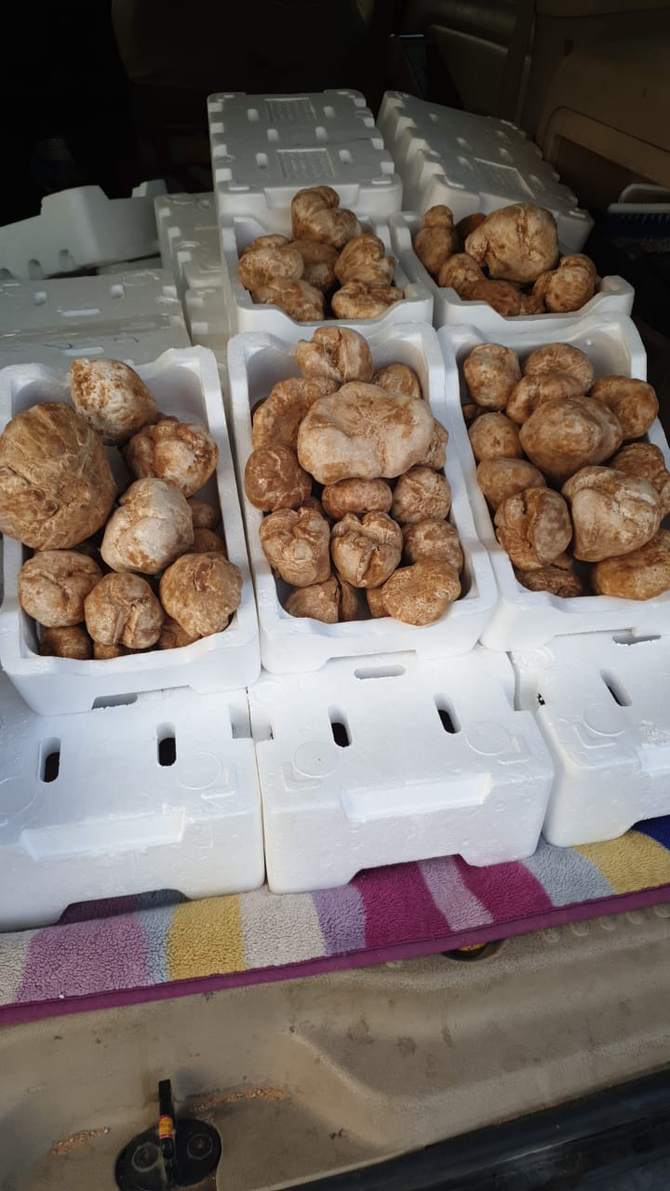
“At truffle markets, you will encounter experienced dealers who will have fresh and newly extracted specimens. Though you may sometimes find sellers hawking them in trucks on the sides of the road, people should take extreme caution buying from them because they are of unknown sources and may have been exposed to improper storage, imported and therefore not as fresh, or gathered during previous seasons,” he said.
More importantly, once a crop of fresh truffles has been successfully procured, how would one go about preparing them for consumption?
Al-Ruwaili stressed that the truffles need to be properly scrubbed, to ensure that all of the dirt is removed from the crevices, before they are peeled and cooked.
“For me, the best way to cook them is by grilling them, while taking care to extract the water coming out of them to be used for homeopathic purposes,” he said. “Once they are properly cleaned and peeled, they can be roasted on coals with the addition of nothing but salt. Another way is to boil them in water until tender, then add salt and a little bit of ghee or cultured goat butter,” he said.
As for Al-Adyni, he suggests cooking them in broth, or adding them to kabsa, a traditional Saudi rice dish.
“There are many ways of serving and cooking a desert truffle, limited only by a person’s creativity,” he said.
Al-Adyni has a snapchat account, @aladyni2021, where he posts pictures and videos of his seasonal crops, his experiences hunting truffles during their seasons and the locations where they can be purchased.


