NEW YORK: The threat posed by Daesh to international peace and security is growing as it attempts to regroup and renew its activities, the UN Security Council was told on Wednesday.
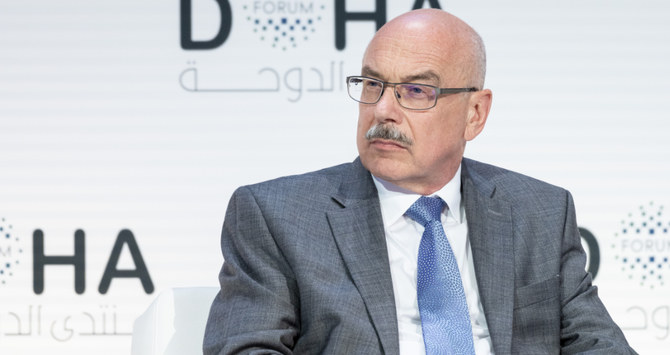
Vladimir Voronkov, head of the UN Office of Counter-Terrorism (UNOCT), said the terror group is using technology to connect with and radicalize young people. Its activities gained momentum in the second half of last year, during which many people were stuck at home during pandemic lockdowns, he added.
His warning came as he briefed the Security Council on the latest UN efforts to counter the dangers from Daesh and other terrorist groups. This is in accordance with Resolution 2368, which calls on the council to adapt to evolving terrorist threats, and member states to strengthen measures to block the funding of terrorism, limit the travel of terrorists, and prevent them from obtaining weapons.
Voronkov said that although Daesh has lost its self-declared caliphate in Iraq and Syria, is still carrying out attacks in both countries and maintains the ability to operate across unprotected borders. It could regain the capacity to orchestrate attacks worldwide this year, he added.
Terrorists have adapted the opportunities provided by cyberspace and new technologies and are exploiting them, he said. With young people, in particular, in many countries spending more time at home and online because of COVID-19 restrictions, Voronkov warned that the risk they will be exposed to Daesh propaganda and incitement has grown as the terror group attempts to rebuild and advance its agenda.
“This could lead to a sudden rash of attacks in some countries when COVID-19-related movement restrictions ease,” he added.
About 10,000 Daesh fighters, mostly in Iraq, are actively engaged in a protracted insurgency that poses “a major, long-term and global threat,” Voronkov said.
“They are organized in small cells hiding in desert and rural areas and moving across the border between (Iraq and Syria), waging attacks.”
He also described the dire security and humanitarian situation in Al-Hol and Roj detention camps in northeastern Syria. About 90,000 people from 57 countries — mostly women and children with family connections to Daesh militants — have been held in the camps since Daesh was driven from territories it once controlled in Iraq and Syria.
Voronkov reiterated a call by UN Secretary-General Antonio Guterres for all member states to abide by the moral responsibility and legal obligation to repatriate their citizens living in the camps.
US ambassador Jeffrey DeLaurentis told the council the global threat from Daesh will continue to grow as long as authorities in many countries refuse to repatriate their citizens from the camps. Experts have warned that they are a perfect breeding ground for extremism and radicalization.
“Beyond being the best option from a security standpoint, repatriation is also simply the right thing to do,” he said. “It is estimated that 90 percent of children in the camps are under 12, and 50 percent under five.
“They have limited access to food, medical care, clean water and other basic services. Education is almost nonexistent. They cannot possibly live up to their potential under these conditions.”
Vassily Nebenzya, Russia’s permanent representative to the UN, said: “Unfortunately a whole slew of states of origin of these people prefer to close their eyes on this issue. The Russian Federation cooperates closely with Syria and Iraq so as to determine the location of and return their minors back to the country.”
He urged other countries to do the same and to engage with “the legitimate authorities in Syria.”
This year marks the 20th anniversary of the UN’s pivotal anti-terrorism Resolution 1373, which was adopted after the 9/11 attacks on the US. Voronkov urged member states to honor the occasion by recommitting to “multilateral action against terrorism.” The resolution calls for all countries to criminalize the financing of terrorism, prevent the recruitment of terrorists, stop them from traveling, and to ensure they are not provided with safe havens.
It also established a Counter-Terrorism Committee to monitor the global implementation of the resolution. The committee’s Executive Directorate (CTED) was established in 2004 to assess how successful the UN’s 193 member nations have been in achieving this, and recommend ways to address shortcomings, facilitate technical assistance, and analyze counter-terrorism trends.
CTED is led by Michele Coninsx, who told the Security Council that the COVID-19 pandemic represents “the most urgent challenge” because it has exacerbated and fueled threats that had been dormant.
Levels of terrorist violence tend to ebb and flow and are likely to continue to do so, Coninsx said, adding that “there has been a consistent and welcome downward trend over the past five years.”
She added: “As the terrorist threat has evolved, so too has the response of the United Nations.”
Syria and Iraq remain Daesh’s primary focus, so CTED is planning a visit to Iraq and neighboring countries to assess the situation, Coninsx said.
“This will allow us to identify challenges that still need to be addressed to effectively counter the evolving threat in the region,” she added.


![]()

UN warned that Daesh terror threat will grow if nations do not act
Short Url
https://arab.news/cbhrx
UN warned that Daesh terror threat will grow if nations do not act
- Experts say terror group is exploiting pandemic to regroup, using cyberspace to prey on young people stuck at home during lockdowns
- Nations that refuse to repatriate citizens from detention camps in Syria are failing in their moral duties and threatening security, envoys say


Latest updates


© 2026 SAUDI RESEARCH & PUBLISHING COMPANY, All Rights Reserved And subject to Terms of Use Agreement.