

Arab world basks in the glory of UAE Mars mission triumph

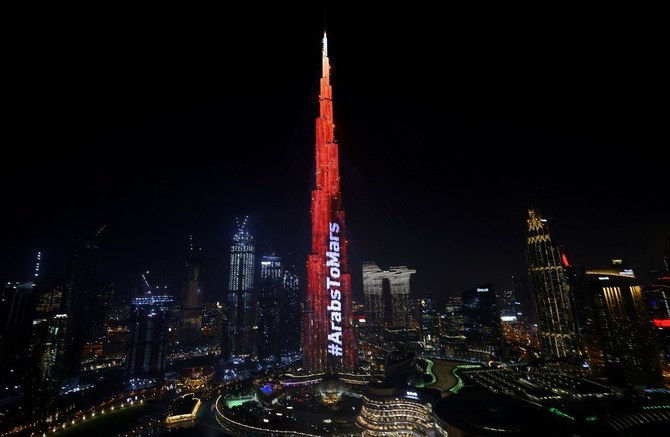
Dubai's Burj Khalifa is lit up in red on February 9, 2021, as the UAE's "Al-Amal" -- Arabic for "Hope" -- probe's to Mars carries out a tricky maneuver to enter the Red Planet's orbit (AFP)
Short Url
Updated 10 February 2021
Follow

Arab world basks in the glory of UAE Mars mission triumph

  • Entry of Hope probe into Red Planet’s orbit marked success of Arab world’s first interplanetary mission
  • Tuesday’s feat puts UAE’s space agency in a club of just five that have pulled off a functioning Mars mission

DUBAI: For months, the Hope probe’s journey to Mars had been tracked eagerly by the Arab news media. In the UAE, hoardings depicting the unmanned spacecraft (known in Arabic as Al-Amal) have been positioned along highways as part of the country’s 50th anniversary celebrations.

On Tuesday, landmarks across the Arab world, including Dubai’s Burj Khalifa, the tallest tower on Earth, glowed red to mark the probe’s arrival at Mars.

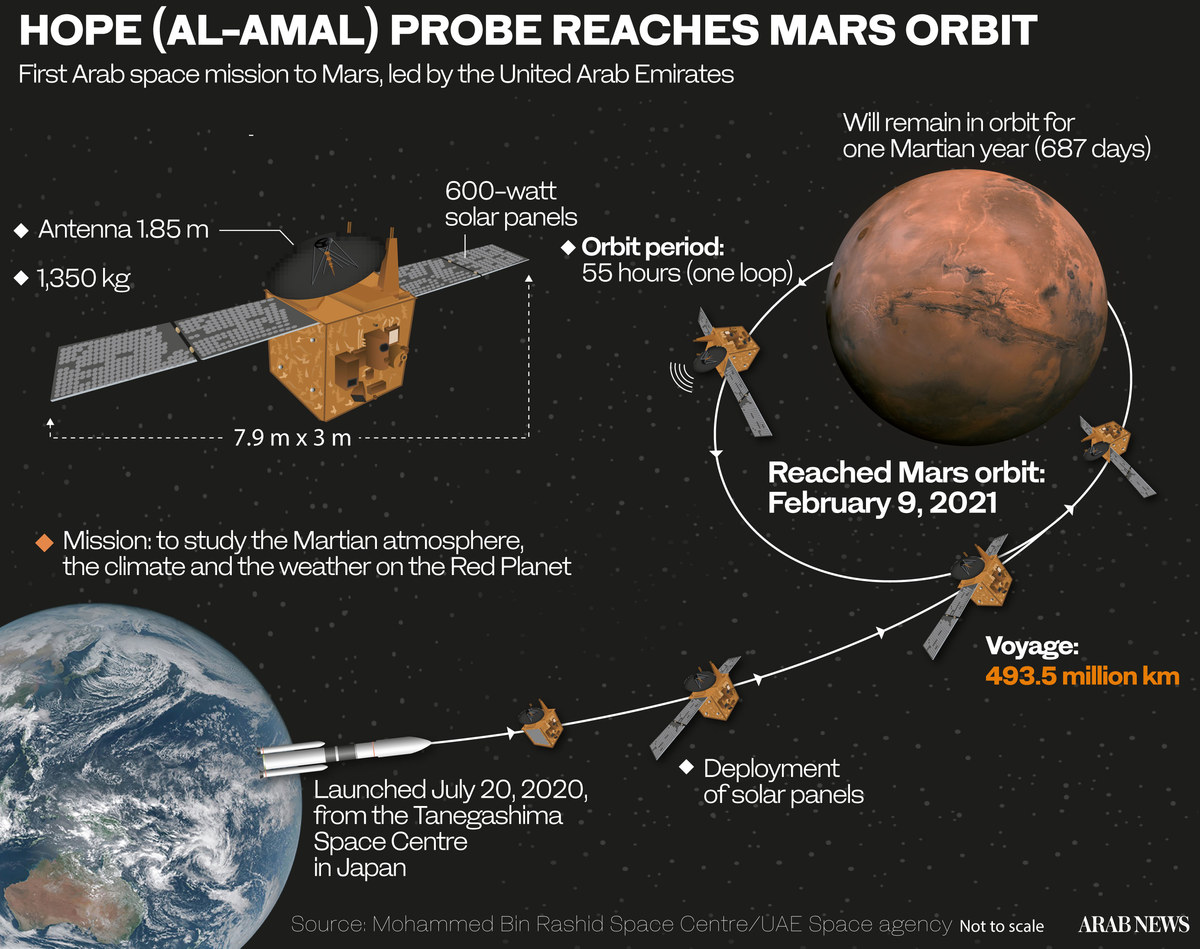
Seven months after its launch from Japan’s Tanegashima Space Center, the probe completed its 495 million kilometer voyage and settled into orbit around the planet in a triumph for the Arab world’s first interplanetary mission.

Ground controllers at the Mohammed bin Rashid Space Center (MBRSC) in Dubai rose to their feet and applauded when news broke that the Hope probe had begun circling the Red Planet, where it will gather data on the Martian atmosphere.

Omran Sharaf, project manager of the Emirates Mars Mission, announced: “To the people of UAE and to the peoples of Islamic and Arab nations, we announce the success of the United Arab Emirates in (reaching) the orbit of the Red Planet. We thank God.”

The craft swung into a high Martian orbit, joining six spacecraft already operating around the planet — three US, two European and one Indian. Mission controllers had to pull off a series of delicate turns and power adjustments to maneuver the probe into position.

“Anything goes even slightly wrong and you lose the spacecraft,” said Sarah Al-Amiri, minister of state for advanced technology and the chair of the UAE’s space agency.

She described the mission’s success as “a historic development and a fulfilment for the dreams of 200 engineers and scientists” who worked behind the scenes.

The Hope’s arrival puts the UAE in a league of just five space agencies in history that have pulled off a functioning Mars mission. Two more unmanned spacecraft from the US and China are following close behind, set to arrive at the planet in the next several days.
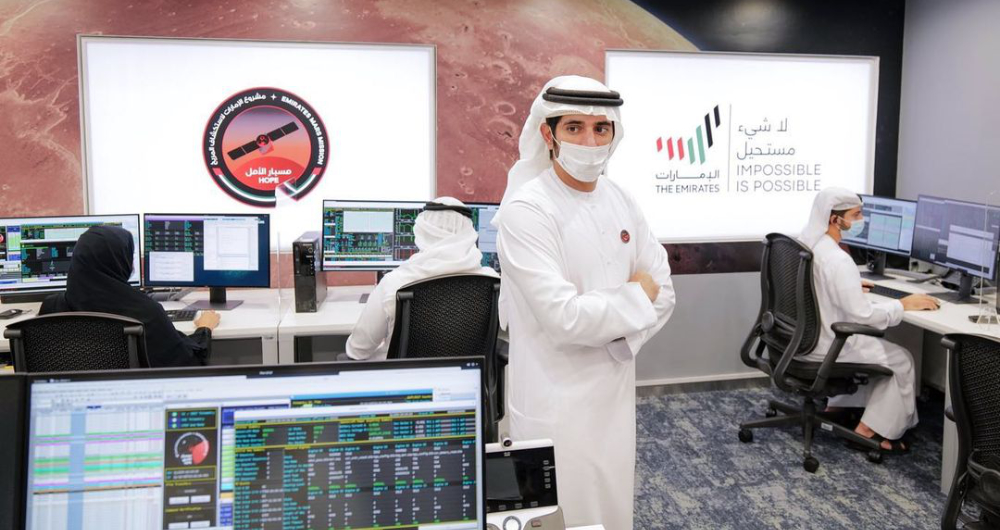


Dubai’s Crown Prince Hamdan bin Mohammed Al-Maktoum watches the mission to Mars unfold at the Mohammed bin Rashid Space Center. (Supplied)

All three missions were launched in July last year to take advantage of the close alignment of Earth and Mars.

In a congratulatory tweet on Tuesday addressed to the Emiratis, Thomas Zurbuchen, NASA’s science mission chief, said: “Your bold endeavor to explore the Red Planet will inspire many others to reach for the stars. We hope to join you at Mars soon with Perseverance.”

Speaking to Arab News, Salem Al-Marri, assistant director general for scientific and technical affairs at the Mohammed bin Rashid Space Center, said: “The (completion of the Mars orbit insertion) means a lot: Within 15 years, building capabilities at the center to be able to build satellites, launch astronauts and build a mission like this to Mars.

“The first thing that it means to the country and to us is that we have the capability to build such technologies. Number two is that now we have a mission that has a global impact. Its importance is on a global level, so the data that we’re going to get from this mission is going to benefit everybody studying the Martian atmosphere who wants to understand the planet better.

“I think a mission such as this means a lot everybody.”

Earlier, Hessa Al-Matrooshi, science lead of Data Analysis and Management of EMM at the space center, had said in an interview: “There are many similarities between Earth and how Mars was about 2 billion years ago. Data has shown traces of water on the Red Planet 2 billion years ago. We believe it had a very thick atmosphere, it had water and liquid state.

“If you look at Mars now, a lot has happened. It has a very thin atmosphere and you don’t find traces of water unless it’s water vapor and ice. The question is why the drastic transformation happened. Through this, we can understand factors taking place on Earth that can lead to similar results, thus preventing it.”

The Hope probe was assembled in Boulder, Colorado, before being sent to Japan for launch aboard a Mitsubishi Heavy Industries H2A rocket.

The $200 million cost of the mission is considered among the lowest in the world when compared with similar programs, Mohammad Al-Gergawi, the UAE minister for cabinet affairs, said in a tweet last year.
However, the price tag excludes operating costs at Mars. The Chinese and US expeditions are considerably more complicated — and expensive — because of their rover exploration devices. NASA’s Perseverance mission has a likely cost of $3 billion.

Nevertheless, the success of the mission represents a tremendous boost to the UAE’s space ambitions. It follows decades of preparations and work to achieve a grand vision set out in the 1970s by the UAE’s founder, the late Sheikh Zayed bin Sultan Al-Nayhan. His interest in space was triggered by a meeting in 1976 with NASA astronauts who had flown a number of Apollo missions to the Moon.

US President Richard Nixon had presented Sheikh Zayed with a gift of a lunar rock collected from the Taurus-Littrow Valley during the 1972 Apollo 17 mission. Soon after, Sheikh Zayed sent a clear message to his people, and the world, that Emirati ambitions for space exploration would know no bounds. So began the country’s journey into space.

In 2006, the UAE began collaborating closely with universities and space agencies around the world to establish knowledge-transfer programs, with the goal of one day sending a spacecraft to Mars. However, it was not until the UAE Space Agency was formed in 2014 that the world really began to take notice of the country’s space exploration plans.

In 2017, Emirati military pilot Hazza Al-Mansouri was one of two people selected from 4,000 applicants to join the agency’s inaugural astronaut corps. After rigorous mental and physical tests, he trained in Russia as a part of an agreement between the Mohammed bin Rashid Space Center and the Russian space agency, Roscosmos.

The UAE’s first astronaut joined the crew of a Soyuz MS-15 spacecraft that took off on Sept. 25, 2019, bound for the International Space Station. Al-Mansouri’s eight-day mission ended on Oct. 2, when he landed safely in Kazakhstan, after which he proudly said that he had returned with “Sheikh Zayed’s space mission achieved.”

Looking to the future of Arab space exploration, the MBRSC’s Al-Marri said: “We have a 10-year plan already in place and we have multiple teams working on multiple missions. If I talk specifically about the next step with the Emirates Mars Mission, we will start after a couple of weeks focusing on the scientific objectives.

“But the next steps in terms of the MBRC is the other 10-year plan. The next mission we have is launching, for the first time in the history of the Arab world, a mission that will land on the Moon. So, we’ll be sending a rover, it’s called Rashid Rover. We’re building that as we speak.”

— with input from agencies.

Twitter: @jumanaaltamimi


When a Saudi went to space
Prince Sultan bin Salman speaks exclusively to Arab News about his 1985 NASA mission and how he became the first Arab, Muslim and royal in space

Enter


keywords

A language course is reviving Moroccan Jewish culture and bridging Middle East divide

Updated 7 sec ago
Follow

A language course is reviving Moroccan Jewish culture and bridging Middle East divide

  • “In my family there were (many) different languages — Moroccan Arabic, French, Hebrew at the synagogue, and my dad also speaks Amazigh, Berber,” said Elfassi.
  • His passions for music and language took Elfassi on a journey to Bordeaux, France, and Be’er Sheva, Israel, writing a dissertation on Jewish identity among Moroccan Jews

RABAT: Growing up in Fez, Morocco, Yona Elfassi was always aware of the history of the city, which has been a center of culture, learning and spirituality since the ninth century.
Home to great minds such as the 12th-century philosopher and jurist Ibn Rushd and his contemporary, the physician and codifier of Jewish law Maimonides, the city was shaped by Jewish, Arab, Amazigh, Spanish and French cultures.
These influences left a deep imprint on Elfassi, 37.
“In my family there were (many) different languages — Moroccan Arabic, French, Hebrew at the synagogue, and my dad also speaks Amazigh, Berber,” said Elfassi.
Music, too, was a constant presence — from Andalusian to Flamenco, to Moroccan classic, to Moroccan chaabi popular, to Berber music,” he said. “We weren’t a family of professional musicians, but we were a family that lived with music.”
As a Jewish resident of Morocco, Elfassi belongs to a tiny demographic, as 99 percent of Jews of Moroccan heritage today live elsewhere. After major emigrations in the 20th century, only around 2,500 Jews remain in a country where they once made up 5 percent of the population. Today an estimated 50,000 live in France, 25,000 in Canada and 25,000 in the United States; and some 1 million Moroccan Jews make up one of Israel’s largest ethnic groups.
His passions for music and language took Elfassi on a journey to Bordeaux, France, and Be’er Sheva, Israel, writing a dissertation on Jewish identity among Moroccan Jews. (He has two doctorates, one in sociology and political science from Sciences Po Bordeaux and one in anthropology and history from Ben-Gurion University of the Negev.)
His research into Morocco’s history eventually grew into a vocation to teach Darija, the Moroccan Arabic dialect, to allow diaspora Moroccan Jews to connect with their ancestors through language, culture and stories.
“As a sociologist, I was fueled by the conviction that academic research ought to forge connections and deepen understanding” beyond the academy, Elfassi said. “These stories and human histories are at the core of why I decided to teach, and my identity has inspired me to work with Jews of Moroccan background to reconcile with their ancestral language.”
As the COVID-19 pandemic ended, he launched Limud Darija, an educational movement and multimedia language platform. The hybrid courses mix Zoom classes with in-person gatherings, which take place in Israel. Elfassi also holds music workshops, drawing from Sephardic piyyutim— Jewish liturgical poems with Judeo-Arabic pronunciation and melodies — and the music of 20th-century Moroccan pop icons such as Hajja El Hamdaouia, Sliman Elmaghribi, Zohra El Fassiya and Abdelhadi Belkhayat.
Limud Darija’s impact has grown rapidly. “Today our community includes over 500 active members with the mission of connecting people across generations, helping participants reclaim lost voices and fostering resilience and a sense of belonging through cultural practices,” Elfassi said.
Through his Instagram feed and TikTok presence, many Moroccan Muslims have found Elfassi’s work and are inspired to see Moroccan Jews preserving the language of their shared home. Muslims, Elfassi said, in turn have expressed interest in learning Hebrew. “I opened an active WhatsApp group where we’re teaching Hebrew to Muslim speakers of Darija,” he said.
“Through this shared connection, divisions begin to fade,” Elfassi said. “The Israelis the Muslim Moroccans meet are seen as Moroccans like themselves, as family. They are talking a common language, talking about what unites them, people are begun to be seen as individuals.” The Muslims and Jews, he said, get the chance “to bond over music and heritage and language, not political or war-related topics, and they do not further the false ‘pro-Palestine’ vs ‘pro-Israel’ dichotomy, and instead humanize everyone as individuals, as human beings.”
Limud Darija students describe how the program has connected them more deeply with people in their own lives as well. “My parents talked between them in Moroccan language, but by the time I was an adult, I forgot,” said Yehudit Levy, a retired schoolteacher in Ganei Tikvah, Israel, who has studied with Elfassi for three years. “Since I started to learn with Yona, everything comes up — songs, music, food, poetry, all the traditional things come up. I smell Morocco when I am in the class.”
Noam Sibony, a Limud Darija alumnus, is a neuroscience researcher and musician living in Toronto. The 28-year-old spent nine months volunteering in Lod, an Israeli city whose population is Arab and Jewish, at a community center, working with local children and youth. Limud Darija, he said, showed him how learning the language of another culture can help build relationships that transcend regional politics and conflicts.
Habiba Boumlik, a professor of French, literature and women’s and gender studies at LaGuardia University in Queens, New York, and co-founder of the New York Forum of Amazigh Film, an annual film festival celebrating the Indigenous Berber people of North Africa, sees parallels between Elfassi’s work and her efforts to preserve the Tamazight language.
“I give credit to people who invest in learning language, and it is great with the new technology and variety of sources on the Internet. Even if people aren’t fluent, they can do so much with the language, and they will go to Morocco and connect more deeply,” Boumlik said.
Darija is closely related to the Judeo-Arabic dialect, Boumlik explained, and so has the potential to contribute to the Moroccan vernacular, just as Judeo-Arabic slang and idioms have shaped Modern Hebrew.
“The exchange among the Moroccans and Israelis will only enrich Darija as they also enrich their families and themselves,” Boumlik said. “And it is so important that they can connect with Moroccans on the Internet and have a dialogue. It is not just the culture and language of their grandparents — it is the living language and culture of the new generation.”
Bringing people together on this level, Elfassi said, is peacebuilding on a human scale, prioritizing personal stories, shared culture and mutual respect. “For me, peace will start with people, not with the decision-makers,” he said. “Peace is just two people talking to each other, having respect for each other and having a conversation where they can disagree, but where they always show respect for the humanity of the other.”