CanSinoBIO's COVID-19 dose 65.7% effective in large trial — Pakistani official

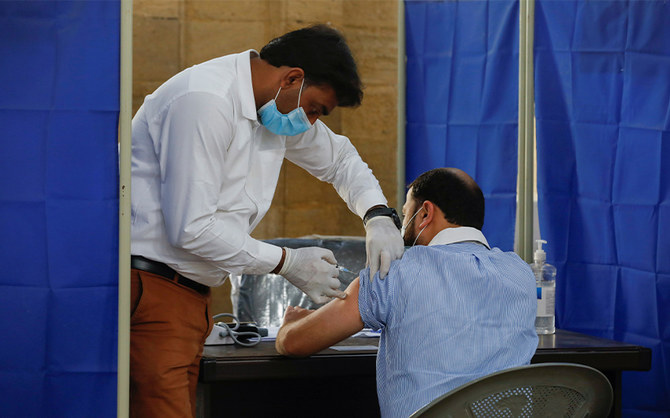
A health worker receives a dose of Sinopharm's coronavirus disease (COVID-19) vaccine, donated by China, at a vaccination center in Karachi, Pakistan, on February 8, 2021. (REUTERS)
Short Url
Updated 09 February 2021
Follow

CanSinoBIO's COVID-19 dose 65.7% effective in large trial — Pakistani official

  • Vaccine 90.98% effective in stopping severe disease in interim multi-country results
  • Vaccines from Chinese developers have shown lower protection rates than some Western products

ISLAMABAD: A COVID-19 vaccine developed by CanSino Biologics Inc (CanSinoBIO) showed 65.7% efficacy in preventing symptomatic cases, and 90.98% efficacy in stopping severe disease in interim multi-country trial results, Pakistan's Health Minister Faisal Sultan said on Monday.
The vaccine, jointly developed by a research institute affiliated with the Chinese military, follows two competing shots from Chinese companies Sinovac and state-backed Sinopharm that showed efficacy of between 50% and 91%.
Although vaccines from Chinese developers have shown lower protection rates than some Western products, and no detailed study results are publicly available yet, they have already been approved in several developing countries battling a surge in coronavirus infections.
The efficacy of CanSinoBIO's vaccine, the one-dose Ad5-nCoV, is based on analysis of 30,000 participants and 101 cases of COVID-19, the minister said on Twitter, quoting data from an independent data monitoring committee.
In the Pakistani subset, efficacy of the CanSinoBIO vaccine at preventing symptomatic cases was 74.8% and 100% at preventing severe disease, Sultan added.
CanSinoBIO was not immediately available for comment.


Pakistan says repaid over $13.06 billion domestic debt early in last 14 months

Updated 29 January 2026
Follow

Pakistan says repaid over $13.06 billion domestic debt early in last 14 months

  • Finance adviser says repayment shows “decisive shift” toward fiscal discipline, responsible economic management
  • Says Pakistan’s total public debt has declined from over $286.6 billion in June 2025 to $284.7 billion in November 2025

KARACHI: Pakistan has repaid Rs3,650 billion [$13.06 billion] in domestic debt before time during the last 14 months, Adviser to the Finance Minister Khurram Schehzad said on Thursday, adding that the achievement reflected a shift in the country’s approach toward fiscal discipline. 

Schehzad said Pakistan has been repaying its debt before maturity, owed to the market as well as the State Bank of Pakistan (SBP), since December 2024. He said the government had repaid the central bank Rs300 billion [$1.08 billion] in its latest repayment on Thursday. 

“This landmark achievement reflects a decisive shift toward fiscal discipline, credibility, and responsible economic management,” Schehzad wrote on social media platform X. 

Giving a breakdown of what he said was Pakistan’s “early debt retirement journey,” the finance official said Pakistan retired Rs1,000 billion [$3.576 billion] in December 2024, Rs500 billion [$1.78 billion] in June 2025, Rs1,160 billion [$4.150 billion] in August 2025, Rs200 billion [$715 million] in October 2025, Rs494 billion [$1.76 billion] in December 2025 and $1.08 billion in January 2026. 

He said with the latest debt repaid today, the July to January period of fiscal year 2026 alone recorded Rs2,150 billion [$7.69 billion] in early retirement, which was 44 percent higher than the debt retired in FY25.

He said of the total early repayments, the government has repaid 65 percent of the central bank’s debt, 30 percent of the treasury bills debt and five percent of the Pakistan Investment Bonds (PIBs) debt. 

The official said Pakistan’s total public debt has declined from over Rs 80.5 trillion [$286.6 billion] in June 2025 to Rs80 trillion [$284.7 billion] in November 2025. 

“Crucially, Pakistan’s debt-to-GDP ratio, around 74 percent in FY22, has declined to around 70 percent, reflecting a broader strengthening of fiscal fundamentals alongside disciplined debt management,” Schehzad wrote. 

Pakistan’s government has said the country’s fragile economy is on an upward trajectory. The South Asian country has been trying to navigate a tricky path to economic recovery under a $7 billion loan from the International Monetary Fund.