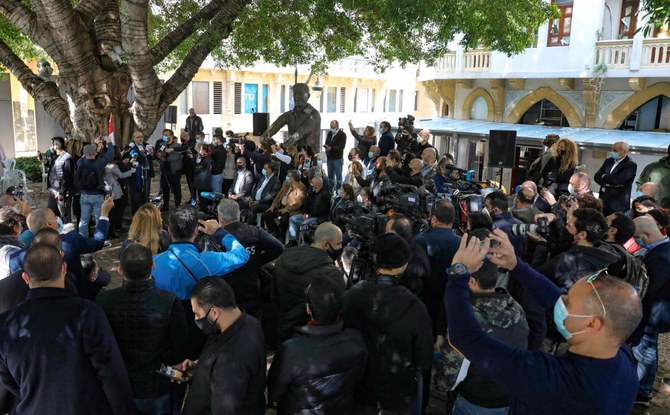
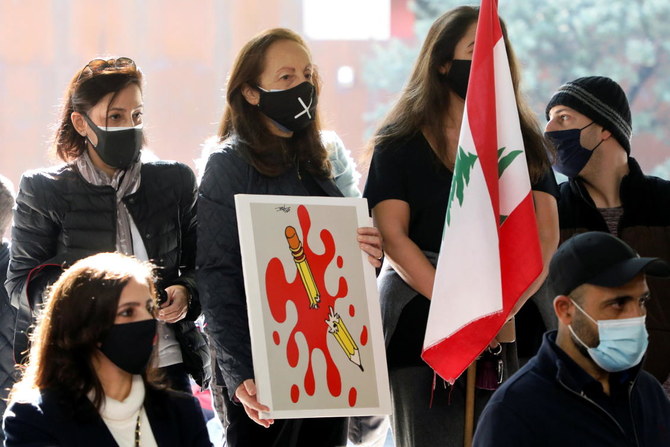
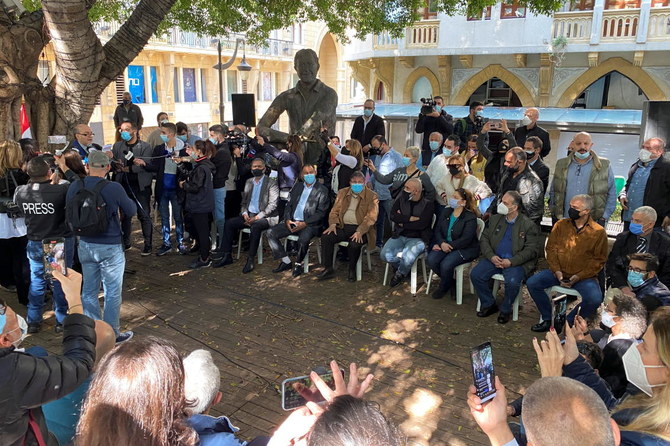

BEIRUT: Activists on Saturday protested the murder of anti-Hezbollah activist Luqman Slim, who was found shot dead in his rented car earlier in the week.
They demanded a transparent investigation into his death, and chanted that the one who killed him also assassinated the writer and journalist Samir Kassir and the journalist Gebran Tueni.
A medical report, which Slim's family had requested from a private doctor who examined his body in a Beirut hospital, showed that he was killed at 2 a.m. on Thursday. There were bruises on his body, indicating that he may have been tortured.
Slim, who was a leading secular voice in Lebanon’s Shiite community, was routinely threatened because of his stance against Hezbollah.
The Popular Nasserist Organization, led by MP Osama Saad, condemned the murder.
Saad stressed the “rejection of the methods of political assassination, terrorism, threats, accusations of betrayal, and the approach of oppression, domination and exclusion because that leads to tyranny and political desertification.”
Ali Al-Amin, a journalist and political opponent of Hezbollah, believed that Slim’s assassination had brought about “a state of restlessness” within the Shiite community because there were no articles from Hezbollah supporters gloating over the murder like there had been after other killings.
“In the downturn, the allies usually rise and reconsider their accounts,” he told Arab News. “The position of the (Hezbollah-allied) Free Patriotic Movement and Osama Saad may be in this direction. Saad, who is considered a leader in Sidon, has begun to feel that Hezbollah has erased much of this leadership. The Free Patriotic Movement (FPM) believes that its ally is just watching, so the movement decided to reconsider its accounts.”
Although the loyalty of Hezbollah supporters was a “foregone conclusion,” the people inside the Shiite community that usually supported the party's positions were dissatisfied with this crime, he added.
“The most evident proof of this is that the party is defending itself and is surprised at being accused of killing an individual. This means that people are asking: ‘Why did you kill an individual who did not harm anyone?’”
A further sign of trouble in pro-Hezbollah circles came in the form of a statement from the FPM, which is headed by the president’s son-in-law MP Gebran Bassil. It said that an agreement signed with Hezbollah 15 years ago was no longer needed.
The agreement, which transformed the country’s political scene, was signed between the secretary-general of Hezbollah, Hassan Nasrallah, and the FPM's leader at the time Michel Aoun, who is now president, in Mar Mikhael Church.
The FPM statement, issued on Saturday, came on the anniversary of the signing of the understanding.
It said: “This understanding has not succeeded in the project of building the state and the rule of law, and it is no longer needed if those committed to it do not succeed in the battle of building the state and the honorable Lebanese victory over the alliance of the corrupt, which is destructive for any resistance or struggle."
The FPM has rejected the government line-up that Prime Minister-designate Saad Hariri handed to Aoun on Dec. 10 because the president was not a partner in choosing the ministers or determining the number of members in the government.
It has also refused Hariri as prime minister-designate although its allies, Hezbollah and the Amal Movement, are clinging to him as head of the next administration.
MP Asaad Dergham, from the FPM, gave a statement to Al Markazia-Central News Agency.
He said: “Recently, specifically since the beginning of the era of President Michel Aoun, Hezbollah did not contribute with us to the issues of building the state and fighting corruption. He was satisfied with monitoring and we, as the FPM, were not able to complete the files presented by us in parliament due to Hezbollah's standing by its ally, Speaker Nabih Berri.”