

India to lift lengthy Internet clampdown in Kashmir: official

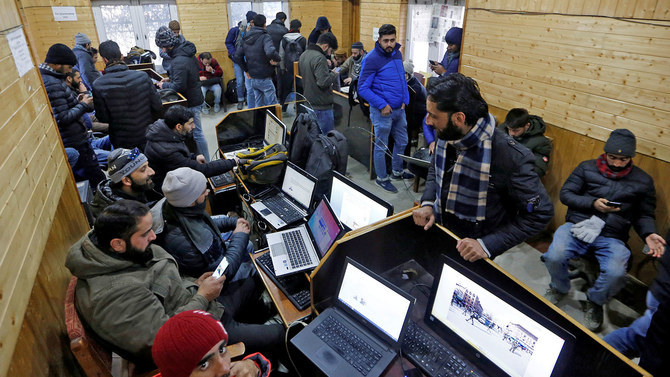
In this file photo, journalists use the internet as they work inside a government-run media centre in Srinagar on Jan. 10, 2020. (REUTERS)
Short Url
Updated 06 February 2021
Follow

India to lift lengthy Internet clampdown in Kashmir: official

  • New Delhi imposed communications shutdown on August 5, 2019, making this one of the world’s longest web clampdowns
  • India restricted Internet access more often than any other country in 2020

Authorities in Indian-administered Kashmir said Friday they would restore high-speed web access in the region, bringing to an end what rights groups have called one of the world’s longest Internet clampdowns.
New Delhi imposed a communications shutdown on August 5, 2019 in restive Kashmir to quell unrest after it revoked the region’s semi-autonomy and brought it under direct rule.

Access to slow, 2G Internet for mobile and fixed-line subscribers was restored in March 2020, but high-speed 4G access remained blocked.
Authorities then issued fortnightly orders restricting mobile data speeds, with the latest rolling ban due to expire on Saturday.
“4G mobile Internet services being restored in entire J&K,” Rohit Kansal, a spokesman for the Jammu & Kashmir territory, tweeted late Friday.
No further details were released, but an AFP journalist in Kashmir’s main city of Srinagar reported a jump in mobile Internet speeds just before midnight local time.
The 4G announcement follows international scrutiny on Internet blackouts around India’s capital New Delhi, where farmers protesting new agriculture laws have been camping out for more than two months.
Pop superstar Rihanna and climate activist Greta Thunberg tweeted a link to a news story about the blackouts and commented on the protests Tuesday, triggering a furious response from the foreign ministry which slammed the “sensationalist” social media comments.
In Kashmir, officials had said Internet restrictions were needed to clamp down on protests and prevent armed rebels — who have been challenging Indian rule since 1989 in fighting that has killed tens of thousands of people, mostly civilians — from launching attacks on government forces.
Apart from the shutdown, authorities often cut access to mobile Internet services in parts of the region, fearing unrest or during gunbattles between rebels and Indian soldiers.
India — the world’s biggest democracy — restricted Internet access more often than any other country in 2020, imposing over 75 blackouts, many in Kashmir, according to British virtual private networks review site Top10VPN.com.
Human Rights Watch last year called for full Internet access to be restored in Kashmir, saying it had badly affected businesses, students’ access to education and medical services during the coronavirus pandemic.


26 Doctors without Borders workers remain unaccounted for in South Sudan a month after attacks

Updated 4 sec ago
Follow

26 Doctors without Borders workers remain unaccounted for in South Sudan a month after attacks

  • A hospital in the town of Lankien was bombed by government forces, MSF said
  • “We have lost contact with them amid ongoing insecurity”

NAIROBI: More than two dozen Doctors Without Borders workers remain unaccounted for a month after attacks in South Sudan, the medical charity said.
Two facilities belonging to the group, known by French acronym MSF, were attacked on Feb. 3 in Jonglei State, northeast of the capital, Juba, where violence has displaced an estimated 280,000 people since December.
A hospital in the town of Lankien was bombed by government forces, MSF said, while another medical facility in the town of Pieri was raided by “unknown assailants.” Both were located in opposition-held areas.
Staff working at the two facilities fled alongside much of the local population into deeply rural areas where armed clashes and aerial bombardments were ongoing.
MSF said in a statement on Monday that “26 of 291 of our colleagues working in Lankien and Pieri remain unaccounted for.
“We have lost contact with them amid ongoing insecurity,” it said.
The lack of communication with its staff could be linked to the limited network connectivity in much of the state. Staff members who had been contacted described “destruction, violence and extreme hardships.”
Fighting escalated sharply in December, when opposition forces captured a string of government outposts in north central Jonglei. In January, the government responded with a counteroffensive that recaptured most of the area it had lost.
Displaced people in Akobo, an opposition-held town near the Ethiopian border, described horrific violence by government fighters. Many described not being able to find food or water as they walked for days to reach safety.
The attacks on MSF facilities in Lankien and Pieri are part of an uptick in violence on humanitarian staff, supplies and infrastructure, aid groups say. MSF facilities have been attacked 10 times in the last 12 months.
“This violence has taken an unbearable toll not only on health care services, but on the very people who kept them running,” said Yashovardhan, MSF head of mission in South Sudan, who only uses one name.
“Medical workers must never be targets,” he said. “We are deeply concerned about what has happened to our colleagues and the communities we serve.”