

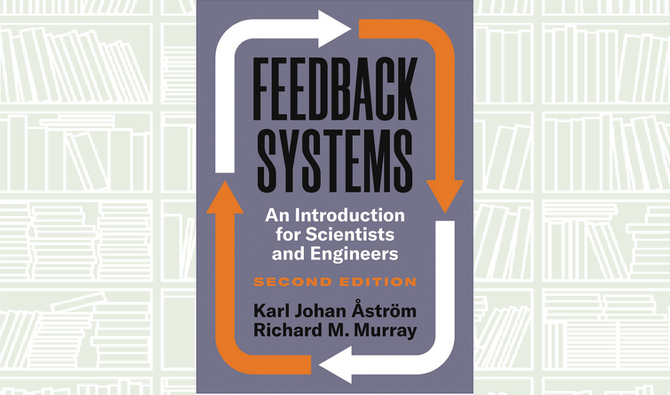
What We Are Reading Today: Feedback Systems

Short Url
Updated 03 February 2021
Follow

What We Are Reading Today: Feedback Systems

Edited by Karl Johan Åström and Richard M. Murray

This textbook covers the mathematics needed to model, analyze, and design feedback systems. Now more user-friendly than ever, this revised and expanded edition of Feedback Systems is a one-volume resource for students and researchers in mathematics and engineering. 

It has applications across a range of disciplines that utilize feedback in physical, biological, information, and economic systems, says a review on the Princeton University Press website. 

Karl Åström and Richard Murray use techniques from physics, computer science, and operations research to introduce control-oriented modeling. 

They begin with state space tools for analysis and design, including stability of solutions, Lyapunov functions, reachability, state feedback observability, and estimators. 

The matrix exponential plays a central role in the analysis of linear control systems, allowing a concise development of many of the key concepts for this class of models. 

Åström and Murray then develop and explain tools in the frequency domain, including transfer functions, Nyquist analysis, PID control, frequency domain design, and robustness.


What We Are Reading Today: ‘Rituals of War’

Photo/Supplied
Updated 29 December 2025
Follow

What We Are Reading Today: ‘Rituals of War’

  • Bahrani brings together and analyzes facets of war and sovereign power that fall under the categories of representation and display, the aesthetic, the ritualistic, and the supernatural

Author: Zainab Bahrani

“Rituals of War” is an investigation into the earliest historical records of violence and biopolitics. In Mesopotamia, ancient Iraq (ca. 3000–500 BC) rituals of war and images of violence constituted part of the magical technologies of warfare that formed the underlying irrational processes of war. In the book, three lines of inquiry are converged into one historical domain of violence, namely, war, the body, and representation.

Building on Foucault’s argument in “Discipline and Punish” that the art of punishing must rest on a whole technology of representation, Zainab Bahrani investigates the ancient Mesopotamian record to reveal how that culture relied on the portrayal of violence and control as part of the mechanics of warfare. Moreover she takes up the more recent arguments of Giorgio Agamben on sovereign power and biopolitic to focus on the relationship of power, the body and violence in Assyro-Babylonian texts and monuments of war.

Bahrani brings together and analyzes facets of war and sovereign power that fall under the categories of representation and display, the aesthetic, the ritualistic, and the supernatural.