

In Karachi’s cattle colonies, thousands of newborn buffaloes illegally killed each year

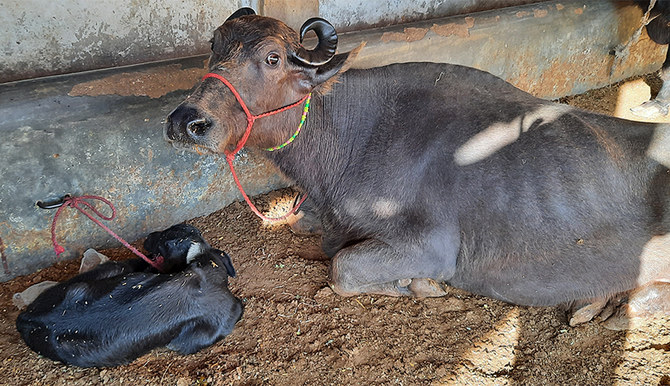
A buffalo and her calf at the Bhains cattle colony in Karachi, Pakistan, on January 30, 2021. (AN Photo)
Short Url
Updated 03 February 2021
Follow

In Karachi’s cattle colonies, thousands of newborn buffaloes illegally killed each year

  • 1.4 million animals, including newborns, perish illegally at slaughterhouses in the port city annually
  • The calf mortality rate in Pakistan is 30 percent but as high as 80 percent in Sindh province

KARACHI: More than 1.4 million animals are illegally killed every year in the cattle colonies of Karachi, officials and dairy farmers said, including newborn buffalo calves whose life span is no longer than a week as “commercial greed” lands them in slaughterhouses scattered across the port city.
Under the Karachi Municipal Corporation Slaughterhouse Byelaws 1975, it is forbidden to slaughter infant as well as “useful animals,” including those that are fertile.
 There are currently around 700,000-800,000 milk producing animals in Karachi’s over a dozen cattle colonies, including 400,000 in just the famed Bhains Colony, the prime source of milk and meat for over 15 million residents of the capital of Sindh. These animals together produce around 4.5 million liters of milk daily.
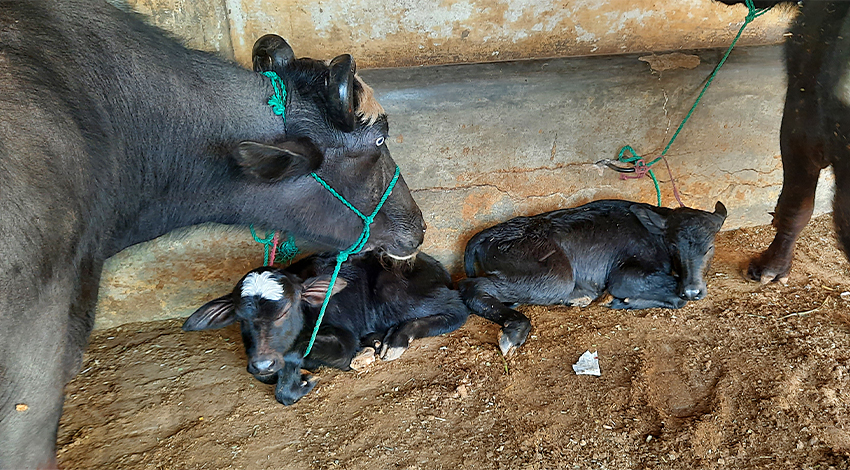


Newborn calves with their mothers at the Bhains cattle colony in Karachi, Pakistan, on January 30, 2021. (AN Photo)

“Every year 700,000 calves, some of them a day-old, come with their mothers from Punjab [province] and interior of Sindh to the cattle colonies, including Bhains colony, and most of them are slaughtered within a week,” Shakir Umar Gujjar, president of the Dairy and Cattle Farmers Association (DCFA) told Arab News. “They are separated from their mother soon after birth.”

“The brutality does not end here,” he said. “After 272 days, the mothers, when they get dry [lactation ends], are sold at half price to butchers and new ones take their place. In this way, more than 1.4 million animals are eliminated every year. The practice has been going on for decades.”
Gujjar said one reason why dairy farmers sold newborn calves was the high cost of feeding them milk.
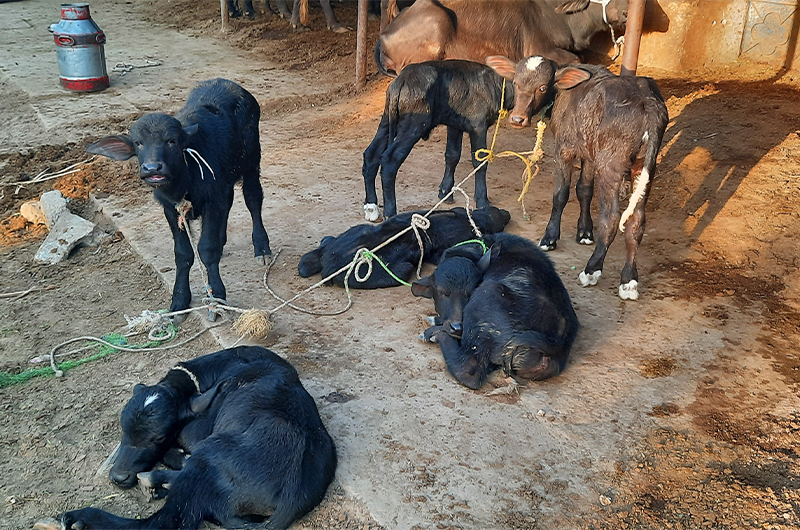


Buffalo calves at the Bhains cattle colony in Karachi, Pakistan, on January 30, 2021. (AN Photo)

“They sell the mothers’ milk instead of feeding it to the calf,” he said, saying farmers were financially burdened. “The animals eat more, but their average milk production is only around 8 liters.”
Farmers said they were incurring around Rs23 per liter of milk in losses due to the low price of milk, which in Karachi is Rs120/liter, while the cost of production was over Rs143 per liter.
Available for as low as Rs200 per infant, farmers insist they don’t sell the newborn babies for slaughter but so they can be reared — but a “mafia” was slaughtering them to be supplied to restaurants scattered across the city’s main highways.
“Every farmer wants to keep the calves, but the problem is that every calf needs 3-4 liters of milk every day which is not possible for financially troubled farmers,” dairy farmer Hammad Ala said. “It is not necessary that farmers sell calves for the purpose of slaughtering. Unfortunately, this is being done by a mafia which supplies meat to roadside restaurants.”

Dr. Mohsin Kiani, project manager for the federal government’s Save the Calf Project under the Livestock and Dairy Development Board, said the calf mortality rate in Pakistan was 30 percent but in Karachi, it was as high as 80 percent.
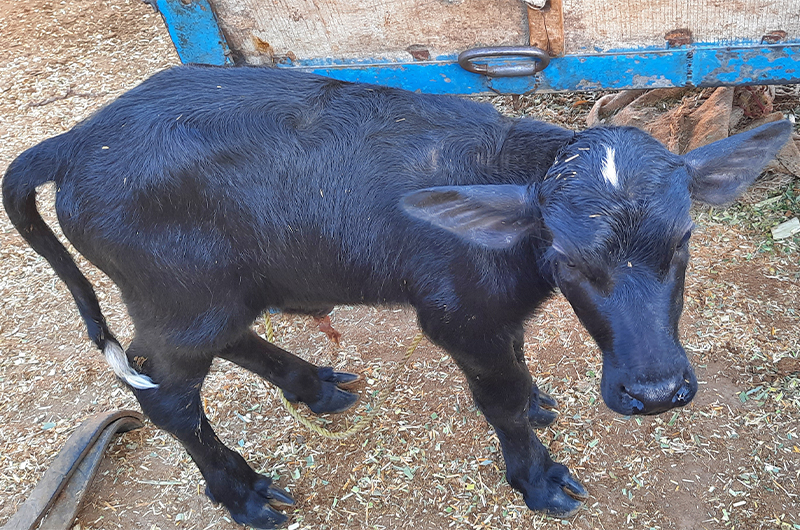


A newborn calf at the Bhains cattle colony in Karachi, Pakistan, on January 30, 2021. (AN Photo)

“Under the program, which would end in 2023, we have targeted saving 380,000 calves through various incentives to farmers, including a cash subsidy of Rs6,500 per animal,” Kiani told Arab News.
The program is ongoing in the Khyber-Pakhtunkhwa and Punjab provinces. Sindh was initially part of it, but later opted out to launch its own program, which could not materialize for financial reasons, Abdul Bari Pitafi, Sindh Minister for Livestock and Fisheries, said.
In the absence of incentives and a livestock management program at the government level, elite breeds of the water buffalo would keep ending up in Karachi’s slaughterhouses, experts warned.
“Karachi’s farmers buy the finest breeds of buffaloes from other parts of the country, but these end up in slaughterhouses. A buffalo, which can further be recycled for another 7-8 years, ends up in the food chain at the end of lactation period,” said Dr. Alamdar Hussain Malik, former secretary of the Pakistan Veterinary Medical Council.

“Milk production can only be enhanced by focusing on breeding as there is no other short cut for it,” he said. “Way out is to save the newborn calves and improve breeds by allocating space in the suburbs of the city for recycling.”


Nine killed, one child injured as avalanche hits house in northwest Pakistan

Updated 5 sec ago
Follow

Nine killed, one child injured as avalanche hits house in northwest Pakistan

  • Avalanche strikes family home in Arandu area of Lower Chitral district
  • Heavy snowfall cuts off towns and villages across northern Pakistan

PESHAWAR/QUETTA: At least nine people were killed while an injured child was rescued alive when an avalanche struck a house in a mountainous district of northwestern Khyber Pakhtunkhwa province, officials said on Friday, as the Pakistan Meteorological Department (PMD) warned of more rain and snowfall in the area along with southwestern Pakistan.

The incident occurred in the Arandu region of Lower Chitral district, affecting members of the same family, as the PMD urged tourists to avoid unnecessary travel while authorities worked to prevent weather-related emergencies.

Rescuers evacuated dozens of residents and tourists as heavy snow blocked roads in Khyber, South Waziristan and Swat districts, where authorities cleared routes and provided food, clothing and bedding, the Rescue 1122 service said.

“An avalanche fell in Sarigal village of Arandu, a far-flung area in subdivision Drosh,” Deputy Commissioner of Lower Chitral Rao Hashim Azeem told Arab News over the phone.

“Ten people from the same family came under the avalanche in which nine were found dead and one child was rescued alive,” he added. “Police, Chitral scouts, rescue and local administration took part in the operation.”

Azeem said the rescue efforts were hampered by heavy snowfall and the area’s remote location, adding that the bodies were taken to Drosh for burial.

Heavy snow hit Azad Kashmir, Gilgit-Baltistan, Murree, and Galiyat, stranding vehicles and causing power outages, local media reported.

“The system causing rain/snowfall is active over northern parts of the country,” the PMD said in its advisory on Friday at noon, predicting more showers and snow in the next few hours.

“Tourists [are] advised to stay vigilant and avoid unnecessary travel during rain and snowfall,” it added.

TEMPERATURE DROP IN BALOCHISTAN

The PMD said temperatures in several in districts southwestern Balochistan province dropped to –9°C as a snowstorm with strong winds hit Quetta, Kalat, Chaman, Killa Saifullah, Nushki and Loralai, disrupting daily life.

“Dozens of vehicles including passenger buses have been stranded at N-50 highway near Muslim Bagh due to heavy snowfall since Thursday night,” Assistant Commissioner Muslim Bagh Dheeraj Kalra told Arab News.

“District administration accompanied by PDMA [Provincial Disaster Management Authority] Balochistan removed the snow from the N-50 highway and opened the roads for traffic on Friday morning.”

Meanwhile, PMD Balochistan Deputy Director Muhammad Afzal said the next spell of snowfall and rain would hit the southwestern parts of the country from Jan. 25 to 27 but will not be as harsh as the first one.

“The recent system of snowstorm entered Balochistan through the Iran-Afghan border which dropped the mercury to –9°C and this freezing temperature will continue till tomorrow evening,” he said.

Weather authorities this week forecast intermittent rains and snowfall in northern regions of the country between Jan. 21 and Jan. 24, with heavy snowfall likely in upper and hilly areas of the province.

Tens of thousands of tourists flock to Pakistan’s scenic north every winter to witness snowfall, often neglecting warnings from disaster management authorities.

In Jan. 2022, at least 21 people, including children, died after they were stuck in freezing temperatures during a snowstorm in the Pakistani hill station of Murree.

In view of the situation, Federal Minister Abdul Aleem Khan on Friday directed the National Highway Authority (NHA) to ensure that all highways remain open and fully operational under all circumstances.

“The minister has instructed NHA field staff to remain on high alert and to maintain 24/7 monitoring of weather conditions on highways in snowfall-affected areas,” the Pakistani information ministry said.

“He emphasized that ensuring uninterrupted traffic flow on national highways, particularly in upper regions, is a top priority.”