

Pakistan’s Charlie Chaplin aims to raise a smile in bleak times

Usman Khan, 29, dressed up as Charlie Chaplin, performs along the street in Peshawar, Pakistan, on January 27, 2021. (REUTERS)
Short Url
Updated 01 February 2021
Follow

Pakistan’s Charlie Chaplin aims to raise a smile in bleak times

  • Usman Khan who used to sell children’s toys during the COVID-19 pandemic has transformed himself into Charlie Chaplin
  • In just two months, he has gained more than 800,000 followers on the social media platform Tik Tok 

PESHAWAR: In the bustling northern Pakistani city of Peshawar a man in bowtie, bowler hat and carrying a cane flamboyantly weaves through busy traffic, narrowly avoiding rickshaws, motorcycles and buses in a scene reminiscent of a 1920s silent film.
Usman Khan, 28, used to sell children’s toys from a roadside stand but during the COVID-19 pandemic has transformed himself into Charlie Chaplin, a century after the silent comedian was propelled to global fame with his slapstick antics.
“When the coronavirus was around, a lot of people were in real stress, some people gave up on life,” Khan told Reuters. “I was watching Charlie’s videos and thought, ‘Let me act like Charlie.’”


Khan dons the familiar costume of Chaplin’s “The Tramp” character, with fake moustache and a little eyeliner. He takes to the streets, often accompanied by friends filming him, hoping to bring a bit of cheer in dreary times.
His Chaplin visits a gym to interrupt a ping-pong match, attempting to hit the ball with his cane, and draws ire from shopkeepers as he upends their wares, coming close to landing himself in trouble, as his namesake often did in his films. But he also draws the laughter of children who gather round him after he poses on stairs in a local neighborhood.
“Making people smile with silent comedy, winning people’s hearts with silent comedy is a difficult task,” Khan said.
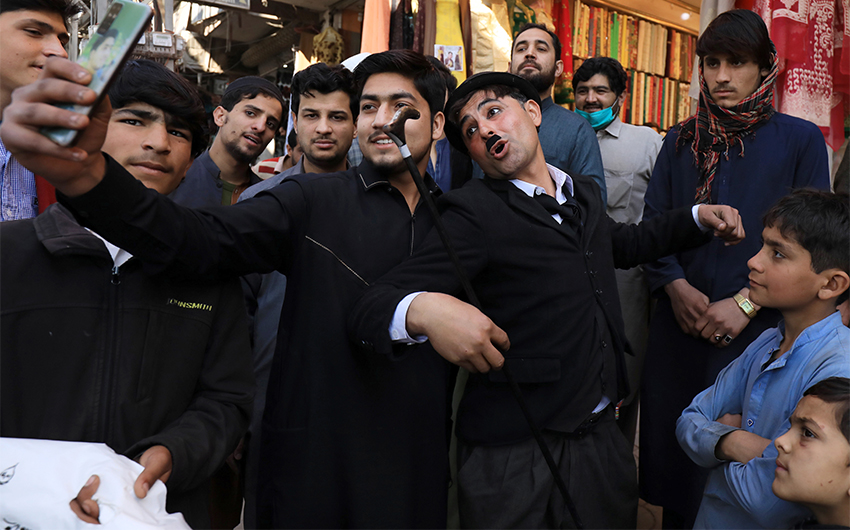


Usman Khan, 29, dressed up as Charlie Chaplin, poses for a photo with fans as he performs along the street in Peshawar, Pakistan, on January 27, 2021. (REUTERS)

In just two months, he has gained more than 800,000 followers on the social media platform Tik Tok — people, he says, from around the globe who find his comedy a welcome respite from the pandemic and its lockdowns and social-distancing.
Khan hopes film and television producers will notice him as well — and says if he ever became wealthy he would share his earnings with the poor.
The act is also a brief escape for Khan, who — like the real-life Chaplin before he shot to fame in Hollywood — comes from an impoverished family. Hawking toys does not bring in enough to cover daily expenses, he says.
“When I leave my home, I shut the door on my own problems and look to bring happiness to others.”


Nearly 25% of Pakistan’s primary schools enrolling girls operate as single-teacher ones— report

Updated 13 sec ago
Follow

Nearly 25% of Pakistan’s primary schools enrolling girls operate as single-teacher ones— report

  • Pakistan needs over 115,000 more teachers in primary schools enrolling girls to meet global benchmark of one teacher per 30 students, says report
  • Sixty percent of Pakistani primary schools enrolling girls are overcrowded, while 32% lack clean drinking water or toilets, says Tabadlab report

ISLAMABAD: Nearly 25% of Pakistan’s primary schools that enrolls girls operate as single-teacher ones, a report by a leading think tank said this week, calling on the government to devolve teacher recruitment powers, upskill underutilized teachers and introduce reforms to hire and promote faculty members. 

Pakistan faces an acute education crisis which is reflected in the fact that it has the world’s second-highest number of out-of-school children, an estimated 22.8 million aged 5-16 who are not in educational institutions, according to UNICEF. 

While poverty remains the biggest factor keeping children out of classrooms, Pakistan’s education crisis is exacerbated by inadequate infrastructure and underqualified teachers, cultural barriers and the impacts of frequently occurring natural disasters. 

According to “The Missing Ustaani,” a report published by Islamabad-based think tank Tabadlab and supported by Malala Fund and the Pakistan Institute of Education (PIE), Pakistan needs over 115,000 more teachers in primary schools with girls’ enrolment to meet the basic international benchmark of ensuring one teacher per 30 children. Currently, the average Student-to-Teacher Ratio (STR) across Pakistan’s primary schools with girls’ enrolment is 39:1, it said. 

“Approximately 60% of these schools are overcrowded, necessitating the recruitment of over 115,000 additional teachers nationwide,” the report said on Monday. “Compounding this, nearly 25% of primary schools with girls’ enrolment operate as single-teacher schools, placing immense pressure on the quality of education.”

It said the situation is more dire in Pakistan’s poverty-stricken southwestern Balochistan province, where nearly 52% of the schools are single-teacher only ones while the percentage decreases slightly in the southern Sindh province to 51 percent. 

The report said while the STR improves to 25:1 at the middle school level, acute shortages of subject specialists emerge as the top-priority concern for quality education in these schools.

“Furthermore, around 32% of primary schools with girls’ enrolment and 18% of middle schools face ‘critical infrastructural shortages’— lacking clean drinking water or toilets in addition to high STRs— which significantly affects girls’ attendance and learning, particularly during adolescence,” the report said. 

The report cited a set of priority recommendations to address Pakistan’s systemic teacher deployment challenges and improve educational equity for girls. 

It urged the government to devolve recruitment authority to school or cluster levels to enable timely, context-specific hiring. It also called upon authorities to reform teacher transfer and promotion policies to introduce school-specific postings with minimum service terms. 

This, it said, would reduce arbitrary transfers and improving continuity in classrooms. The report advised authorities to upskill surplus or underutilized primary teachers to support instruction at the middle school level, helping address subject-specialist shortages.

“Together, these reforms offer a pathway toward a more equitable, efficient, and responsive teaching workforce— one capable of improving learning outcomes and ensuring that every girl in Pakistan has access to a qualified teacher,” the report said. 

To tackle Pakistan’s education crisis, Prime Minister Shehbaz Sharif declared an ‘education emeregency’ in September 2024, stressing the importance of education for all.