

Lebanon PM threatens mass arrests over deadly clashes

1 / 3
Garbage bins, set on fire by demonstrators, block a road during a protest in Tripoli, Lebanon on January 26, 2021 against the lockdown and worsening economic conditions amid the spread of the COVID-19. (REUTERS/Omar Ibrahim )
2 / 3
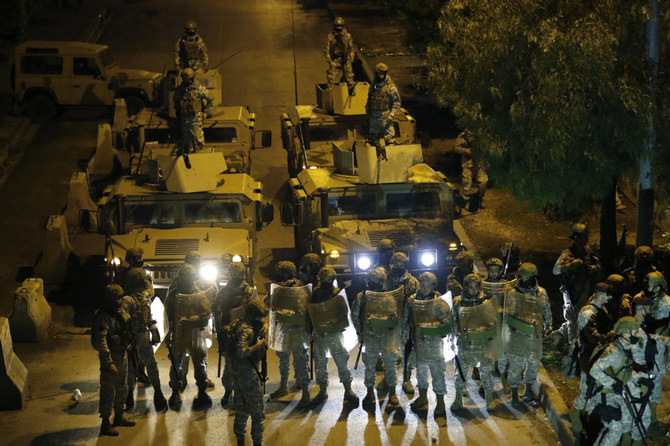
Lebanese soldiers prepare to move protesters from streets during a protest in Tripoli, Lebanon, on Jan. 29, 2021 gainst deteriorating living conditions and strict coronavirus lockdown measures. (AP Photo/Hussein Malla)
3 / 3
Prime Minister Hassan Diab. (AFP)
Short Url
Updated 31 January 2021
Follow

Lebanon PM threatens mass arrests over deadly clashes

  • Tripoli violence ‘an assault on the state,’ claims Diab
  • Beirut shooting sparks fears of more unrest

BEIRUT: Lebanon’s caretaker Prime Minister, Hassan Diab, broke his silence on Saturday to condemn days of violent protest in Tripoli, the country’s most impoverished city, as “an assault on the state and its integrity.”

“Everyone who participated in the riots will be arrested,” Diab said.

His comments followed deadly clashes during the week when protests at Lebanon’s extended coronavirus lockdown and worsening economic crisis turned violent.

Frustrations boiled over after 30-year-old Omar Taibi was shot by security forces during protests. The ensuing clashes left more than 220 people injured.

Protesters set fire to several buildings in Tripoli on Thursday as outrage grew.

Violence escalated quickly as molotov cocktails, hand grenades and stones were launched at the security forces, who responded with tear gas, rubber bullets and then live ammunition.

However, that did not deter others from expressing their outrage with the caretaker government as protests spread to other parts of the country.

On Saturday, groups of female protesters blocked the highway linking Tripoli, Lebanon’s second-largest city, with Akkar. The women complained that they were no longer able to secure basic needs for their families.

SPEEDREAD

The political dispute between Saad Hariri and the Free Patriotic Movement, led by Gebran Bassil, worsened on Saturday as both men swapped accusations.

Another group of protesters marched to the Beirut home of Mohamed Fahmi, Lebanon’s interior minister, to voice their anger at the security forces’ handling of the Tripoli protests.

A shooting in Beirut’s Hamra commercial district late on Saturday sparked fears of worsening violence in the capital.

However, security forces described the attack as “an isolated incident.”

A security source told Arab News: “The problem started between a delivery driver and one of the residents. Young men from the Syrian Social Nationalist Party interfered and defended the Syrian delivery driver, then started shooting into the air.”

After nearby residents appeared on the street, troops arrived and cordoned off the site, the source said.

Meanwhile, former prime minister Fouad Siniora, the leader of the Future Movement’s parliamentary group, warned that the violence in Tripoli has deepened Lebanon’s political divisions, making the formation of a rescue government even more difficult.

“The most dangerous thing about the current situation is the inability of the political forces to take initiative in determining a national rescue destination,” he said.

“Every sectarian party is waging two battles: A fierce internal battle to impose itself as its sole representative, and a grinding battle against other sects to identify the sect’s quota in the government.”

The political dispute between Saad Al-Hariri, Lebanon’s prime minister-designate, and the Free Patriotic Movement (FPM), led by Gebran Bassil, worsened on Saturday as both men swapped accusations.

Bassil urged Al-Hariri to “head immediately to the Baabda Palace and form a government in agreement and full partnership with the president — a government that enjoys broad political and national support.”

The FPM described the demand for partnership in the government formation as “a right.”

However, the Future Movement responded later, accusing the FPM of “reducing the rights of Christians to the rights of a few men.”


International law at ‘breaking point’ amid ‘epidemic’ of conflicts: Survey

Updated 02 February 2026
Follow

International law at ‘breaking point’ amid ‘epidemic’ of conflicts: Survey

  • Gaza war highlighted as one of the most concerning areas; atrocities in Sudan also noted
  • ‘Well over’ 100,000 civilians have been killed in past 18 months amid ‘rampant impunity’

LONDON: A new survey of 23 conflicts worldwide has said more than 100,000 civilians have been killed in the past 18 months, with adherence to international humanitarian law reaching “a critical breaking point.”

The “War Watch” survey highlighted the war in Gaza as one of the most concerning areas in an “epidemic” of violence, while also noting concerning levels of atrocities in Sudan.

Taken under the auspices of the Geneva Academy of International Humanitarian Law and Human Rights, the survey covers July 2024 to the end of 2025.

Lead author Stuart Casey-Maslen said: “Atrocity crimes are being repeated because past ones were tolerated. Our actions — or inaction — will determine whether international humanitarian law vanishes altogether.”

In Gaza, local authorities say 18,592 children and 12,400 women have been killed since Israel invaded the Palestinian enclave in October 2023. 

The report said Gaza’s overall population had declined by “about 254,000 people, a 10.6 percent decline compared with pre-conflict estimates,” making it one of the most deadly conflicts in the world. It noted that despite a ceasefire being agreed late last year, civilian casualties have continued.

In Sudan, after the fall of the city of El-Fasher to the Rapid Support Forces last October, widespread reports of survivors “being gang-raped by RSF fighters” — including in the presence of relatives — were recorded in numerous instances.

The survey said: “We do not know how many civilians have been killed in the conduct of hostilities during armed conflicts in 2024 and 2025, but we do know that the number is well over 100,000 in each of the two years.”

It added that “serious violations of international humanitarian law (IHL) were wrought … on a huge scale and with rampant impunity.” 

The report said IHL and the laws of armed conflict, established after the Second World War to protect civilians, must be upheld by every state under the Geneva Conventions “in all circumstances.”

It added: “Addressing widespread impunity for serious violations of international law should be treated as a policy priority.”

The report suggested several policy ideas to reduce the number of people suffering, including arms export bans for countries “where there is a clear risk that the arms or ammunition to be delivered will be used to commit or facilitate serious violations” of IHL.

It also proposed limiting the use of drones and artificial intelligence targeting in civilian areas, as well as unguided gravity bombs or inaccurate long-range artillery.

In addition, it called for “systematic prosecution of war crimes,” saying more political and financial support need to be given to the International Criminal Court by members of the international community.