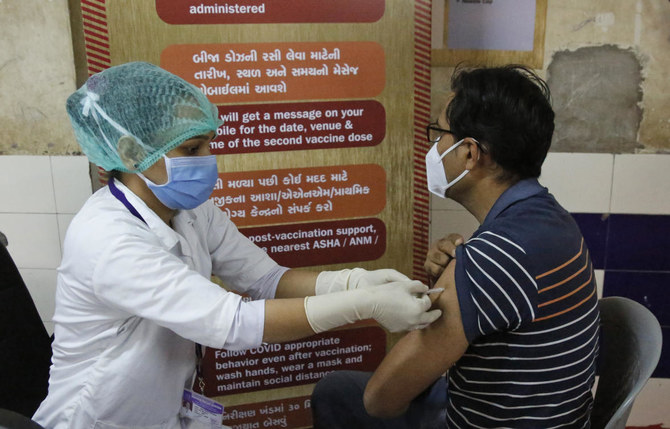
NEW DELHI: The digital platform anchoring India’s massive COVID-19 vaccination drive will be able to handle up to 10 million shots daily to meet the country’s target of covering 300 million people by July-August, a government official told Reuters.
India, which has the world’s second-highest number of coronavirus cases, is relying on CoWIN to link beneficiaries with vaccines in what the government touts as the biggest inoculation campaign anywhere.
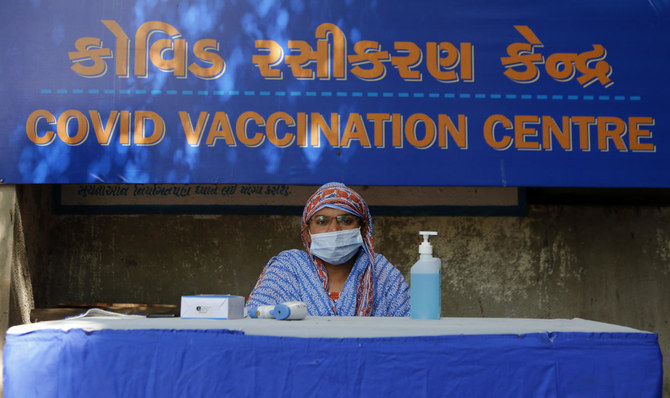
The world’s most populous country after China has vaccinated around three million health care workers in the first two weeks of the campaign, at a rate of just over 200,000 a day on average, but this will have to be raised many times over if India is to meet its summer coverage target.
Though initial glitches in the software slowed the immunization program, which began on Jan. 16 with frontline workers, the government says modifications have been made to ensure there is no such repeat.
“Big numbers won’t be a problem for us,” R.S. Sharma, who chairs a government group overseeing CoWIN, said in a Zoom interview. “We will be able to do 10 million vaccinations per day.”
Sharma said CoWIN would be integrated into government contact-tracing app “Aarogya Setu,” or Health Bridge, which has been downloaded by around 150 million people.
It is using a vaccine developed at home by Bharat Biotech and the Indian Council of Medical Research, and another licensed from Oxford University and AstraZeneca.
In the coming months, India is expected to approve two more vaccines, Russia’s Sputnik V and Cadila Healthcare’s ZyCov-D.
Sharma said individuals would be able to choose vaccination slots and get QR-coded certificates once they have taken their shots through CoWIN, allowing them to carry a proof that can be used for, say, air or foreign travel.
“It’s not a fad,” he said, “It cannot be done without technology.”
India, the world’s biggest vaccine maker, is also gifting or selling shots to more than a dozen countries, and Sharma said there had already been some international interest in using the CoWIN platform, including from South Africa.
At home, Sharma said CoWIN would use online and offline systems to register beneficiaries, including through telephone help lines and walk-in centers.
“There will be millions of registrations every day and the system should be able to handle it effortlessly,” he said.
Discussions were still underway on how to inoculate such large numbers of people, including possibly using a combination of government and private health facilities, said Sharma, who is also part of a national expert group on vaccine administration.
With 10.7 million confirmed COVID-19 infections, India, with a total population of nearly 1.4 billion, trails only the United States’ tally.
It reported 18,855 new cases in the past 24 hours, the highest in three weeks, while deaths rose by 163 to a total of 154,000.


India’s vaccination platform readied to handle 10m shots daily
https://arab.news/8f5xf
India’s vaccination platform readied to handle 10m shots daily

- In the coming months, India is expected to approve two more vaccines, Russia’s Sputnik V and Cadila Healthcare’s ZyCov-D
- India, the world’s biggest vaccine maker, is also gifting or selling shots to more than a dozen countries


India, Arab League target $500bn in trade by 2030
- It was the first such gathering of India–Arab FMs since the forum’s inauguration in 2016
- India and Arab states agree to link their startup ecosystems, cooperate in the space sector
NEW DELHI: India and the Arab League have committed to doubling bilateral trade to $500 billion by 2030, as their top diplomats met in New Delhi for the India–Arab Foreign Ministers’ Meeting.
The foreign ministers’ forum is the highest mechanism guiding India’s partnership with the Arab world. It was established in March 2002, with an agreement to institutionalize dialogue between India and the League of Arab States, a regional bloc of 22 Arab countries from the Middle East and North Africa.
The New Delhi meeting on Saturday was the first gathering in a decade, following the inaugural forum in Bahrain in 2016.
India’s Foreign Minister S. Jaishankar said in his opening remarks that the forum was taking place amid a transformation in the global order.
“Nowhere is this more apparent than in West Asia or the Middle East, where the landscape itself has undergone a dramatic change in the last year,” he said. “This obviously impacts all of us, and India as a proximate region. To a considerable degree, its implications are relevant for India’s relationship with Arab nations as well.”
Jaishankar and his UAE counterpart co-chaired the talks, which aimed at producing a cooperation agenda for 2026-28.
“It currently covers energy, environment, agriculture, tourism, human resource development, culture and education, amongst others,” Jaishankar said.
“India looks forward to more contemporary dimensions of cooperation being included, such as digital, space, start-ups, innovation, etc.”
According to the “executive program” released by India’s Ministry of External Affairs, the roadmap agreed by India and the League outlined their planned collaboration, which included the target “to double trade between India and LAS to US$500 billion by 2030, from the current trade of US$240 billion.”
Under the roadmap, they also agreed to link their startup ecosystems by facilitating market access, joint projects, and investment opportunities — especially health tech, fintech, agritech, and green technologies — and strengthen cooperation in space with the establishment of an India–Arab Space Cooperation Working Group, of which the first meeting is scheduled for next year.
Over the past few years, there has been a growing momentum in Indo-Arab relations focused on economic, business, trade and investment ties between the regions that have some of the world’s youngest demographics, resulting in a “commonality of circumstances, visions and goals,” according to Muddassir Quamar, associate professor at the School of International Studies, Jawaharlal Nehru University.
“The focus of the summit meeting was on capitalizing on the economic opportunities … including in the field of energy security, sustainability, renewables, food and water security, environmental security, trade, investments, entrepreneurship, start-ups, technological innovations, educational cooperation, cultural cooperation, youth engagement, etc.,” Quamar told Arab News.
“A number of critical decisions have been taken for furthering future cooperation in this regard. In terms of opportunities, there is immense potential.”


