

PIF: Saudi Aramco may sell more shares if market conditions are right

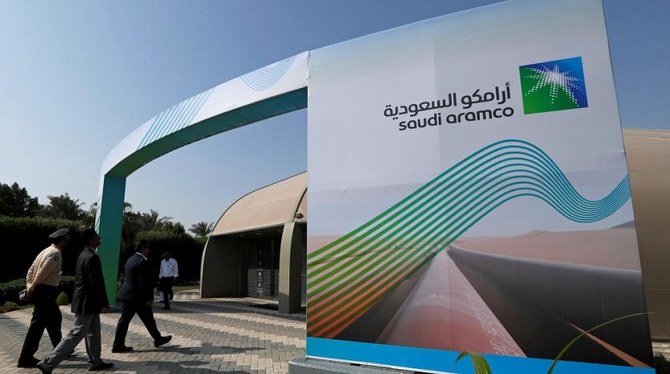
The logo of Aramco is seen as security personnel walk before the start of a press conference by Aramco at the Plaza Conference Center in Dhahran, Saudi Arabia November 3, 2019. (REUTERS/File)
Short Url
Updated 27 January 2021
Follow

PIF: Saudi Aramco may sell more shares if market conditions are right

  • Kingdom’s sovereign wealth fund has set out a plan to increase assets to $400 billion
  • The Saudi government sold over 1.7 percent of Aramco in an initial public offering (IPO) in 2019

RIYADH: Saudi Aramco may consider selling more shares in the oil giant if market conditions are right, the head of the Kingdom’s sovereign wealth fund, Yasir Al-Rumayyan, said on Tuesday in a televised news briefing.

The Saudi government sold over 1.7 percent of Aramco in an initial public offering (IPO) in 2019 that raised a record $29.4 billion.

The listing has triggered more IPOs in the Kingdom, which is also seeking to deepen its capital markets under reforms aimed at reducing its reliance on oil.

Al-Rumayyan asserted that there is no direct relationship between the balance sheet and finances of Aramco and Saudi Arabia’s Public Investment Fund (PIF) and any listing would depend “if they see the right market is in the right condition.”

The fund’s governor also told reporters the PIF plans to increase its assets from SR570 billion ($152 billion) to SR1.5 trillion ($400 billion).

The fund has become a fundamental pillar for the sustainability of the Saudi economy and is directly related to the Kingdom’s Vision 2030, he added.

Al-Rumayyan said that the PIF was currently developing the eight basic pillars of the fund’s strategy for the years 2021-2025, and would focus on local investments within the PIF’s new strategy, which was announced by Crown Prince Mohammed bin Salman last week.

He added that they would allocate four portfolios for local investment and two portfolios for foreign investments, with plans to also invest SR1 trillion ($267 billion) in new projects in the next five years

Al-Rumayyan said that financing new investments from the fund’s money and assets would be granted by the government, and it would rely on profits generated by their current companies to fund future projects, adding that the PIF has launched more than 30 new companies.

In 2017, the fund announced it would invest $45 billion in Softbank’s inaugural $100 billion technology fund. “Softbank is reaching an all-time high,” Al-Rummayan said. “The higher the risk the higher the returns. We always look to diversity in our bets and investments in different sectors and geography.”

Another high profile PIF-backed company is Lucid Motors, the Californian electric vehicle carmaker the fund backed with a $1 billion investment in 2018. Media reports have claimed the carmaker is in talks with the PIF to build an electric vehicle factory in the
Kingdom, reportedly near Jeddah.

“We are always open for any good ideas,” the governor said. “One of the things that we would like to provide for the investor, is how we can open up many opportunities for them,” he added.

Al-Rumayyan said the fund has started talks with a number of other potential companies for investment, but declined to give any specific details.

“We are at very advanced stages, but you know how complicated these contracts can be with all the terms, conditions and negotiations. But we are at very advanced stages with many companies and during this year we will see many companies coming in.”


Lebanese social entrepreneur Omar Itani recognized by Schwab Foundation

Updated 23 January 2026
Follow

Lebanese social entrepreneur Omar Itani recognized by Schwab Foundation

  • FabricAID co-founder among 21 global recipients recognized for social innovation

DAVOS: Lebanon’s Omar Itani is one of 21 recipients of the Social Entrepreneurs and Innovators of the Year Award by the Schwab Foundation for Social Entrepreneurship.

Itani is the co-founder of social enterprise FabricAID, which aims to “eradicate symptoms of poverty” by collecting and sanitizing secondhand clothing before placing items in stores in “extremely marginalized areas,” he told Arab News on the sidelines of the World Economic Forum in Davos, Switzerland.

With prices ranging from $0.25 to $4, the goal is for people to have a “dignified shopping experience” at affordable prices, he added.

FabricAID operates a network of clothing collection bins across key locations in Lebanon and Jordan, allowing people to donate pre-loved items. The garments are cleaned and sorted before being sold through the organization’s stores, while items that cannot be resold due to damage or heavy wear are repurposed for other uses, including corporate merchandise.

Since its launch, FabricAID has sold more than 1 million items, reached 200,000 beneficiaries and is preparing to expand into the Egyptian market.

Amid uncertainty in the Middle East, Itani advised young entrepreneurs to reframe challenges as opportunities.

“In Lebanon and the Arab world, we complain a lot,” he said. Understandably so, as “there are a lot of issues” in the region, resulting in people feeling frustrated and wanting to move away. But, he added, “a good portion of the challenges” facing the Middle East are “great economic and commercial opportunities.”

Over the past year, social innovators raised a combined $970 million in funding and secured a further $89 million in non-cash contributions, according to the Schwab Foundation’s recent report, “Built to Last: Social Innovation in Transition.”

This is particularly significant in an environment of geopolitical uncertainty and at a time when 82 percent report being affected by shrinking resources, triggering delays in program rollout (70 percent) and disruptions to scaling plans (72 percent).

Francois Bonnici, director of the Schwab Foundation for Social Entrepreneurship and a member of the World Economic Forum’s Executive Committee, said: “The next decade must move the models of social innovation decisively from the margins to the mainstream, transforming not only markets but mindsets.”

Award recipients take part in a structured three-year engagement with the Schwab Foundation, after which they join its global network as lifelong members. The program connects social entrepreneurs with international peers, collaborative initiatives, and capacity-building support aimed at strengthening and scaling their work.