

Locals say Arab falconers have uplifted impoverished communities in Pakistani hunting towns

Wildlife officials release a falcon in Peshawar on Oct. 23, 2019. (AFP/File)
Short Url
Updated 25 January 2021
Follow

Locals say Arab falconers have uplifted impoverished communities in Pakistani hunting towns

  • Falconers from Saudi Arabia, UAE, Qatar and Bahrain arrive in Pakistan to hunt houbara bustard birds between December to February every year
  • World Wildlife Fund and other conservationists have raised alarm about continued hunting of the species in the absence of annual population surveys

LAHORE – Winter expeditions to Pakistan by Gulf falconers to hunt the rare houbara bustard every year have helped uplift impoverished hunting towns, some locals say, though conservationists have raised alarm about continued hunting in the absence of annual population surveys of the birds.
The International Union for Conservation of Nature lists the bustard — a shy, rare bird, the size of a chicken — as a vulnerable species with a global population of between 50,000 and 100,000. The bird has nearly vanished on the Arabian Peninsula.
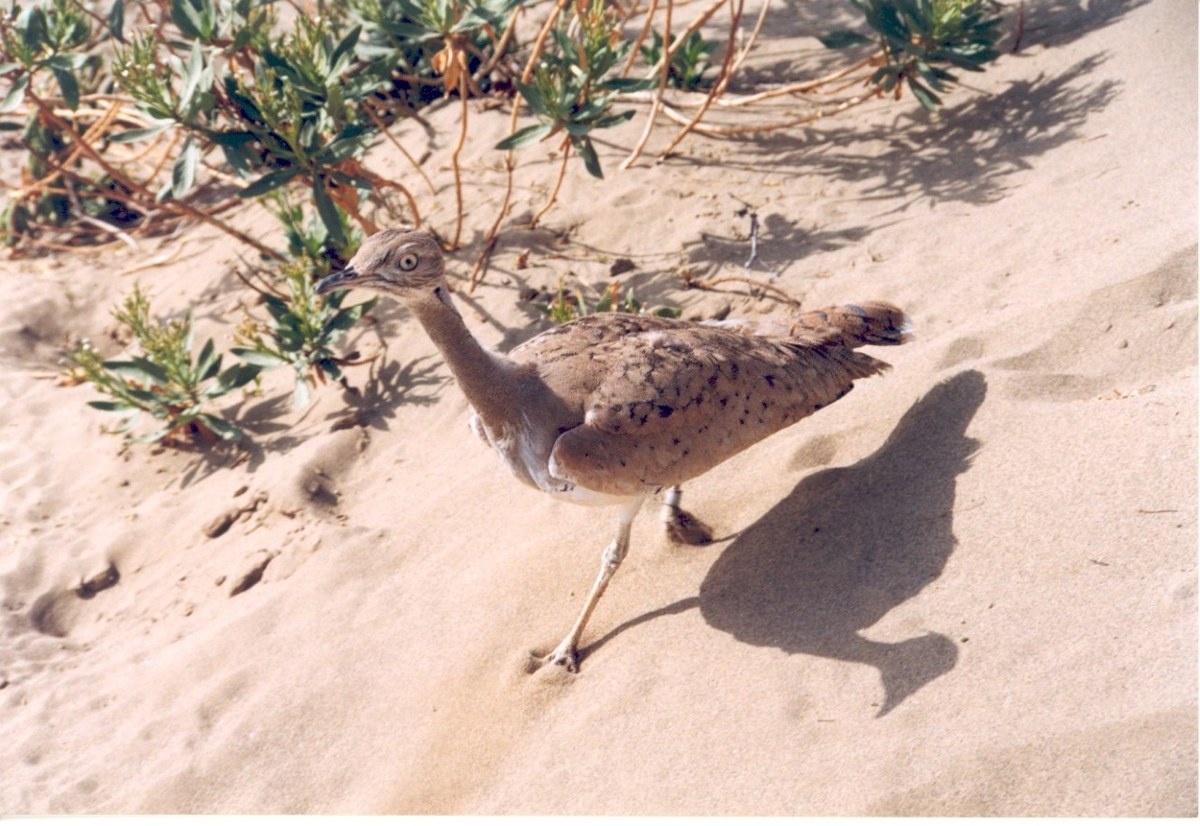


A released houbara bustard bird is seen in this undated photo after being released from poachers. (Photo courtesy: Houbara Foundation International Pakistan)

The World Wildlife Fund has recommended that the Pakistan government stop issuing hunting permits for the bustard and completely ban hunting “with immediate effect,” saying controlled hunting should be allowed only after carrying out population surveys on an annual basis “with the involvement of relevant stakeholders to determine the population status and trends of the species in the country.”
For now, between the months of December and February, royals from Saudi Arabia, UAE, Qatar and Bahrain arrive in Pakistan and partake in falconry — the hunting of wild animals in their natural state and habitat by means of a trained bird of prey. Each hunting party pays $100,000 to be assigned a territory, another $100,000 for a ten-day permit to hunt 100 birds, and $1,000 for each falcon used in the hunt, according to a 2019 report published in The Economist.
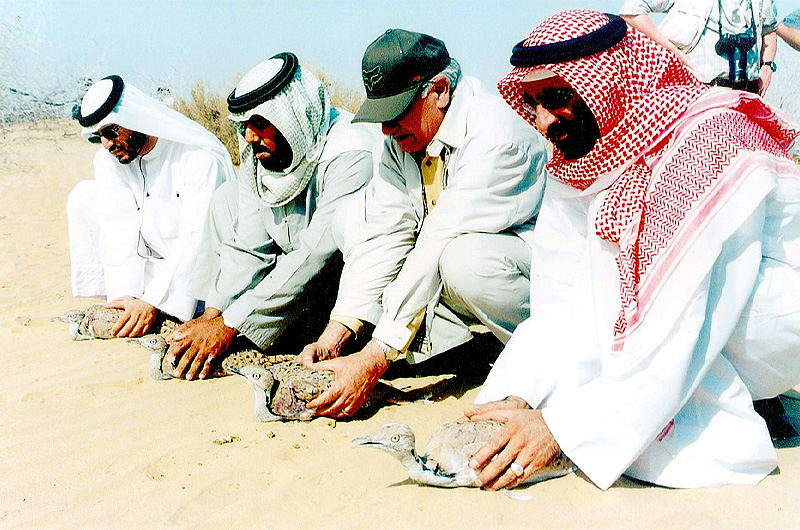


In this undated photo, Mohamed Ahmed Al Bowardi, managing director of the Environment Agency in Abu Dhabi, and Pakistani Brigadier Mukhtar Ahmed, President of the Houbara Foundation International Pakistan, release houbara bustard birds. (Photo courtesy: Houbara Foundation International Pakistan)

Locals say the visitors have helped develop the remote towns across Pakistan where the hunts take place, setting up health, education, water supply and infrastructural projects worth millions of dollars. Officials at the Houbara Foundation International Pakistan (HFIP) argue sustainable hunting of the bustard is the best means of conservation.
“Not a single person from the last three generations of my family saw a school but my children are going to school. We spent our lives in mud huts, in the freezing cold and the blistering heat; now, we are living in a colony with all of life’s facilities,” Ali Ahmad, 32, who lives in Punjab’s Rahim Yar Khan, told Arab News.
He said this was because of “Sheikhs from the UAE” who had come to his hometown to hunt.
“They’ve done a lot of development projects here, and made our lives livable,” Ahmad added.
Another local, Nina Kumari, said her 12-year-old daughter was admitted at Sheikh Zayed Medical Complex Rahim Yar Khan, a facility built by the UAE government and named after the founder of the Emirates.
“Medicine is free and attendants get free meals,” Kumari said in a phone interview.
Other locals said hunting permit fees and jobs created around the hunting business had helped improve their lives.
In 2014, the government had imposed a “temporary moratorium” on hunting the bustard. In August 2015, the Supreme Court ordered a blanket ban, lifting it the following year after the government argued houbara hunting was a “cornerstone” of Pakistan’s relations with the Middle Eastern rulers and sustainable hunting was a means of conserving the vulnerable bird.
Officials at the Houbara Foundation International Pakistan (HFIP) concurred, telling Arab News the hunts by Arab dignitaries in designated areas had contributed toward the protection and conservation of the otherwise threatened species.
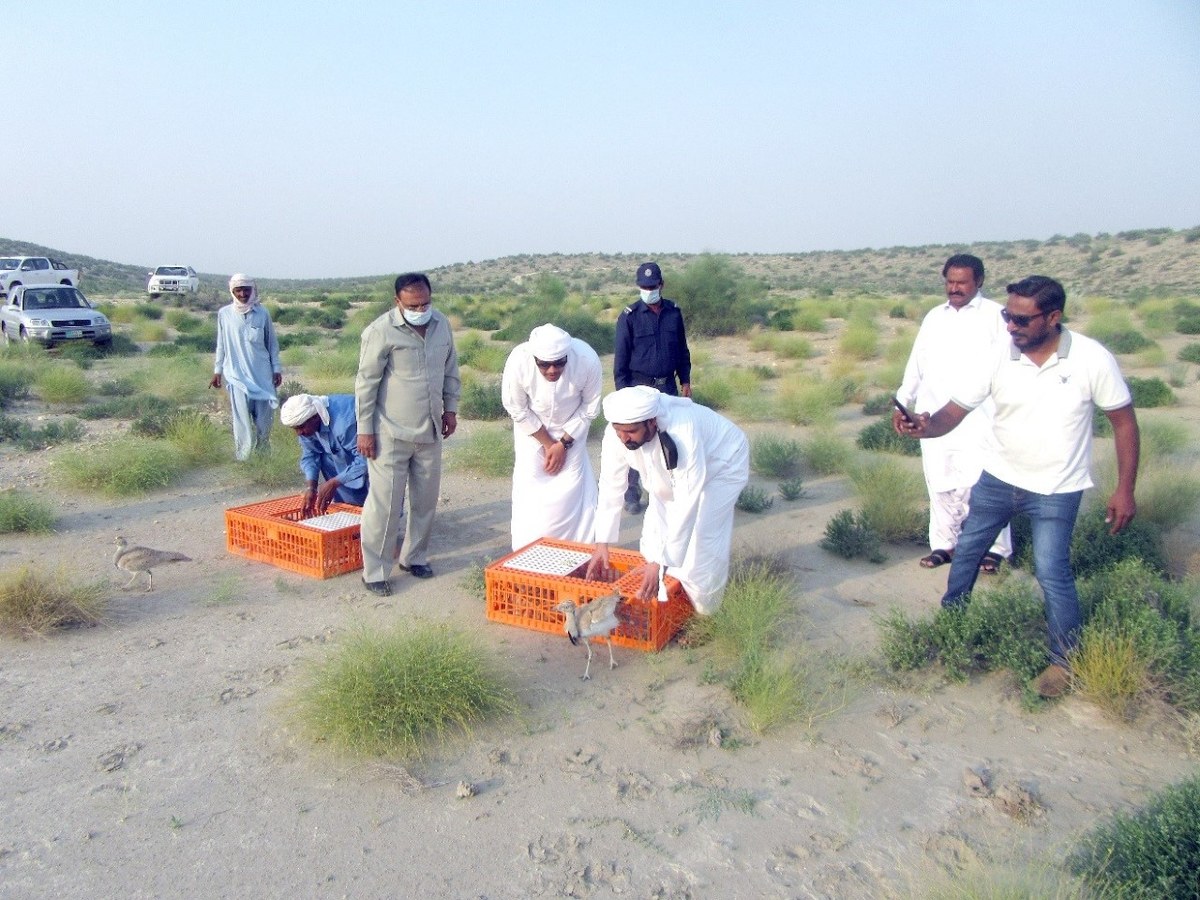


Officials from the International Fund for Houbara Conservation (IFHC) UAE, along with the Houbara Foundation International Pakistan release 250 houbara bustard birds in Kot Digi, Sindh, Pakistan on October 21, 2020. (Photo courtesy: Houbara Foundation International Pakistan)

“The Arab dignitaries release houbara in the deserts of Pakistan in the month of February and March every year,” an official at the Lahore-based HFIP, who declined to be named, said. “Last year, 3,200 houbara were released. The number of released houbara is bigger than the number hunted.”
He said Arab hunters had also initiated several projects to develop areas marked as protected for the houbara.
“Several health, educational, water supply and infrastructural projects worth millions of dollars have been completed with the financial help of UAE governments,” the HFIP official said. “The UAE government also provides funds for the protection and conservation of houbara on Pakistani soil.”


Sindh government announces compensation as 15 killed, 65 missing after Karachi mall blaze

Updated 9 sec ago
Follow

Sindh government announces compensation as 15 killed, 65 missing after Karachi mall blaze

  • 15 confirmed dead include firefighter, $36,000 per victim pledged as search continues
  • Traders seek urgent rehabilitation after 1,200 shops destroyed in Saddar building inferno

ISLAMABAD: The Sindh provincial government on Monday announced compensation for victims of a deadly fire at a major shopping plaza in Karachi, saying 15 people were confirmed dead while 65 were reported missing as recovery operations continued at the site.

The blaze broke out late Saturday at Gul Plaza in Karachi’s Saddar business district and spread rapidly through multiple floors, trapping shoppers and workers inside the densely packed building. 15 deaths have been confirmed so far, including a firefighter, while debris removal and search operations remain underway, Sindh Chief Minister Murad Ali Shah told reporters on Monday afternoon. 

Deadly fires in commercial buildings are a recurring problem in Karachi, a city of more than 20 million people, where overcrowding, outdated infrastructure and weak enforcement of fire safety regulations have repeatedly resulted in mass casualties and heavy economic losses.

Announcing relief measures, Shah said the provincial government would provide Rs10 million ($36,000) in compensation to the family of each person killed in the fire, which destroyed over 1,200 shops in the plaza. 

“On behalf of the government of Sindh, we will give one crore rupees to every person who has lost his life,” Shah said at a press conference, adding that payments would begin once documentation was completed.

Shah said one of the15 victims was a firefighter he identified by his first name, Furqan, who died while battling the blaze, noting that Furqan’s father had also been killed in the line of duty years earlier. Shah said the Karachi mayor had been directed to ensure care for the firefighter’s family.

The chief minister also announced the formation of a joint committee involving provincial officials and the Karachi Chamber of Commerce and Industry (KCCI) to assess losses and oversee rehabilitation of affected traders. He said temporary arrangements were being explored to relocate 1,000 to 1,200 shops so businesses could resume operations as quickly as possible.

Citing past precedents such as the Bolton Market arson and Cooperative Market fire, Shah said similar compensation and recovery mechanisms had helped traders rebuild their livelihoods and would guide the current response.

Karachi has previously suffered devastating commercial fires that prompted large-scale compensation and rehabilitation efforts. 

In 2009, a massive arson attack at Bolton Market, one of the city’s oldest wholesale hubs, destroyed hundreds of shops and disrupted supply chains across the city. The federal and Sindh governments later approved special relief packages that funded compensation, reconstruction and the rebuilding of fire-hit markets. More recently, fires at the Cooperative Market and Victoria Building areas again wiped out clusters of small traders, leading authorities to reuse leftover funds from earlier relief schemes to compensate affected businesses. Officials say these precedents have shaped the province’s current approach to combining government support with trader-led assessments to restore livelihoods after major disasters.

KCCI said on Sunday preliminary assessments showed more than 1,000 small and medium-sized businesses were completely destroyed in the latest fire, leaving thousands of families without incomes. Traders have urged both provincial and federal authorities to announce a comprehensive rehabilitation package.

Authorities have ordered a formal inquiry into the incident, with Shah stressing that the investigation would focus on identifying systemic failures rather than assigning blame.

He said a fire safety audit covering 145 buildings, conducted in 2024, would now be enforced immediately, alongside mandatory installation of fire alarms in commercial markets across the city.

Prime Minister Shehbaz Sharif has also offered full federal support, calling for a “coordinated and effective system” to control fires quickly in densely populated urban areas and prevent similar tragedies in the future.

Battling large fires in Karachi’s congested commercial districts remains notoriously difficult. Many markets and plazas are built with narrow access points, encroachments and illegal extensions that block fire tenders, while buildings often lack functioning fire exits, alarms or sprinkler systems. 

Although safety regulations exist, inspections are sporadic and penalties rarely enforced, allowing hazardous wiring and flammable materials to go unchecked — conditions that enable fires to spread rapidly and magnify human and economic losses.