

From white sand beaches to orange groves, Saudi Arabia’s Tabuk has it all

Tabuk is one of the most important tourist destinations in the Kingdom, home to major heritage sites. (SPA)
Short Url
Updated 25 January 2021
Follow

From white sand beaches to orange groves, Saudi Arabia’s Tabuk has it all

  • Tabuk has much to explore, such as the ancient Tabuk Castle, one of the many archaeological sites, the old buildings of Hijaz Railway Station and Ain Sukkar, which is one of the city’s oldest water springs

JEDDAH: From the dark, deep blue waters off the coast to the surrounding valleys and orange farms, the city of Tabuk has it all.
The city has enjoyed a surge of tourists recently as many Saudis have opted to visit new regions and cities across the nation due to the restrictions on foreign travel.
Families and groups can explore Tabuk’s attractions either on their own or as part of a tour group through the Saudi Winter season website, which is registered with the Saudi Tour Guides Association.
Tabuk is one of the most important tourist destinations in the Kingdom, home to major heritage sites. Visitors driving to the city are engulfed by mesmerising mountains with glimpses of the Red Sea to the west until they finally enter the city limits.
Manar Al-Harthi, a private sector worker in Jeddah, traveled with her husband and family recently and was in awe of the city’s varied landscapes and beauty.
“The city’s amenities were really amazing. You had a variety of restaurants if you’d want to eat out, lots of fresh local produce for picnics, great beaches to relax and enjoy an outdoor excursion, and so much more,” she told Arab News. “This is our first time to the area. The people are so welcoming and we’ll be back for a second visit soon.”
What attracted her is not only the diversity of the geographical features of the city but how unspoilt it is.

HIGHLIGHT

Families and groups can explore Tabuk’s attractions either on their own or as part of a tour group through the Saudi Winter season website, which is registered with the Saudi Tour Guides Association.

It is said that Tabuk is the “gateway to the north,” and the relics it houses reflect the successive civilizations that inhabited it. It is also called “Tabuk Al-Ward” (Tabuk of roses) because its vast rose farms export their produce to the world.
“Not only did we visit the rose farms, but we also went to the orange groves and discovered that we have kumquats. They were absolutely delicious and I’ve never seen them grown here in Saudi Arabia before. You can see how fertile the soil is as we passed by the many farms to get here,” she said.
Tabuk has much to explore, such as the ancient Tabuk Castle, one of the many archaeological sites, the old buildings of Hijaz Railway Station and Ain Sukkar, which is one of the city’s oldest water springs.
Tour operators often include the most beautiful tourist oases on the Tabuk Mountains in their packages. One of those is Tayyib Asim, which is a few hours from the city, 314 meters above sea level, and overlooks the Gulf of Aqaba. It is known for its many palm trees, reeds, and clean water springs, making it more like a very beautiful nature reserve.
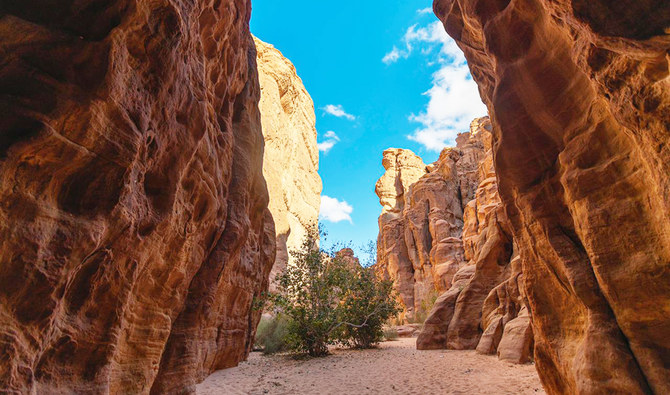
Tucked between towering red sandstone escarpments and canyon peaks, the valley of Wadi Al-Disa is known for its abundance of crystal-clear stream and palm trees. Lying approximately 2 hours away from the city and secluded from any kind of pollution, the area is ideal for hiking and camping out in the canyon and provides some of the best views of the heavens, a dream for stargazers.


‘Stability can’t be bought’: Saudi ministers extol benefits of long-term reform in a fragmented world

Updated 6 sec ago
Follow

‘Stability can’t be bought’: Saudi ministers extol benefits of long-term reform in a fragmented world

  • They outline during discussion at the World Economic Forum in Davos the ways in which the Kingdom is capitalizing on stability as a competitive advantage
  • They highlight in particular the use of predictable policymaking, disciplined public finances, and long-term planning under Saudi Vision 2030

DAVOS: Stability is the crucial ingredient for long-term economic growth, especially in an increasingly fragmented global economy, Saudi ministers said on Thursday at the World Economic Forum in Davos.

It is not something that can be purchased or improvised, said Faisal Alibrahim, the minister of economy and planning, it must be developed patiently.

“You have to build it, accumulate it over time, for it to be the right kind of stability,” he said. “We treat it as a discipline,”

Speaking during a panel discussion on the Saudi economy, Alibrahim and Finance Minister Mohammed Al-Jadaan outlined the ways in which the Kingdom has sought to capitalize on stability as a competitive advantage.

They highlighted in particular the use of predictable policymaking, disciplined public finances, and long-term planning under the Kingdom’s Vision 2030 plan for national development and diversification.

Al-Jadaan said governments and businesses alike are operating in a world where uncertainty has become the norm, which places a greater burden on policymakers to reduce ambiguity wherever possible.

“Businesses can price tariffs, they can price taxes,” he said. “What they find very difficult to price is ambiguity. We are trying to ensure that we build that resilience within our economy and give the private sector that predictability that they need.”

This focus on predictability, he added, has been central to Saudi Arabia’s economic transformation, by helping the private sector to plan for the long term while the government undertakes deep structural reform.

Alibrahim noted that trust has become a big factor in global trade and investment, particularly as geopolitical tensions and economic fragmentation intensify.

In a fragmenting world, one of the rarest things now is the idea that a “commitment made today will be honored tomorrow,” he said. Yet trust shapes how the world trades and how markets remain active, because it means participants can predict what will happen, he added. Stability therefore becomes a “rare currency, and even a competitive edge.”

He also said that reform on paper was not enough; it must be coupled with streamlined regulation and continuous engagement, so that businesses can develop long-term thinking and navigate uncertainty with more confidence.

Al-Jadaan framed Saudi Vision 2030 as a multiphase journey that began with structural reforms, followed by an execution-heavy phase, and is now entering a third stage focused on the maximization of impact.

He said the Kingdom was in a phase of “learning, reprioritizing and staying the course,” would make bold decisions, and had the “courage to continue through difficulties.” A key anchor of all this, he added, was discipline in relation to public finance.

“You cannot compromise public finance for the sake of growth,” Al-Jadaan said. “If you spend without restraint, you lose your anchor while the economy is still diversifying.”

This discipline underpins what he described as Saudi Arabia’s “deficit by design” — in other words, borrowing strategically to fund capital expenditure that supports long-term growth, rather than consumption.

“If you borrow to spend on growth-enhancing investment, you are safe,” he said. “If you borrow to consume today, you are leaving the burden to your children.”

Alibrahim said the focus in the next phase of Vision 2030 will be on the optimal deployment of capital, ensuring the momentum continues while costs are tightly managed.

Looking ahead, both ministers emphasized the importance of long-term planning, which can be a challenge for some countries constrained by short election cycles.

“If you cannot take a long-term view in a turbulent world, it becomes very difficult,” Al-Jadaan said.

“Success stories like Singapore, South Korea and China were built on decades-long plans, pursued through good times and bad.”

The ministers’ discussion points were echoed by international participants. Noubar Afeyan, founder and CEO of life sciences venture capital firm Flagship Pioneering, said that by utilizing technology, including artificial intelligence, alongside a strategic vision in the form of Vision 2030, the Kingdom had been able to turn vulnerabilities into strengths, becoming not only self-sufficient but a potential exporter of innovation and intellectual property.

“Uncertainty opens up opportunities for countries that might otherwise be overlooked,” he added.

“Saudi Arabia, with Vision 2030, is positioning itself to not only address its own challenges but also become a net exporter of innovation and expertise.”

Ajay Banga, the president of the World Bank, said Vision 2030 had helped create “physical and human infrastructure” that allows Saudi Arabia to capitalize on its demographic dividend.

Jennifer Johnson, CEO of investment management firm Franklin Templeton, said Saudi policymakers stood out for their openness and curiosity.

“I have spoken to Saudi ministers and they ask what they need to do — that doesn’t happen often,” she said.