

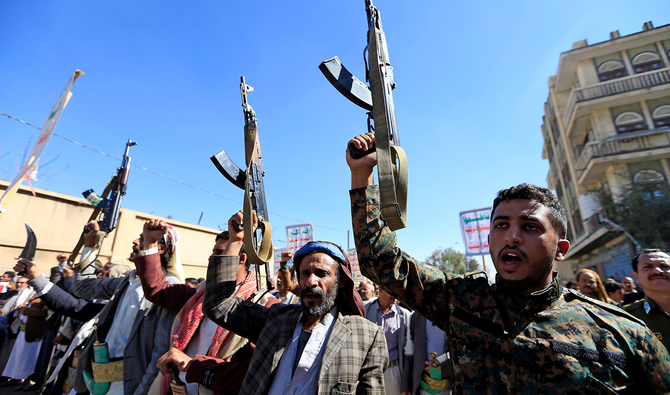
Yemeni government and Houthis hold prisoner swap meeting

The Houthi visit to Amman is the first since the US designated the group as a foreign terrorist organization (FTO). (AFP)
Short Url
Updated 24 January 2021
Follow

Yemeni government and Houthis hold prisoner swap meeting

  • Previous talks led to release of 1,065 inmates

AL-MUKALLA: Yemen and the Houthi militia held a new round of prisoner swap talks on Sunday, the UN and Yemeni officials said.

The UN Special Envoy for Yemen Martin Griffiths said that the Supervisory Committee on the Implementation of the Prisoners and Detainees Exchange Agreement, which includes the warring parties in Yemen, held its fifth meeting in Amman. 

Griffiths called on them to focus on securing the release of vulnerable people and sick and elderly detainees.

“I urge the parties to prioritize in their discussions the immediate and unconditional release of all sick, wounded, elderly and children detainees as well as all arbitrarily detained civilians, including women,” he said. “I also urge the parties to discuss and agree on names beyond the Amman meeting lists to fulfill their Stockholm commitment of releasing all conflict-related detainees as soon as possible.” 

Previous talks led to the release of 1,065 inmates in October and rekindled hopes of striking a deal to end the war.

Griffiths, buoyed by that success, has pushed Yemeni parties into accepting his peace ideas, known as the Joint Declaration. This suggests putting into place a nationwide truce followed by economic measures to alleviate the world’s worst humanitarian crisis. 

A Yemeni government official with knowledge of the talks, who preferred to remain anonymous, told Arab News that the talks would be based on previous ones in Amman and might lead to the release of 301 detainees on both sides.

The government aims to secure the release of prominent military and political detainees who were mentioned in UN Security Council Resolution 2216, such as former Defense Minister Mahmoud Al-Subaihi and the Yemen president’s brother Nasser Mansour Hadi.

Abdul Kader Al-Murtada, head of the Houthi prisoner affairs committee, was in Amman on Saturday to take part in the meeting.

The Houthi visit to Amman is the first since the US designated the group as a foreign terrorist organization (FTO).

Yemenis on Sunday launched a social media campaign to highlight Houthi crimes and to convince countries to follow the US.

The people behind the campaign said they wanted to “inform the world about the terrorism acts by the Houthi militia against Yemenis and to call all free countries to designate them as a FTO.”

Dozens of Yemeni journalists, human right activists, intellectuals and officials have condemned the group’s human right abuses, using the hashtag #HouthiTerrorismInYemen, and shared images and videos that show Houthis blowing up the houses of their opponents.

“The Houthis waged numerous wars against civilians,” activist Mohammed Abdullah Qassem tweeted. “Until today, they are still attacking Taiz, Mareb, Al-Bayda, etc. They insist on ruling Yemenis by force, based on the theory of the divine right to rule, the ideology that the West overthrew before centuries.”

Zayed Al-Jaberi, a human rights advocate, was angry about media reports saying the US might reverse its terrorist designation decision. He added that Yemenis, who had borne the brunt of the group’s crimes, had treated them as terrorists for years.

“Apart from the designation of the US State Department, we as Yemenis, totally know that the Houthi militia is the worst terrorist group throughout history,” he tweeted.


Lebanon PM says IMF wants rescue plan changes as crisis deepens

Updated 4 sec ago
Follow

Lebanon PM says IMF wants rescue plan changes as crisis deepens

  • “We want to engage with the IMF. We want to improve. This is a draft law,” Salam said
  • “They wanted the hierarchy of claims to be clearer. The talks are all positive”

DAVOS, Switzerland: The International Monetary Fund has demanded amendments to a draft rescue law aimed at hauling Lebanon out of its worst financial crisis on record and giving depositors access to savings frozen for six years, Prime Minister Nawaf Salam said.
The “financial gap” law is part of a series of reform measures required by the IMF in order to access its funding and aims to allocate the losses from Lebanon’s 2019 crash between the state, the central bank, commercial banks and depositors.
Salam told Reuters the IMF wants clearer provisions in the hierarchy of claims, which is a core element of the draft legislation designed to determine how losses are allocated.
“We want to engage with the IMF. We want to improve. This is a draft law,” Salam said in an interview at the World Economic Forum annual meeting in ⁠the Swiss mountain resort of Davos.
“They wanted the hierarchy of claims to be clearer. The talks are all positive,” Salam added.
In 2022, the government put losses from the financial crisis at about $70 billion, a figure that analysts and economists forecast is now likely to be higher.
Salam stressed that Lebanon is still pushing for a long-delayed IMF program, but warned the clock is ticking as the country has already been placed on a financial ‘grey list’ and risks falling onto the ‘blacklist’ if reforms stall further.
“We want an IMF program and we want to continue our discussions until we get there,” he said, adding: “International pressure is real ... The longer we delay, the more people’s money will evaporate.”
The draft law, which was passed by Salam’s government in December, is under parliamentary review. It aims to give depositors a guaranteed path to recovering their funds, restart bank lending, and end a financial crisis that has left nearly a million accounts frozen and confidence in the system shattered.
The roadmap would repay depositors up to $100,000 over four years, starting with smaller accounts, while launching forensic audits to determine losses and responsibility.
Lebanon’s Finance Minister Yassine Jaber, who is driving the reform push with Salam, told Reuters it was ⁠essential to salvage a hollowed-out banking system, and to stop the country from sliding deeper into its cash-only, paralyzed economy.
The aim, Jaber said, is to give depositors clarity after years of uncertainty and to end a system that has crippled Lebanon’s international standing.
He framed the law as part of a broader reckoning: the first time a Lebanese government has confronted a combined collapse of the banking sector, the central bank and the state treasury.
Financial reforms have been repeatedly derailed by political and private vested interests over the last six years and Jaber said the responsibility now lies with lawmakers.
Failure to act, he said, would leave Lebanon trapped in “a deep, dark tunnel” with no way back to a functioning system.
“Lebanon has become a cash economy, and the real question is whether we want to stay on the grey list, or sleepwalk into a blacklist,” Jaber added.