

Islamabad setting up Pak-Arab federation to boost image in Middle East 

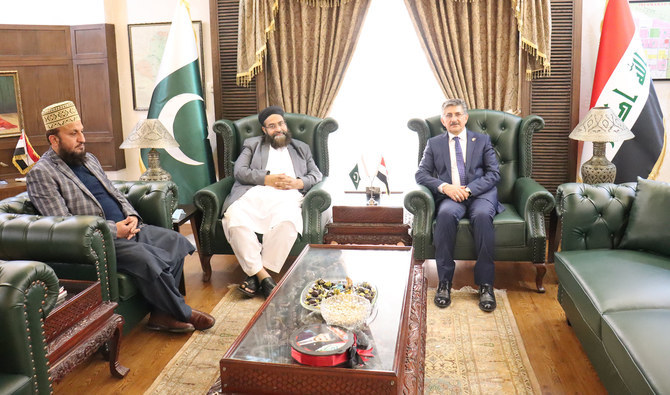
Prime minister’s special advisor on religious harmony and the Middle East, Tahir Mahmood Ashrafi, center, during his meeting with Hamid Abbas Lafta, right, Ambassador of the Republic of Iraq in Islamabad, on Jan. 14. 2021. (Photo courtesy: @TahirAshrafi/Twitter)
Short Url
Updated 24 January 2021
Follow

Islamabad setting up Pak-Arab federation to boost image in Middle East 

  • Federation will be an autonomous body, consisting of representatives of Pakistan and all major Arab countries
  • It will also serve as an advisory body to the Pakistani government and as a "back-channel diplomacy forum" 

ISLAMABAD: Pakistan has started work on setting up a Pakistan-Arab federation to strengthen Islamabad's relations with Arab states, the Pakistani prime minister’s special adviser on religious harmony and the Middle East said on Sunday.

The establishment of the forum follows Prime Minister Imran Khan’s policy to improve Pakistan's economic and strategic ties with all Arab countries. In October, the government founded a study center specialized in the Middle East at the Institute of Strategic Studies Islamabad.


"The work on the Pak-Arab Federation has started with the basic aim to help in strengthening the relationship of Pakistan with brotherly Arab countries," the prime minister's aide, Tahir Mahmood Ashrafi, told Arab News.

He explained that the federation will be an autonomous body, consisting of representatives of Pakistan and all major Arab countries. 

"This forum will be an autonomous non-governmental federation which consist of businessmen, chambers of commerce, religious scholars, intellectuals, academicians, journalists and other professional bodies," Ashrafi said.

He added that the federation will also serve as an advisory body to the Pakistani government to help it boost Pakistan's image in Arab countries. 

"This federation will also work as crisis management forum to remove misconception which can hamper bilateral relations of Pakistan with any of the Arab country," he said, adding that it would act as a "back-channel diplomacy forum" to help quickly resolve important issues through people-to-people contacts.

The federation is also going to form a close liaison with more than 5 million Pakistanis in Arab countries, Ashrafi said, and "will work to facilitate our Arab brothers to improve their people-to-people contact with Pakistan."

He added: “This federation will work to further enhance relations between Islamic countries and will not be affected by the change of governments."

Earlier this month, Ashrafi met with the ambassadors of Oman, Kuwait and Iraq in Islamabad to start the initiative, and after initial work will take other embassies of Arab states on board.

"After completion of initial work, we will contact the embassies of all Arab countries to brief them about the work and scope of the federation," he said, "We will also incorporate their suggestions to make it an effective federation."


Pakistan, global crypto exchange discuss modernizing digital payments, creating job prospects 

Updated 05 December 2025
Follow

Pakistan, global crypto exchange discuss modernizing digital payments, creating job prospects 

  • Pakistani officials, Binance team discuss coordination between Islamabad, local banks and global exchanges
  • Pakistan has attempted to tap into growing crypto market to curb illicit transactions, improve oversight

ISLAMABAD: Pakistan’s finance officials and the team of a global cryptocurrency exchange on Friday held discussions aimed at modernizing the country’s digital payments system and building local talent pipelines to meet rising demand for blockchain and Web3 skills, the finance ministry said.

The development took place during a high-level meeting between Finance Minister Muhammad Aurangzeb, Pakistan Virtual Assets Regulatory Authority (PVARA) Chairman Bilal bin Saqib, domestic bank presidents and a Binance team led by Global CEO Richard Teng. The meeting was held to advance work on Pakistan’s National Digital Asset Framework, a regulatory setup to govern Pakistan’s digital assets.

Pakistan has been moving to regulate its fast-growing crypto and digital assets market by bringing virtual asset service providers (VASPs) under a formal licensing regime. Officials say the push is aimed at curbing illicit transactions, improving oversight, and encouraging innovation in blockchain-based financial services.

“Participants reviewed opportunities to modernize Pakistan’s digital payments landscape, noting that blockchain-based systems could significantly reduce costs from the country’s $38 billion annual remittance flows,” the finance ministry said in a statement. 

“Discussions also emphasized building local talent pipelines to meet rising global demand for blockchain and Web3 skills, creating high-value employment prospects for Pakistani youth.”

Blockchain is a type of digital database that is shared, transparent and tamper-resistant. Instead of being stored on one computer, the data is kept on a distributed network of computers, making it very hard to alter or hack.

Web3 refers to the next generation of the Internet built using blockchain, focusing on giving users more control over their data, identity and digital assets rather than big tech companies controlling it.

Participants of the meeting also discussed sovereign debt tokenization, which is the process of converting a country’s debt such as government bonds, into digital tokens on a blockchain, the ministry said. 

Aurangzeb called for close coordination between the government, domestic banks and global exchanges to modernize Pakistan’s payment landscape.

Participants of the meeting also discussed considering a “time-bound amnesty” to encourage users to move assets onto regulated platforms, stressing the need for stronger verifications and a risk-mitigation system.

Pakistan has attempted in recent months to tap into the country’s growing crypto market, crack down on money laundering and terror financing, and promote responsible innovation — a move analysts say could bring an estimated $25 billion in virtual assets into the tax net.

In September, Islamabad invited international crypto exchanges and other VASPs to apply for licenses to operate in the country, a step aimed at formalizing and regulating its fast-growing digital market.