

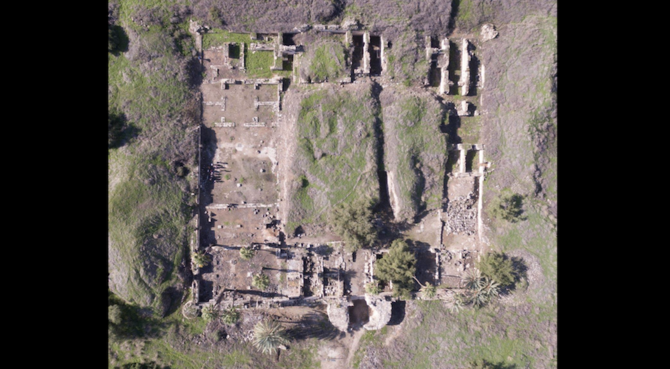
Mosque dating back to Levant conquest unearthed in Israel

One of the world’s oldest mosques has been uncovered by a team of archaeologists from the Hebrew University of Jerusalem on the shores of Israel’s Sea of Galilee. (Facebook: Tiberias/ Tiberiades Excavations חפירות טבריה)
Short Url
Updated 23 January 2021
Follow

Mosque dating back to Levant conquest unearthed in Israel

  • Religious site ‘could have been built by commander of Muslim army,’ expert says

LONDON: One of the world’s oldest mosques has been uncovered by a team of archaeologists on the shores of Israel’s Sea of Galilee.

The remains of the mosque were found beneath the ruins of a building originally identified as from the Byzantine period. It might have been constructed as early as A.D. 635 by a companion of the Prophet Muhammad who was a commander of the Muslim armies that conquered the Levant in the seventh century.

The mosque is located on the outskirts of the city of Tiberias in Israel’s north, which overlooks the western shore of the Sea of Galilee. The discovery was announced last week in an academic conference after 11 years of excavation by a team led by Katia Cytryn-Silverman of The Hebrew University of Jerusalem.

The site was previously excavated in the 1950s when a colonnaded structure was found and identified as a marketplace from the late Byzantine period. However, later excavations revealed pottery shards and coins from the early Islamic period. Together with the multilevel structure of the building’s foundations, archaeologists have pointed to the site having Islamic origins.

Archaeologists had earlier identified the remains of an eighth-century mosque, but further digs revealed that the structure was in fact a century older.

Historians already know the location of older mosques, but they lie hidden beneath existing mosques where archaeologists cannot access them. The oldest known remains of a mosque were uncovered east of Baghdad in the ancient city of Wasit, and have been dated to A.D. 703.

However, the Israeli archaeologist team believes that the mosque uncovered in Tiberias was built decades earlier, and perhaps founded by Shurahbil ibn Hasana, a commander of the army that conquered the area.

“We can’t say for certain that this was Shurahbil’s,” said Dr. Cytryn-Silverman.

“But we do have historic sources that say he established a mosque in Tiberias when he conquered it in 635.”


Child injured as Israeli settlers assault Palestinians

Updated 27 min 16 sec ago
Follow

Child injured as Israeli settlers assault Palestinians

  • Local authorities decry ongoing efforts to restrict Palestinian livelihoods and displace Bedouin communities

HEBRON: Israeli settlers assaulted a child and attempted to run over several others in Masafer Yatta, south of Hebron, on Sunday evening.
In Khirbet Rajoum Ali, settlers attacked 12-year-old Salah Ismail Al-Hadra, causing bruises and other injuries.
He was taken to Yatta Governmental Hospital. 

FASTFACT

Israeli settlers also chased shepherds in Rajum Ulei, drove livestock into crops, and conducted provocative patrols near homes.

In Khirbet Al-Halawa, settlers chased children tending sheep, assaulted several, and tried to run them over with vehicles.
Masafer Yatta has seen a sharp rise in settler attacks, often under Israeli military protection.
Separately, settlers assaulted farmers plowing land in Khirbet Salama, Kharsa (south of Hebron), injuring locals identified as Ayman Izzat Awda and Diaa Awda.
In Jabal Al-Baba Bedouin community (Al-Eizariya, south of occupied Jerusalem), Israeli forces shot at shepherds grazing sheep in Wadi Al-Hawd.
One was wounded, and another arrested.
Authorities described it as part of ongoing efforts to restrict Palestinian livelihoods and displace Bedouin communities.
Settlers also attacked farmers in Mahfuriya (south of Aqraba, Nablus) while they worked their land, and damaged windows at the home of one person, identified as Munther Shreida, in Al-Shajra, Duma.
In Masafer Yatta, settlers in military-style uniforms detained and abused six residents near Khirbet Al-Fukhit before releasing them.
Settlers also chased shepherds in Rajum Ulei, drove livestock into crops, and conducted provocative patrols near homes.
Late on Saturday, settlers attempted to steal sheep from shepherd Imad Houshiyeh’s herd in Khirbet Al-Markaz but were stopped by local residents.