Egypt unveils trove of ancient coffins excavated in Luxor

1 / 2
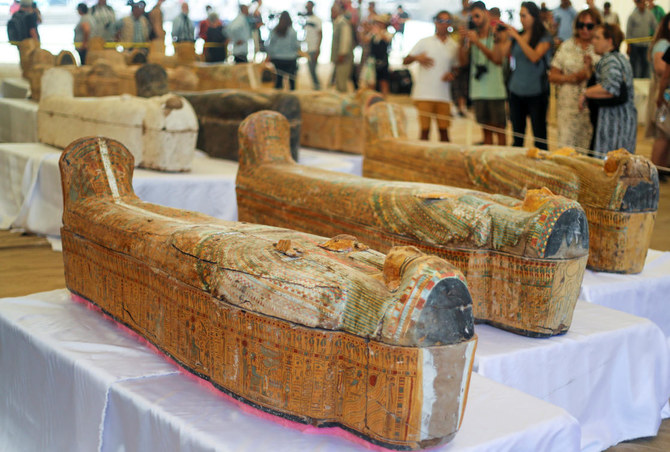
Painted ancient coffins are seen at Al-Asasif necropolis, unveiled by Egyptian antiquities officials in the Valley of the Kings in Luxor on Saturday. (Reuters)
2 / 2
Tourists look at painted ancient coffins at Al-Asasif necropolis, unveiled by Egyptian antiquities officials in the Valley of the Kings in Luxor, Egypt October 19, 2019. (Reuters)
Updated 20 October 2019
Follow

Egypt unveils trove of ancient coffins excavated in Luxor

  • Mostafa Waziri, secretary general of the Supreme Council of Antiquities, says the coffins were for men, women and children from the 22nd dynasty (945 B.C. 715 B.C.)

LUXOR: Egypt revealed on Saturday a rare trove of 30 ancient wooden coffins that have been well-preserved over millennia in the archaeologically rich Valley of the Kings in Luxor.
The Antiquities Ministry officially unveiled the discovery made at Asasif, a necropolis on the west bank of the Nile River, at a press conference against the backdrop of the Hatshepsut Temple.
“This is the first discovery in Asasif by dedicated Egyptian hands, comprised of archaeologists, conservationists and workers,” head of the Supreme Council of Antiquities, Mostafa Al-Waziri, told reporters.
The 30 ornately decorated coffins of men, women and children were found only 3 feet underground, stacked in two rows. They are believed to belong to family members of high priests.
Waziri explained that excavations of the site in the 19th century had revealed royal tombs, but this latest discovery had yielded a collection of priests’ burials.
The sarcophagi date back to the 22nd Dynasty, founded around 3,000 years ago in the 10th century BC.
Despite their age, black, green, red and yellow paintings of snakes, birds, lotus flowers and hieroglyphics that cover the coffins are still clearly visible.
“We only did remedial first-aid on these well-preserved coffins. They are considered to be in great condition because there were hardly any settlements” around the site, local Antiquities Ministry restorer Saleh Abdel-Gelil told AFP.
According to Antiquities Minister Khaled El-Enany, discoveries of ancient Egyptian relics had slowed after the 2011 Arab Spring revolution that toppled long-time autocrat Hosni Mubarak and plunged the country in political turmoil.

SPEEDREAD

Egypt has sought to promote its archaeological heritage and recent finds in a bid to revive its vital tourism sector, which has suffered due to political insecurity and terror attacks.

But several high-level officials, including President Abdel Fattah El-Sisi, have in recent weeks affirmed Egypt’s stability following rare, small-scale protests in September that drew a heavy-handed response from security forces.
“Some people, we don’t have to mention names, don’t want us to have these discoveries ... that impress the world,” said Enany before throngs of tourists, referring to Egypt’s detractors.
“These discoveries are priceless for Egypt’s reputation,” he added.
Enany said the “important” Asasif collection will be moved to the recently opened Grand Egyptian Museum next year.
Egypt has sought to promote its archaeological heritage and recent finds in a bid to revive its vital tourism sector, which has suffered due to political insecurity and terror attacks.
However, critics point to archaeological sites and museums suffering from negligence and poor management.


Death toll rises to at least 10 in violence around Iran protests

Updated 11 sec ago
Follow

Death toll rises to at least 10 in violence around Iran protests

DUBAI: Violence surrounding protests in Iran sparked by the Islamic Republic’s ailing economy killed two other people, authorities said Saturday, raising the death toll in the demonstrations to at least 10 as they showed no signs of stopping.
The new deaths follow US President Donald Trump warning Iran on Friday that if Tehran “violently kills peaceful protesters,” the United States “will come to their rescue.” While it remains unclear how and if Trump will intervene, his comments sparked an immediate, angry response from officials within the theocracy threatening to target American troops in the Mideast.
The weeklong protests, have become the biggest in Iran since 2022, when the death of 22-year-old Mahsa Amini in police custody triggered nationwide demonstrations. However, the protests have yet to be as widespread and intense as those surrounding the death of Amini, who was detained over not wearing her hijab, or headscarf, to the liking of authorities.
The deaths overnight into Saturday involved a new level of violence. In Qom, home to the country’s major Shiite seminaries, a grenade exploded, killing a man there, the state-owned IRAN newspaper reported. It quoted security officials alleging the man carried the grenade to attack people in the city, some 130 kilometers (80 miles) south of the capital, Tehran.
Online videos from Qom purportedly showed fires in the street overnight.
The second death happened in the town of Harsin, some 370 kilometers (230 miles) southwest of Tehran. There, the newspaper said a member of the Basij, the all-volunteer arm of Iran’s paramilitary Revolutionary Guard, died in a gun and knife attack in the town in Kermanshah province.
Demonstrations have reached over 100 locations in 22 of Iran’s 31 provinces, the US-based Human Rights Activists News Agency reported.
Iran’s civilian government under reformist President Masoud Pezeshkian has been trying to signal it wants to negotiate with protesters. However, Pezeshkian has acknowledged there is not much he can do as Iran’s rial has rapidly depreciated, with $1 now costing some 1.4 million rials. That sparked the initial protests.