

WEEKLY ENERGY RECAP: A mixed week for oil with investors regaining confidence

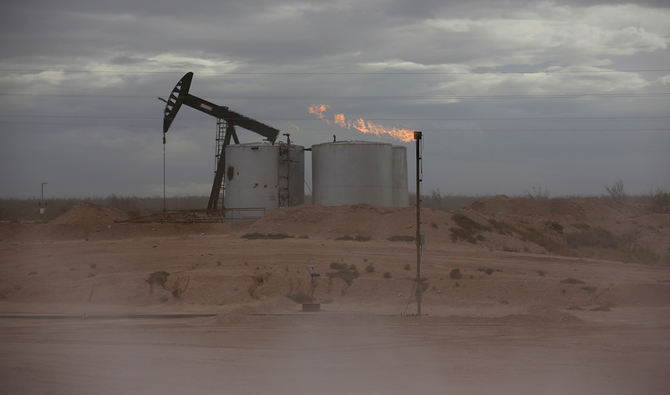
Dust blows around a crude oil pump jack and flare burning excess gas at a drill pad in the Permian Basin in Loving County, Texas, US. (Reuters/File)
Short Url
Updated 17 January 2021
Follow

WEEKLY ENERGY RECAP: A mixed week for oil with investors regaining confidence

  • For 2021, OPEC forecast global oil demand to increase by 5.9 million bpd

It was a very mixed week, with oil prices remaining relatively steady despite mixed bearish developments. The commodity market is seeing renewed confidence from investors who have pushed oil prices more than 40 percent since the end of October 2020 after a series of coronavirus vaccine breakthroughs, which raised expectations for a sustained recovery in oil consumption.

On the week closing, Brent crude price made the first weekly decline in three weeks when it fell to $55.10 per barrel. The WTI ended the week slightly up at $52.36 per barrel. The Brent crude weekly price drop came amid the highest increase in COVID-19 cases in China in more than 10 months, which have led to isolation measures and weighed on oil market sentiment.

This week bearish news came mostly from China (the largest oil importer) after its crude oil imports slumped to 9.1 million barrels per day (bpd) in December 2020, from 11.1 million bpd in November 2020. That is the lowest oil import level in 27 months.

The US is planning a stimulus package that some hope will revive its economy and help oil market recovery. The US Energy Information Administration (EIA) reported the latest US crude inventories were lower for the fifth straight week, dropping by 3.2 million barrels. The EIA also surprised the market with its pessimistic forecast for US crude oil production to average 11.1 million bpd in 2021, down by 200,000 bpd from the 2020 average production level.

On the other hand, the OPEC monthly oil market report gave an optimistic oil supply outlook for US shale oil in 2021. With oil prices increasing, OPEC expects oil output to recover more in the second half of 2021 but this is very unlikely to hamper OPEC+ efforts to rebalance if oil demand goes to pre-pandemic levels.

The OPEC monthly report shows total commercial oil stocks for the OECD were at 163.1 million barrels above the latest five-year average for November 2020, which is the latest available data.

OPEC left its forecast for world oil demand unchanged, which has declined by 9.8 million bpd to an average of 90 million bpd in 2020. For 2021, OPEC forecast global oil demand to increase by 5.9 million bpd to average 95 million bpd.

OPEC reported mixed results for global refining margins in December 2020, slightly improving in the US but weaker in Europe. The surge in crude oil prices weighed further on Asian refining economics after returning from the autumn peak maintenance season. That contributed to a slight rise in available spare capacity as it awaits the right economic incentives.

OPEC reported US refinery use rates increased in December 2020 to average 79.14 percent while European refinery use averaged 65.32 percent. In selected Asia countries — China, India, Japan, Singapore and South Korea — refinery use rates increased, averaging 89.83 percent in December, corresponding to a throughput of 25.52 million bpd.

• Faisal Faeq is an energy and oil marketing adviser. He was formerly with OPEC and Saudi Aramco. Twitter:@faisalfaeq



India and US release a framework for an interim trade agreement to reduce Trump tariffs

Updated 58 min 25 sec ago
Follow

India and US release a framework for an interim trade agreement to reduce Trump tariffs

  • Under the deal, tariffs on goods from India would be lowered to 18 percent, from 25 percent, after Indian Prime Minister Narendra Modi agreed to stop buying Russian oil, Trump had said.

NEW DELHI: India and the United States released a framework for an interim trade agreement to lower tariffs on Indian goods, which Indian opposition accused of favoring Washington.
The joint statement, released Friday, came after US President Donald Trump announced his plan last week to reduce import tariffs on the South Asian country, six months after imposing steep taxes to press New Delhi to cut its reliance on cheap Russian crude.
Under the deal, tariffs on goods from India would be lowered to 18 percent, from 25 percent, after Indian Prime Minister Narendra Modi agreed to stop buying Russian oil, Trump had said.
The two countries called the agreement “reciprocal and mutually beneficial” and expressed commitment to work toward a broader trade deal that “will include additional market access commitments and support more resilient supply chains.” The framework said that more negotiations will be needed to formalize the agreement.
India would also “eliminate or reduce tariffs” on all US industrial goods and a wide range of food and agricultural products, Friday’s statement said.
The US president had said that India would start to reduce its import taxes on US goods to zero and buy $500 billion worth of American products over five years, part of the Trump administration’s bid to seek greater market access and zero tariffs on almost all American exports.
Trump also signed an executive order on Friday to revoke a separate 25 percent tariff on Indian goods he imposed last year.
Indian Prime Minister Narendra Modi thanked Trump “for his personal commitment to robust ties.”
“This framework reflects the growing depth, trust and dynamism of our partnership,” Modi said on social media, adding it will “further deepen investment and technology partnerships between us.”
India’s opposition political parties have largely criticized the deal, saying it heavily favors the US and negatively impacts sensitive sectors such as agriculture. In the past, New Delhi had opposed tariffs on sectors such as agriculture and dairy, which employ the bulk of the country’s population.
Meanwhile, Piyush Goyal, Indian Trade Minister, said the deal protects “sensitive agricultural and dairy products” including maize, wheat, rice, ethanol, tobacco, and some vegetables.
“This (agreement) will open a $30 trillion market for Indian exporters,” Goyal said in a social media post, referring to the US annual GDP. He said the increase in exports was likely to create hundreds of thousands of new job opportunities.
Goyal also said tariffs will go down to zero on a wide range of Indian goods exported to the US, including generic pharmaceuticals, gems and diamonds, and aircraft parts, further enhancing the country’s export competitiveness.
India and the European Union recently reached a free trade agreement that could affect as many as 2 billion people after nearly two decades of negotiations. That deal would enable free trade on almost all goods between the EU’s 27 members and India, covering everything from textiles to medicines, and bringing down high import taxes for European wine and cars.
India also signed a comprehensive economic partnership agreement with Oman in December and concluded talks for a free trade deal with New Zealand.