Malaysia takes legal action against EU over palm biofuel curbs

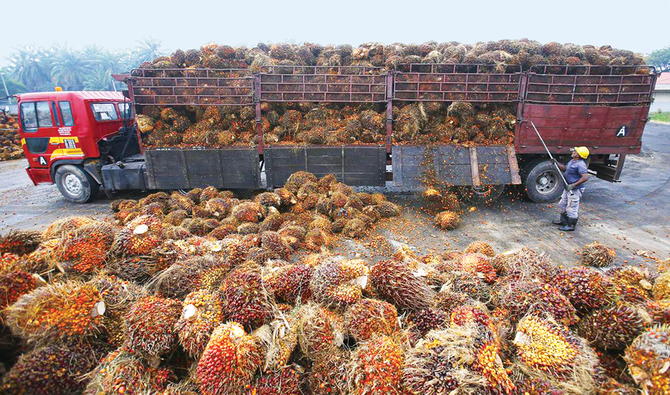
Indonesia and Malaysia, together account for 85 percent of the global output of palm oil. It is the world’s most produced and traded edible oil. (Reuters)
Short Url
Updated 17 January 2021
Follow

Malaysia takes legal action against EU over palm biofuel curbs

  • Palm oil constitutes 30 percent of the global oils and fats production

KUALA LUMPUR: Malaysia is taking legal action at the global trade watchdog against the EU and member states France and Lithuania for restricting palm oil-based biofuels, the government said.

The world’s second largest palm oil producer, which has called a EU renewable-energy directive “discriminatory action,” is seeking consultations under the WTO’s Dispute Settlement Mechanism, the Plantation Industries and Commodities Ministry said in a statement.

Minister Mohd Khairuddin Aman Razali said the EU proceeded with implementing the directive without considering Malaysia’s commitment and views, even after Malaysia gave feedback and sent economic and technical missions to Europe.

The EU directive “will mean the use of palm oil as biofuel in the EU cannot be taken into account in the calculation of renewable energy targets and in turn create undue trade restrictions to the country’s palm oil industry,” he said in the statement.

The ministry filed the WTO request with cooperation from the Attorney General’s Chambers and the International Trade and Industry Ministry, taking action it had warned of in July against EU Renewable Energy Directive II.

Malaysia will act as a third party in a separate WTO case lodged by neighboring Indonesia, the world’s biggest palm oil producer, as a sign of solidarity and support, the ministry statement said.

Indonesia and Malaysia, together account for 85 percent of the global output of palm oil. Palm oil constitutes 30 percent of the global oils and fats production, and plays a significant role in fulfilling the demand in the global oils and fats market.

It is the world’s most produced and traded edible oil, and its versatility can be seen through its use in a wide range of food and nonfood products, which led to the remarkable palm oil consumption growth.

The US imported approximately $410 million of crude palm oil from Malaysia in 2020, CNN reported.



QatarEnergy and Malaysia’s Petronas sign 20-year LNG supply agreement

Updated 5 sec ago
Follow

QatarEnergy and Malaysia’s Petronas sign 20-year LNG supply agreement

RIYADH: QatarEnergy has entered into a 20-year sales and purchase agreement with Malaysia’s Petronas for the supply of liquefied natural gas, the companies have announced.

Under the deal, QatarEnergy will supply 2 million tonnes per annum of LNG to Petronas, starting in 2028.

The SPA was signed in Doha at a ceremony held alongside the 21st International Conference & Exhibition on Liquefied Natural Gas “LNG2026.”

This marks the first long-term LNG SPA between the two state-owned energy corporations.

The agreement underscores Qatar’s expanding role as one of the world’s leading LNG suppliers, as the country advances major production growth projects aimed at increasing its export capacity later this decade.

According to the press release, the deal “reflects the continued confidence and trust between the two organizations and underscores their shared vision for a sustainable energy future and the strengthening of bilateral cooperation.”

The signatories were Saad Sherida Al-Kaabi, the minister of state for energy affairs as well as president and CEO of QatarEnergy, and YM Tan Sri Tengku Muhammad Taufik Tengku Kamadjaja Aziz, the president and group CEO of Petronas.

Al-Kaabi stated: “QatarEnergy is pleased to enter into this new LNG SPA with Petronas, which highlights our continued commitment to support the growing energy needs of Malaysia as well as our customers across the globe.”

QatarEnergy stated the agreement reflects its ongoing dedication to strengthening global partnerships, promoting cleaner energy solutions, and supporting the economic development goals of key markets worldwide.

On Feb. 3, QatarEnergy signed a memorandum of understanding with Japan’s Ministry of Economy, Trade and Industry and JERA, the country’s largest power generation company, for supplying Japan with additional liquefied natural gas quantities during emergency situations.

The MoU, signed on the sidelines of the same conference in Doha, stipulates QatarEnergy’s response in the event of unforeseen emergencies that could affect Japan, such as natural disasters. The agreement also includes mechanisms for bilateral consultation on appropriate response measures in such situations.

The MoU also underlines QatarEnergy’s role in ensuring energy security to all its customers through access to supplemental LNG volumes during emergencies and supply disruptions, it said in a press release. It also emphasizes Qatar’s ability to provide stable LNG supplies as well as its well established reputation as a reliable and trustworthy energy provider.