

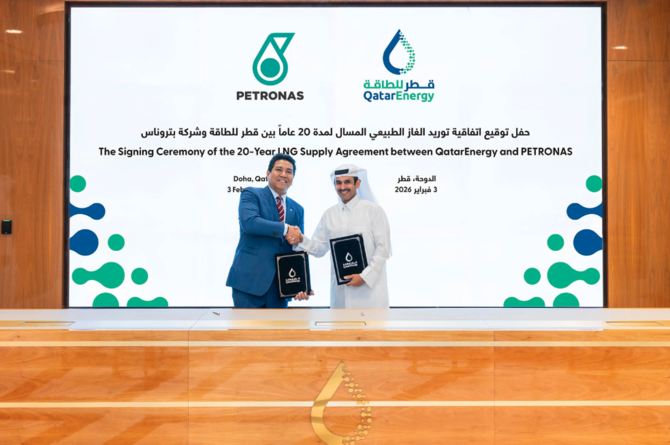
QatarEnergy and Malaysia’s Petronas sign 20-year LNG supply agreement

The agreement was signed by Saad Sherida Al-Kaabi, the minister of state for energy affairs as well as president and CEO of QatarEnergy, and YM Tan Sri Tengku Muhammad Taufik Tengku Kamadjaja Aziz, the president and group CEO of Petronas. QatarEnergy
Short Url
Updated 04 February 2026
Follow

QatarEnergy and Malaysia’s Petronas sign 20-year LNG supply agreement

RIYADH: QatarEnergy has entered into a 20-year sales and purchase agreement with Malaysia’s Petronas for the supply of liquefied natural gas, the companies have announced.

Under the deal, QatarEnergy will supply 2 million tonnes per annum of LNG to Petronas, starting in 2028.

The SPA was signed in Doha at a ceremony held alongside the 21st International Conference & Exhibition on Liquefied Natural Gas “LNG2026.”

This marks the first long-term LNG SPA between the two state-owned energy corporations.

The agreement underscores Qatar’s expanding role as one of the world’s leading LNG suppliers, as the country advances major production growth projects aimed at increasing its export capacity later this decade.

According to the press release, the deal “reflects the continued confidence and trust between the two organizations and underscores their shared vision for a sustainable energy future and the strengthening of bilateral cooperation.”

The signatories were Saad Sherida Al-Kaabi, the minister of state for energy affairs as well as president and CEO of QatarEnergy, and YM Tan Sri Tengku Muhammad Taufik Tengku Kamadjaja Aziz, the president and group CEO of Petronas.

Al-Kaabi stated: “QatarEnergy is pleased to enter into this new LNG SPA with Petronas, which highlights our continued commitment to support the growing energy needs of Malaysia as well as our customers across the globe.”

QatarEnergy stated the agreement reflects its ongoing dedication to strengthening global partnerships, promoting cleaner energy solutions, and supporting the economic development goals of key markets worldwide.

On Feb. 3, QatarEnergy signed a memorandum of understanding with Japan’s Ministry of Economy, Trade and Industry and JERA, the country’s largest power generation company, for supplying Japan with additional liquefied natural gas quantities during emergency situations.

The MoU, signed on the sidelines of the same conference in Doha, stipulates QatarEnergy’s response in the event of unforeseen emergencies that could affect Japan, such as natural disasters. The agreement also includes mechanisms for bilateral consultation on appropriate response measures in such situations.

The MoU also underlines QatarEnergy’s role in ensuring energy security to all its customers through access to supplemental LNG volumes during emergencies and supply disruptions, it said in a press release. It also emphasizes Qatar’s ability to provide stable LNG supplies as well as its well established reputation as a reliable and trustworthy energy provider.


Gold slips over 1 percent on strong dollar, easing rate-cut bets

Updated 58 min 23 sec ago
Follow

Gold slips over 1 percent on strong dollar, easing rate-cut bets

  • Chile central bank issues first gold purchase in decades
  • BMI expects silver to average $93/oz in 2026

Gold prices fell more than 1 percent on Thursday, pressured by a stronger dollar and diminishing hopes for a reduction in borrowing costs as the ongoing Iran war stoked inflation concerns.
Spot gold dipped 1.1 percent at $5,118.16 per ounce by 1:31 p.m. ET (1731 GMT). US gold futures for April delivery settled 1 percent lower at $5,125.80.
The dollar gained for a third consecutive session. The greenback is a competitive ‌safe-haven asset, and ‌a stronger US currency makes gold more ​expensive ‌for ⁠holders ​of other currencies.
“The ⁠higher dollar index, rising treasury yields and lack of interest-rate cuts are the negative factors, but the conflict in the Middle East has been generating some safe-haven flows,” said Phillip Streible, chief market strategist at Blue Line Futures.
Two tankers were ablaze in Iraqi waters in an apparent escalation in Iranian attacks that have cut off ⁠Middle East energy supplies. In reaction, oil prices ‌rose sharply for the day.
Iran will avenge ‌the blood of its martyrs, keep ​the Strait of Hormuz closed and ‌attack US bases, new Supreme Leader Ayatollah Mojtaba Khamenei said.
Higher crude ‌prices feed into inflation by raising transportation and production costs. Gold is considered an inflation hedge, but high interest rates weigh on it by making yield-bearing assets more attractive.
“If they can prevent oil prices from climbing ‌further, gold should be in a good place... On the bullish side for gold, the main argument is ⁠that central ⁠bank buying and steady exchange-traded fund inflows, which have remained positive all year,” Streible added.
Chile’s central bank issued its first major gold purchase since at least 2000. In February, the bank boosted its gold reserves to $1.108 billion, up from $42 million in January, equivalent to 2.2 percent of total reserves.
Elsewhere, spot silver eased 1 percent to $84.90. Prices gained more than 146 percent last year.
Analysts at BMI wrote in a note they expect silver to average $93 per ounce in 2026, with strong investment demand consolidating the gains witnessed in 2025, and offsetting price-induced ​demand destruction in solar ​panels and jewelry.
Spot platinum lost 1.1 percent to $2,145.75, and palladium fell 1 percent to $1,620.86.