

Kabul says no impact on security as US reduces troops to 2,500

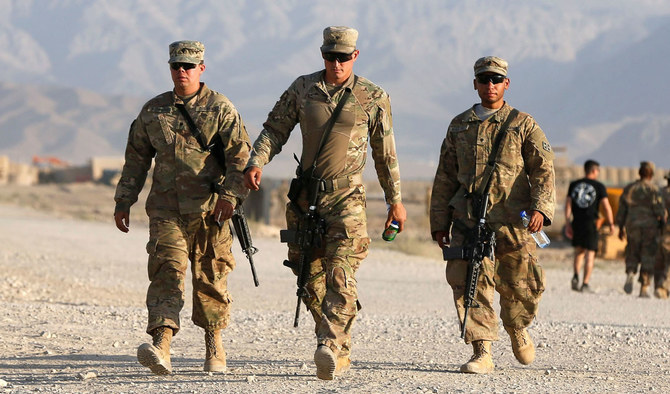
In this file photo, US troops walk at their base in Logar province, Afghanistan on Aug. 4, 2018. Taliban on Saturday denied US media reports saying that a Russian intelligence unit secretly rewarded them for targeting American troops in Afghanistan. (REUTERS)
Short Url
Updated 16 January 2021
Follow

Kabul says no impact on security as US reduces troops to 2,500

  • Reduction means the lowest level of US forces in Afghanistan since 2001, when the US invaded the country and ousted the Taliban
  • Taliban welcome the US move, describing it as important in the implementation of a historic deal signed by the group and Washington in February

ISLAMABAD: The Afghan National Security Council said on Saturday that the reduction of US forces in the country has no major impact on the security situation, as Washington announced it had met its goal of decreasing the number of troops to 2,500.

The Pentagon confirmed the reduction of US troops on Friday as in accordance with President Donald Trump administration’s November pledge to sharply cut the number of US forces in Afghanistan from 4,500 to 2,500 by mid-January.

The troop reduction means the lowest level of American forces in Afghanistan since 2001, when the US invaded the country and ousted the Taliban who were ruling Afghanistan from 1996.

“Reduction or increase of the American forces do not have any major negative impact on the fighting situation in Afghanistan,” Maulvi Rahmatullah, spokesman for the Afghan National Security Council said in a video response to the Pentagon announcement.

However, Afghanistan’s vice president, Amrullah Saleh, in a BBC interview on Friday said that the “pullout risks more violence in the unstable country.”

He added that the American mission, which began 20 years ago, is not yet accomplished and that the US had made a mistake by conceding too much to the Taliban.

The Taliban, meanwhile, have welcomed the US move, describing it as an important step toward the implementation of a historic deal signed by the group and Washington in Doha, Qatar, in February last year, under which all US-led troops would leave Afghanistan within 14 months.

“We consider the decision as a good and effective step toward the implementation of the Doha agreement. We, the Islamic Emirate, are also committed to all sections of the Doha agreement,” Taliban spokesman Zabihullah Mujahid told Arab News on Saturday.

He said the Taliban hope that the Doha agreement would be fully implemented and all American forces would leave Afghanistan as per the agreed timeframe.

“We consider withdrawal of the troops and leaving Afghan soil as a positive step for the people of the US and Afghans and welcome it,” Mujahid said.

While acting US Defense Secretary Chris Miller said on Friday that the US is planning “further reducing US troop levels to zero by May of 2021,” he added that “any such future drawdowns remain conditions-based.”

As the Trump administration is going to end its term when President-elect Joe Biden takes office on Wednesday, there have been few clues on what the new US government plans are for Afghanistan.


Pakistan plans Benghazi consulate, lending legitimacy to Libya’s eastern authorities

Updated 6 sec ago
Follow

Pakistan plans Benghazi consulate, lending legitimacy to Libya’s eastern authorities

  • Libya descended into turmoil after a 2011 NATO-backed uprising toppled Muammar Qaddafi and has been divided into eastern, western authorities
  • The UN-recognized government in Tripoli controls the west, while the Libyan National Army forces based in ‌Benghazi hold ‌the east and the south

KARACHI: Pakistan is in talks to open a consulate ​in the eastern Libyan city of Benghazi, three sources with knowledge of the matter said, a move that could give a diplomatic boost to eastern authorities in their rivalry with Libya’s west.

Libya descended into turmoil after a 2011 NATO-backed uprising toppled Muammar Qaddafi and has been divided into eastern and western authorities since a 2014 civil war. The UN-recognized government in Tripoli controls the west, while

Libyan National Army leader Field Marshal Khalifa Haftar’s forces based in ‌Benghazi hold ‌the east and south, including major oilfields.

Islamabad would be ‌joining ⁠a ​small ‌group of countries with a diplomatic presence in Benghazi. Haftar discussed the move with officials during an ongoing visit to Pakistan, the sources said.

Haftar met Pakistan’s army chief on Monday to discuss “professional cooperation,” the Pakistani military said. He was due to sit down with Prime Minister Shehbaz Sharif on Tuesday, the sources said, declining to be identified because they were not authorized to speak to the media.

Pakistan’s prime ⁠minister’s office and foreign ministry did not respond to requests for comment.

The LNA’s official media page ‌said Haftar and his son Saddam met senior Pakistani ‍army officials “within the framework of strengthening bilateral ‍relations and opening up broader horizons for coordination in areas of common ‍interest.” It did not give further details and Reuters could not immediately reach eastern Libyan authorities for comment.

Pakistan’s air force said in a statement that Saddam Khalifa Haftar met Air Chief Zaheer Ahmed Baber Sidhu to discuss expanding defense cooperation, including joint training, ​with Islamabad reaffirming its support for the “capability development” of the Libyan air force. Pakistan’s army chief Field Marshal Asim Munir visited Benghazi in December, ⁠where he signed a multibillion-dollar defense deal with the LNA, previously reported by Reuters.

All three sources said the decision to open a consulate in Benghazi was linked to the $4 billion defense deal, one of Pakistan’s largest-ever arms sales.

Libya has been under a UN arms embargo since 2011, although UN experts have said it is ineffective. Pakistani officials involved in the December deal said it did not violate UN restrictions. Haftar has historically been an ally of the UAE, which supported him with air power and viewed him as a bulwark against extremists, while Pakistan — the only nuclear-armed Muslim-majority nation — signed a wide-ranging mutual defense pact with Saudi Arabia ‌late last year.