

Pakistani province to set up Braille printing press for the visually impaired

A group of visiting officials inspect a class at the Government Institute for the Blind in Peshawar as visually impaired students read their textbooks on October 20, 2020. (Photo courtesy: Government Institute for the Blind, Peshawar)
Short Url
Updated 18 January 2021
Follow

Pakistani province to set up Braille printing press for the visually impaired

  • The province has earmarked Rs40.3 million for the project and hopes to establish the facility within a month
  • Customised software for the printing press developed in both the Urdu and Pashto languages

PESHAWAR: Pakistan’s northwestern Khyber Pakhtunkhwa province plans to set up its first printing press for Braille to help visually impaired people across the province, said a minister while talking to Arab News on Friday. 

Braille printers are impact devices that are used to create tactile dots on special paper, making written documents accessible to sightless individuals. 

“We have done our homework and set aside Rs40.3 million to launch the printing press within a month,” said Minister for Social Welfare, Dr. Hisham Inamullah Khan. 
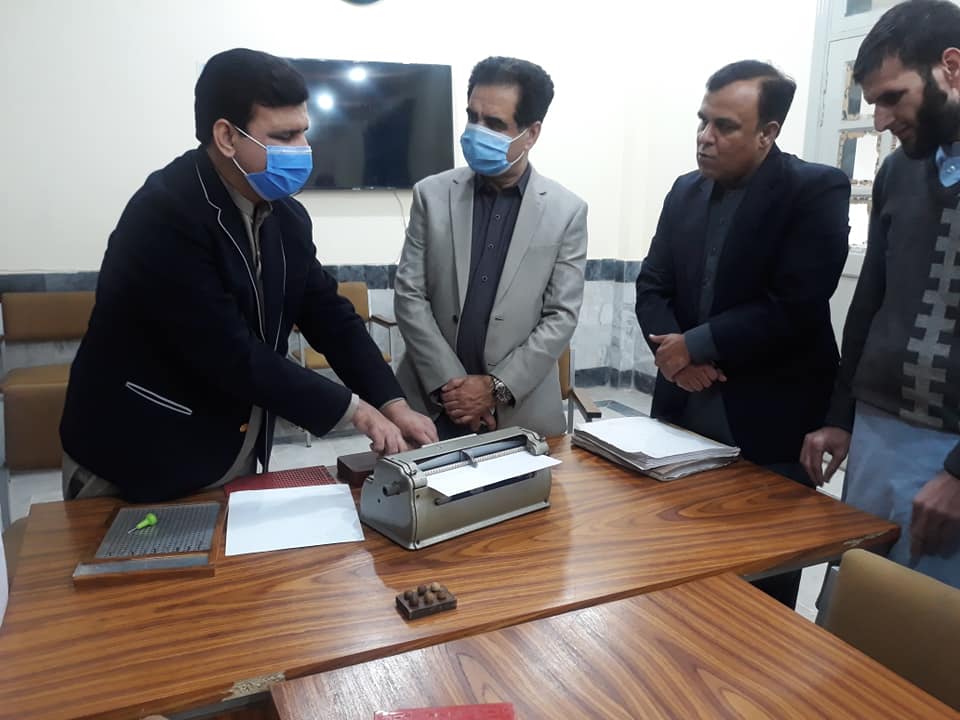


Awais Alam, a visually impaired person, types on a machine as other people watch, at the Government Institute for the Blind in Peshawar on November 19, 2020. (Photo courtesy: Government Institute for the Blind, Peshawar) 

Habib Khan Afridi, director social welfare, special education and women empowerment, told Arab News that the province lacked the facility and relied heavily on a printing press in Lahore.

“We have developed customized software in Urdu and Pashtu languages that will make writing material more use-friendly to blind persons,” Afridi said. 

“While the number of unregistered Persons with Disabilities [PWDs] may be higher, about 148,000 of them are in the provincial database,” he continued. “These not only include people with visual, hearing and physical impairments but also individuals with intellectual disabilities.”

Afridi said that PWDs were entitled to certain benefits, such as two percent quota in all government jobs and Rs3,000 monthly mobility allowance after getting employed.
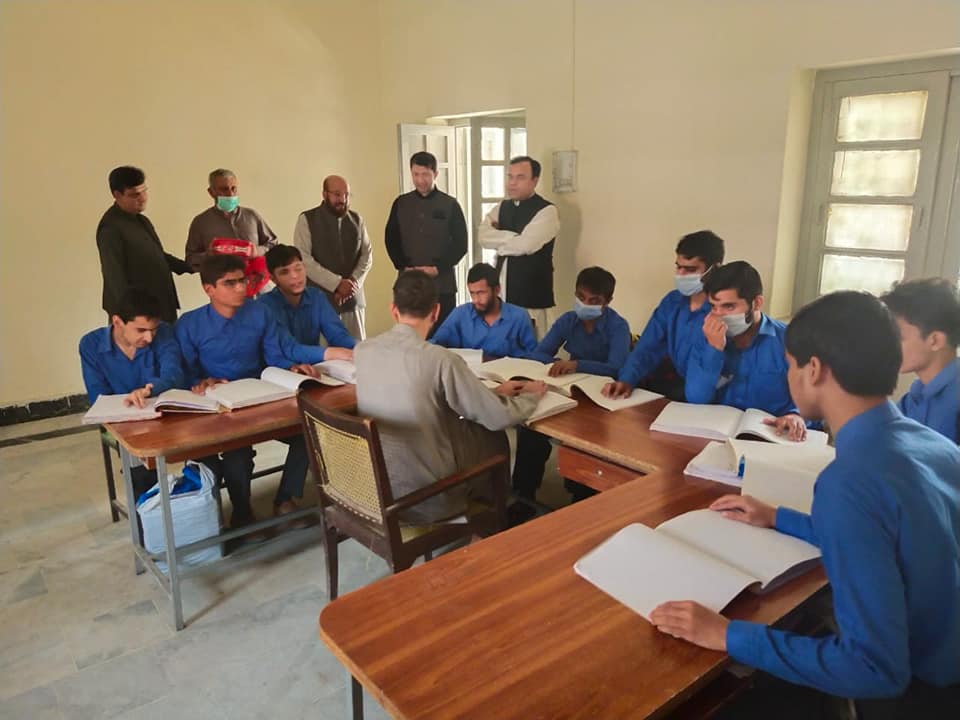


A group of visiting officials inspect a class at the Government Institute for the Blind in Peshawar as visually impaired students read their textbooks on October 20, 2020. (Photo courtesy: Government Institute for the Blind, Peshawar) 

Awais Alam, a visually impaired teacher at Peshawar’s Government Institute for the Blind, lauded the initiative, calling it a “huge favor” for thousands of people. 

“According to my estimate, there are more than 10,000 sightless people in this province,” he said. “We import curriculum books from Punjab and Sindh. In fact, some of us had to move to other provinces due to the unavailability of textbooks and other facilities. This should change now since the new initiative will help resolve one of our pressing problems.” 

Alam, who is also pursuing his MPhil degree in political science, urged parents not to ignore their differently abled children and focus on their education.

“I want to request parents to bring their visually impaired children to blind schools where they can be educated and turned into useful citizens,” he said. 


Saudi, Pakistani officials discuss avenues for enhanced strategic cooperation

Updated 8 sec ago
Follow

Saudi, Pakistani officials discuss avenues for enhanced strategic cooperation

  • Pakistan, Saudi Arabia share a long-standing strategic partnership in political, security and economic domains
  • Last year, both nations signed a landmark defense pact formalizing military ties into binding security commitment

ISLAMABAD: Pakistani and Saudi officials have held discussions on avenues for enhanced strategic cooperation between the two countries, Pakistan’s Press Information Department (PID) said on Friday.

Pakistan and Saudi Arabia share a long-standing strategic partnership in political, security and economic domains, underpinned by deep religious and cultural ties. The two countries maintain high-level engagements and consultations on regional and global developments, often aligning on issues related to peace, stability and the Muslim world.

In September last year, Pakistan and Saudi Arabia signed a landmark defense pact, under which aggression against one country will be treated as an attack against both. The pact signaled a push by both governments to formalize long-standing military ties into a binding security commitment.

On Friday, Saudi ambassador to Pakistan Nawaf bin Saeed Al-Malki met with Pakistan’s Minister for Climate Change and Environmental Coordination Dr. Musadik Malik in Islamabad, according to a PID statement.

“During the meeting, both sides held comprehensive discussions on avenues for enhanced mutual and strategic cooperation,” the statement said.

Malik highlighted Pakistan’s priorities in climate resilience and sustainable development, and emphasized the importance of international partnerships in addressing global environmental challenges, according to the PID. He appreciated Saudi Arabia’s continued support and engagement with Pakistan across multiple sectors.

“The Saudi ambassador reaffirmed the Kingdom’s commitment to further strengthening bilateral cooperation,” it said. “Both sides reiterated the deep-rooted, brotherly relations between Pakistan and Saudi Arabia and expressed confidence that the longstanding partnership would continue to grow.”