

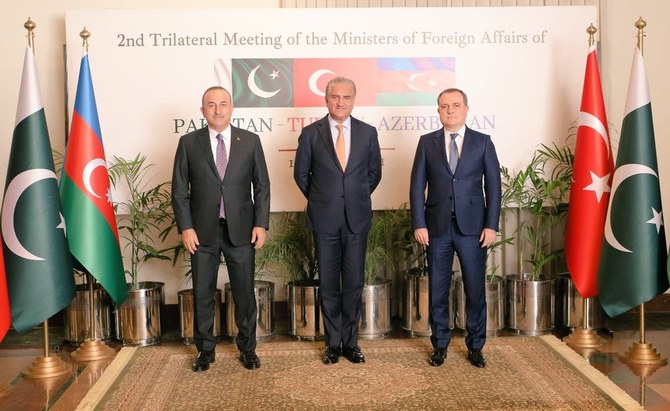

ISLAMABAD: The foreign ministers of Pakistan, Turkey and Azerbaijan agreed to collectively combat Islamophobia and persecution of Muslim minorities in different parts of the world during the second round of their trilateral conference on Wednesday.
all have serious concerns on the systemic and gross human rights violations and crimes against humanity committed against Muslim minorities, including the rising trend of Islamophobia, and reiterated our resolve to jointly confront this at all relevant fora.
— Shah Mahmood Qureshi (@SMQureshiPTI) January 13, 2021
The first round of the trilateral meeting was held in Baku in November 2017.
According to an official handout circulated by the foreign office of Pakistan, the foreign ministers of the three states also decided to strengthen cooperation in peace and security by combating terrorism in all forms and manifestations.
They agreed to work for a peaceful settlement of the Kashmir dispute in accordance with the relevant United Nations Security Council Resolution and support a just, sustainable and realistic resolution to the Cyprus issue.
The foreign ministers called for a normalization of relations between Armenia and Azerbaijan, saying it was important to recognize the territorial integrity of the latter. They also agreed to promote cooperation in the fields of defense and security through regular exchange of delegations and pledged to share best practices and emerging technologies.
Other than that, the trilateral conference focused trade and investment and encouraged the relevant ministries of the three countries to develop a robust action plan with concrete recommendations regarding the reduction of duties, tariff and non-tariff barriers, and transportation costs. They also agreed to improve coordination among their banking sectors and protect mutual investments.
Today we discussed trade, connectivity, people to people bonds & security to enhance our strategic & political cooperation. We share common objectives of promoting peace, stability & devpt in our respective regions & have decided to deepen trilat coop making this dialogue regular https://t.co/Gj6NkToZxO
— Shah Mahmood Qureshi (@SMQureshiPTI) January 13, 2021
The summit agreed to enhance regional connectivity, people-to-people contacts and develop synergies in the fields of education, tourism and information technology.
Turkish Foreign Minister Mevlut Cavusoglu met Prime Minister Imran Khan later in the day.
Khan thanked Turkey for its steadfast support on the Kashmir dispute and highlighted the situation in the disputed Himalayan territory.
In the regional context, the prime minister underscored the importance Pakistan attached to a peaceful solution of the conflict in Afghanistan, and discussed Islamabad’s positive contribution to Afghanistan’s ongoing peace process.
Khan also said it was imperative for all Afghan stakeholders to bring down violence, move toward a ceasefire and do their best to secure an inclusive and broad-based political settlement in their country.


