

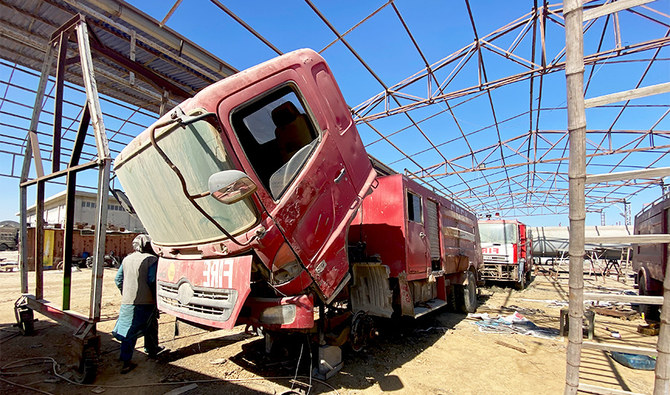

KARACHI: Politicians and fire department officials in Pakistan’s financial hub of Karachi welcomed the arrival of new firefighting vehicles and equipment from China last week, but firefighters and experts say the machinery is nowhere near enough to cater to a megacity of over 15 million people.
Karachi, Pakistan’s biggest city and main port, is home to an ever-expanding nuclear power park, thousands of industrial units and some of the most recognizable skyscrapers in the country. It also has only 22 fire stations, 14 functional fire tenders, two snorkels and a little more than a thousand firefighters for a city where over 700 fire incidents were reported just in the first three months of last year.
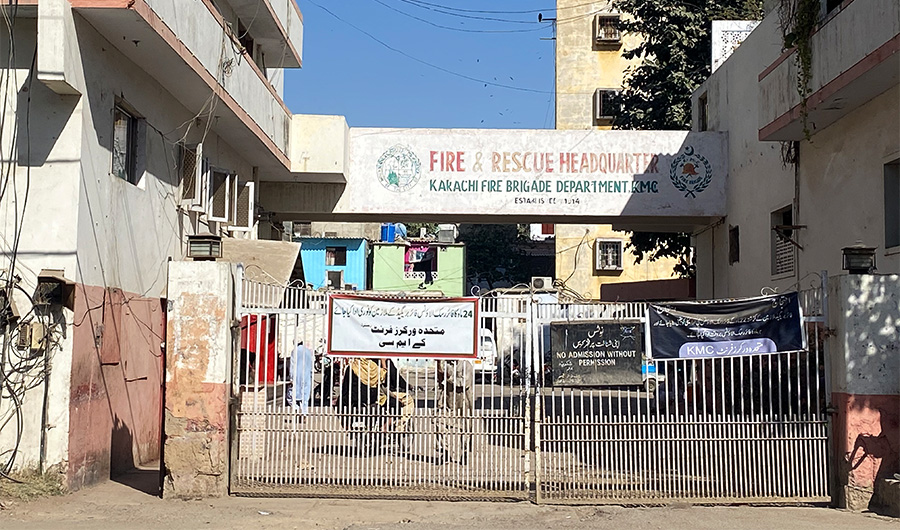
The Karachi Fire Brigade Department, Karachi, Pakistan, on January 11, 2021. (AN Photo)
In one of the worst fire accidents in the country’s history, flames ravaged a textile factory complex in Karachi in 2012, killing almost 300 workers trapped behind locked doors.
On Sunday, a day after a grade-three fire broke out in a chemical warehouse in an industrial area of Karachi, federal authorities announced they had received 50 modern fire trucks and two waters bowsers from China.
But Ali Hassan Sajid, Karachi Metropolitan Corporation’s (KMC) spokesperson, said the new equipment was too little too late — the city’s fire department did not have enough funds to manage the service and required additional snorkel ladders as well as staff to work efficiently.
Osama Jadoon, a fire safety expert, said though Karachi and New York were almost the same size, there was a vast difference in the size and capacity of their firefighting departments.
“Karachi has about 20 fire stations and 1,200 firemen whereas New York has 12,000 highly trained and well-equipped firefighters who get deployed at about 750 different locations,” Jadoon said. “A fire tender [truck] should ideally be able to reach its destination within three minutes, but usually get caught in traffic in Karachi.”
In 2018, the Sindh administration provided three fire trucks and a snorkel to the KMC fire department. Before that, it had added 50 fire trucks to an existing fleet of 17 in 1995. Of the 67 trucks, only 14 are functional now, KMC’s Sajid said.
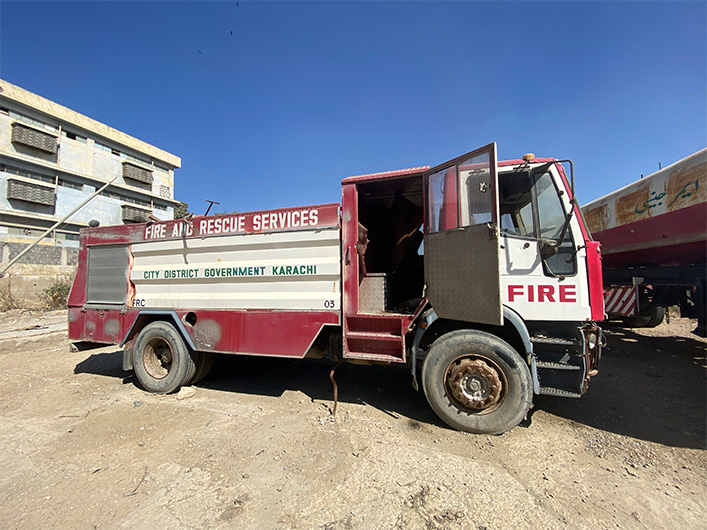
An out-of-order fire truck is stationed at a fire station in Karachi’s industrial area where 258 people burnt alive in September 2012 in a factory fire. Photograph taken in Karachi, Pakistan, on January 11, 2021. (AN Photo)
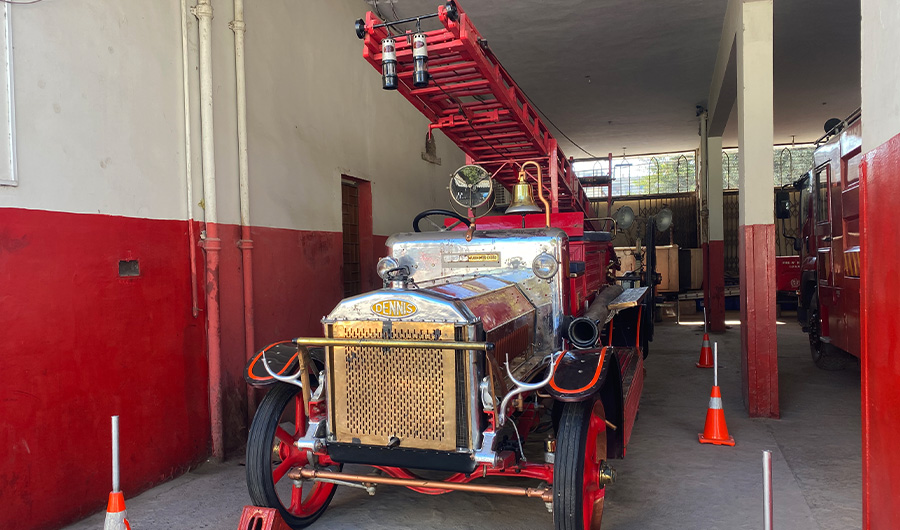
Dennis, the first snorkel ladder of the Karachi fire department, was purchased in 1914. Photographed in Karachi, Pakistan, on January 11, 2021. (AN Photo)
But an insufficient number of vehicles is not the only issue. The KMC spokesperson said the last time a training program was arranged for staff was in 2009. He also admitted that firefighters did not have proper protective gear and a shortage of staff required firefighters to work 12-hour-shifts.
“They have not been paid for putting in extra hours since November 2019,” Sajid said.
But despite tough circumstances, firefighters say they have done their best to protect people in the metropolis. In January 2007, eight firemen burned alive in a cotton factory trying to rescue workers.
“Have you ever seen a solider fight without a weapon?” said a firefighter who requested not to be named as he was not allowed to speak to the media. “That’s the kind of situation we face.”
Another staff member, a truck driver, concurred:
“I am not afraid of flames, but I get scared driving this vehicle,” he said, pointing at the clutch of his fire tender which was held together with a piece of rubber. “Even with these conditions, we managed to deal with 199 fire emergencies last year.”
He added: “Maybe the new fire tender will at least help us get rid of this vehicle.”


